Sunrise Service at Laudato Si' Centre
Reverend Grace Thomas meets with the bishop of Salford at the Laudato Si' Centre in Salford, we hear from volunteers and children.
Reverend Grace Thomas meets with the Bishop of Salford, the Right Reverend John Arnold at the Laudato Si' Centre in Salford and we hear how the garden inspires volunteers and children amidst the busy urban landscape.
Music:
Ten Thousand Reasons by Matt Redman
Reuse it or Lose it, written by Hannah King from the Salford Song book and performed by pupils from Christ the King Roman Catholic Primary School in Manchester
Thine be the Glory performed by Westminster College Choir
Producer:
Carmel Lonergan
Last on

Programme Script
Reader 1: For, lo, the winter is past, the rain is over and gone; The flowers appear on the earth; the time of the singing of birds is come.
Rev Grace Thomas: Good morning and a very happy Easter. The morning dawns, and as the words we just heard from the Song of Songs reflect, the time of the singing birds is come, and we can rejoice in the light of the risen Lord.
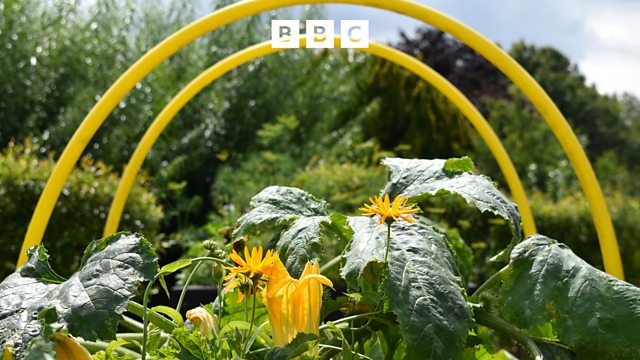
This morning I am at the Laudato Si’ Centre in Salford. Conceived by Bishop John, the Bishop of Salford, from whom we will hear later, the site is a large garden in an urban context, a place of peace amidst the busyness of life. A place of hope, renewal and new life.
Let us begin this Easter morning by singing of God's blessings in Matt Redman's Ten Thousand Reasons.
MUSIC: Ten Thousand Reasons by Matt Redman
Rev Grace Thomas: God of hope and new life, may we give thanks for all the blessings you have given us, not just on this special Easter day, but in all our days. Amen.
Gardens hold a special place in the great narrative of God. We hear in the book of Genesis of the garden of Eden, the place of beginnings, and in the last book of the Bible, the book of Revelation, the garden reappears, representing the time when all things shall be renewed and God's eternal peace will reign. And on this Easter morn, we recall the incredible moment that Mary encounters the resurrected Christ. Let us go to that garden now.
Reader 2: A reading from the holy gospel according to John.
Mary stood weeping outside the tomb. As she wept, she bent over to look into the tomb, and she saw two angels in white sitting where the body of Jesus had been lying, one at the head and the other at the feet. They said to her, “Woman, why are you weeping?” She said to them, “They have taken away my Lord, and I do not know where they have laid him.” When she had said this, she turned around and saw Jesus standing there, but she did not know that it was Jesus. Jesus said to her, “Woman, why are you weeping? Whom are you looking for?” Supposing him to be the gardener, she said to him, “Sir, if you have carried him away, tell me where you have laid him, and I will take him away.” Jesus said to her, “Mary!” She turned and said to him in Hebrew, “Rabbouni!” (which means Teacher).
Rev Grace Thomas: That the resurrection is first revealed in a garden has significance because gardens are places where small miracles of life happen daily. The garden reminds us of how life can come from death, and in the garden we see recycling and reuse, through the compost, through the exchange of sunlight into food and plantation, through the shade of trees and bushes providing comfort, branches being homes, fruit and flowers providing food. Nothing is wasted, everything is precious.
The late Pope Francis wrote ‘Laudato Si’ in 2015, articulating how all of creation is connected and how we are responsible, as Christians, for its care. This Laudato Si’ Centre, is a place where those responsibilities are realised and shared. Here is Bishop John to tell us more.
Bishop John Arnold: Yes hello, good morning, Happy Easter.
Although several Popes had written about the importance of care for the environment and the growing impact of climate change events, it was Pope Francis' Encyclical letter, called Laudato Si (or "Praised be"), “On care for our common home” published in May 2015, which challenged us all and reminded us that we are stewards of creation with our own responsibilities. This letter was addressed not just to members of the Church but to all people of goodwill. The letter has become the most widely published encyclical letter ever.
It was shortly after the publication of the letter that I was asked to be the lead for the Catholic bishops of England and Wales on matters concerning the environment. There was lots to be done to make people aware of the increasing dangers of climate change but it took just one conversation, with a schoolteacher, to realise that we had a great opportunity, here at Wardley Hall, with its extensive grounds and woodland, to help people to celebrate the gift of our environment and to learn about how we can live in harmony with nature. While the actions of industry and politics are vitally important in repairing the damage done to the environment through industrialisation, Pope Francis was clear in saying that "each and every one of us has a part to play".
At Wardley Hall we set about making a visitors’ centre where people of all Faiths and none are welcome. We invite people to come to celebrate a sense of well-being, learning about nature and how we can all learn easy lessons about growing vegetables and flowers, protecting the biodiversity of our wildlife and insects and taking away lessons that we can all duplicate in our homes, in the grounds of our schools and churches, where there is often unused space.
The Centre is proving to be very popular, and we have had over 8,000 visitors in the last two years. Groups come from schools and parishes. There have been special interest and special needs groups, and the Centre is designed to offer full access to all, both in the garden and the woodland way. Visitors can enjoy something of the wonderful diversity of Nature and learn what they can do, even in small areas of garden and open ground, to celebrate and protect creation. It has been particularly pleasing to hear of similar projects being established because of what people have learned during their visits here.
Rev Grace Thomas: Let us now hear the wonderful song Reuse it or Lose it, written by Hannah King from the Salford Song book and performed by pupils from Christ the King Roman Catholic Primary School in Manchester.
MUSIC: Reuse it or Lose it, written by Hannah King from the Salford Song
Rev Grace Thomas: I’m joined now by some children from Christ the King School.
Voices of Children from Christ the King Roman Catholic Primary School in Manchester.
Rev Grace Thomas: I’m now stood in the greenhouse, which is in the middle of the Laudato Si’ Centre, and I’m joined by Marie who is one of the volunteers here.
Voice of Laudato Si’ Centre Volunteer, Marie.
Rev Grace Thomas: Let us now take a moment to pray on this very special Easter Day.
Reader 1: For, lo, the winter is past, the rain is over and gone; The flowers appear on the earth; the time of the singing of birds is come.
Reader 2: Creator God, we pray for a time where all shall be renewed and justice and peace will reign on the earth once more. When the winters seem long and dark clouds linger, may we hold onto the hope that this brings.
Reader 1: For, lo, the winter is past, the rain is over and gone; The flowers appear on the earth; the time of the singing of birds is come.
Reader 2: Redeemer God, on this Easter morning, we celebrate the miracle of the resurrection unfolding among the living garden. May we cherish the garden of creation that you have given as our common home.
Rev Grace Thomas: Let us pray the prayer your Son taught us
Our Father who art in heaven,
hallowed be thy name.
Thy kingdom come.
Thy will be done
on earth as it is in heaven.
Give us this day our daily bread,
and forgive us our trespasses,
as we forgive those who trespass against us,
and lead us not into temptation,
but deliver us from evil.
For thine is the kingdom and the power, and the glory,
forever and ever. Amen.
Rev Grace Thomas: As I walk around the grounds of the Laudato Si’ Centre, in the sunshine/rain/cold/warmth of the day, surrounded by the sights, sounds, smells of this place, I feel the joy of new life. Gardens can be places where, like Mary that first morning, we come in both in joy and in sorrow. We sit among the natural world and, often, find hope in the presence of creation. Thirty years ago this year my own mum died and I often think of her on Easter morning, as she was the person who showed me Gods love, and as she became ill, she held fast to the knowledge she was going to be with God. I often think of her when I walk in gardens like this because they are places of peace and hope. So, before our final hymn (Thine be the Glory), let me read you the last verse of a poem my mum wrote years ago about that beautiful encounter on the first Easter day.
You are raised, beloved saviour, from the tomb where you were laid!
And as morning gilds the garden, I am no longer afraid
In the knowledge of your Good News, Your love forever stay
And the night of grief is over, You are raised, Yours is the Day!
MUSIC: Thine be the Glory performed by Westminster College Choir
Broadcast
- Sunday06:35BBC Radio 4
