Braille library upgrade; Census 2021; Charles Bonnet Syndrome
The upgrade to the RNIB's braille library which promises new, smaller books that will never be out of stock. And all you need to know about filling in the new Census 2021 forms.
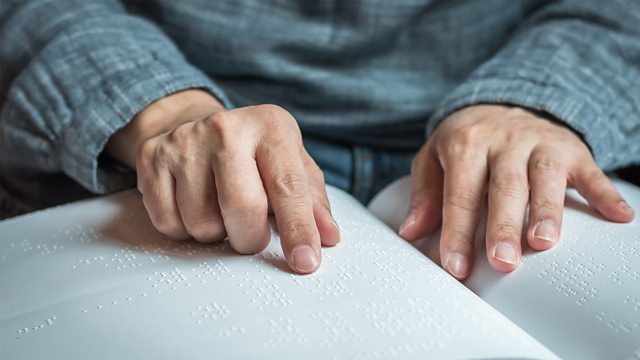
The RNIB have announced big changes to their braille library service. From next month braille books will be smaller, slimmer and newly printed on demand. Users won't even have to return the books but can instead choose to upgrade by buying a more robust spiral-bound version.
The new Census 2021 forms are dropping through letterboxes and the organisers, the Office for National Statistics, are promising it will be the most accessible yet. We'll hear from their Deputy National Statistician Iain Bell about what they've got planned. A telephone contact centre is available on 0800 141 2021 in England and 0800 169 2021 in Wales.
And the TV soaps often seek to reflect life back at us by featuring storylines about illness or medical conditions. Coronation Street is the latest to do that with their portrayal of Charles Bonnet Syndrome - a condition affecting people with sight loss that often involves frightening hallucinations. We talk to the actor Richard Hawley who plays the newly-diagnosed Johnny Connor in the soap.
Last on

In Touch transcript: 09/03/21
Downloaded from www.bbc.co.uk/radio4
THE ATTACHED TRANSCRIPT WAS TYPED FROM A RECORDING AND NOT COPIED FROM AN ORIGINAL SCRIPT. BECAUSE OF THE RISK OF MISHEARING AND THE DIFFICULTY IN SOME CASES OF IDENTIFYING INDIVIDUAL SPEAKERS, THE BBC CANNOT VOUCH FOR ITS COMPLETE ACCURACY.
IN TOUCH – Braille library upgrade; Census 2021; Charles Bonnet Syndrome
TX: 09.03.2021 2040-2100
PRESENTER: PETER WHITE
PRODUCER: SIMON HOLBORN
White
Good evening. Tonight, a new look for braille books but why do they need it and what will it mean for their readers. Filling in the upcoming census form – we look at the help available if you want to do it independently. And…
Music – Coronation Street theme
One of the country’s favourite soaps takes a hand in explaining one of the most puzzling eye conditions.
But first, as I speak, I’m reading from a braille script and the invention of braille, almost 200 years ago, has made my life and a lot of other people’s unimaginably richer. But, with the best will in the world, nobody could describe braille books as beautiful objects – they’re bulky, they weigh a tonne and some feel they present the wrong kind of image. But, now, it seems, they’re going to have a makeover. New books will be smaller and there are changes planned in the way that they’ll be distributed.
Well Dave Williams is the RNIB’s Customer Experience Manager and an experienced braillist himself. Dave, we’ll come on to specific changes in a moment but given that they are iconic objects to a lot of people, why do they need to change at all?
Williams
Well, a number of reasons really. One is, as you mentioned, that these books are bulky and heavy and difficult for some people to handle, particularly people with physical dexterity difficulties or children. Older books don’t age well, once they’ve been posted forward and backwards a few times they do eventually fall apart. And then, of course, there is the issue of hygiene. I think over the last year we’ve all become much more aware of hygiene issues and I can tell you that some of the books we receive back at our library, well, they could be better.
White
Okay, we’ll come on to all of those. Let’s start with – they’re going to be smaller, how much smaller?
Williams
So, the individual volumes are going to be a little bit thinner, so they’re probably going to be around sort of 50 pages and the form factor of newly produced books, that’s going to be more like A4. So, a standard size that will fit on most shelves, will get in most school bags and will be easy to carry around.
White
But unless you’re going to abridge them, if they’re going to be smaller, that’ll mean you’re going to need more of them.
Williams
Well, you will but I mean we’re not going to abridge them, clearly people want the full text, so, we’re certainly not doing that but it does mean that for individual volumes they will be easier to handle and hopefully fit easily through your letterbox.
White
Right. And what about the differences in the way that they’re actually going to be distributed because at the moment people either borrow them and then return them, when they’ve finished with them or if they want to keep them, they buy them. So, what will change with that?
Williams
RNIB’s braille library is moving to a braille on demand service, which means that books are going to be recycled rather than recirculated. So, when you receive a book from the library it will be freshly produced – you’ll receive clean, crisp, clear braille that won’t have been read by anybody else – you can keep that book for as long as you like – read it as many times as you like – and you do not return it to the library. You can either pass it on to another reader or you can recycle it with your other paper waste.
White
So, why would anyone buy any book in that case if you don’t have to return them?
Williams
So, the new braille library books they have a kind of a staple binding, they’re designed to be as environmentally friendly as possible, so we’ve removed pretty much all but all of the plastic in the books but if you are wanting to keep a book that you will refer to lots and lots over time, you might do that for, I don’t know, say, a recipe book or something, then there will still be a small number of braille books available to purchase from the RNIB shop and the big difference will be that the books you buy will continue to have spiral binding.
White
Is part of this about money? I mean we do know the RNIB is trying to use its resources to the best of its ability. I mean the fact of this is you’re not going to have to curate anything like the same number of books are you and you’re obviously not going to have to do the same sort of business of looking after them all when they come back.
Williams
On one hand we will obviously not be maintaining a big cavernous warehouse full of books with miles of shelving but we will be investing more in our braille on demand capacity. So, overall, we expect the costs to remain the same over the first year. However, we have budgeted for an increase in demand and this builds on RNIB’s existing investment in digital braille, as well, we know many people are moving over to reading braille electronically on braille devices – braille notetakers, braille displays, that sort of thing. So, the investment in braille library services will continue and over time, hopefully, that will mean you’ll have more choice because currently the library service has around 20,000 titles available but our book share collection, which is electronic, that has many hundreds of thousands of books. So, what we want to do is to connect up the braille library with the book share collection so that you’ll have a much wider choice of titles.
White
So, when does all this start and what do people need to do?
Williams
You don’t need to do anything, you’ll start receiving the new books from April and we look forward to hearing your book requests and feedback.
White
Okay, Dave Williams, thank you very much for the time being but don’t run away because we’re going to need you again in a moment for this next item.
Now, it happens every 10 years and the next one takes place over the weekend after next. I’m talking about the National Census. And given the number of items that we’ve done recently about inaccessible information for visually impaired people it was rather refreshing to have the Office for National Statistics approaching us asking if they could use our programme maybe to find out what would help listeners to fill in the census form most easily and for those who wanted this independently.
Well, Deputy National Statistician Iain Bell joins me.
I now the Office of National Statistics has been involved in discussions with other organisations about how this process could be made accessible, what arrangements have you made so far?
Bell
We’ve put in a number of arrangements. First off, all our invite letters are coming out in 16 point to make it accessible and also to allow optical character recognition software to work. And of course, it’s an online census this time largely. And we’ve designed this with a lot of accessibility in mind. So, online, you can change colours, zoom to 300% and designed our site to work with a navigator through keyboard and speech recognition software. And we’ve also ensured that screen readers are available to work with it, such as JAWS, NVDA and Voiceover, all of which are available.
However, we also know that some may want additional help through our contact centres and they’re also available to enable everybody to take part and provide the vital information for public services, such as skills healthcare.
White
What do you mean by a contact centre?
Bell
So, it’s a telephone contact centre which can be phoned up and you can order large print questionnaires for example or also we can collect information over the telephone, through the contact centre. And that’s available on 0800 1412021 in England and 0800 1692021 in Wales.
White
Can you use that telephone centre to actually fill in the form, in other words could you ring it and say – I can’t do this online, I want someone to go through it?
Bell
Yes, you could do that on there, we’ve got it set up in order to enable to happen.
White
But this is an online first census, as you said, does that mean that you’d prefer people to fill it in online if they can and presumably if somebody is doing it for you, they will be doing it online?
Bell
We want to maximise responses and while it’s online first we’re expecting about three-quarters of responses to be online and about a quarter on paper and telephone capture available, as we just discussed, through the contact centre. And what matters most to us is that everybody gets the chance and is able to contribute.
White
Okay. Well, Dave Williams is still with us in this case in his own right as a blind person faced with a form. Dave, you’re quite tech savvy and you’ve been looking at the online form, what do you make of it?
Williams
Yeah, I mean I’m in the slightly fortunate position that I can use NVDA or JAWS or whichever screen reader and I can get on to the website and once you get in actually the form is very accessible with the screen reader, as Iain says. My concern is the code, this 16-digit code, and of course, if I didn’t have somebody to read that to me then that might be a problem.
White
Just explain about this 16-digit code. This is something you get before you can fill it in yeah?
Williams
Yeah, that’s right, it’s kind of like your key to sort of unlock your census form. So, you receive it in the post and it’s print and with a bit of trail and error you may be able to use a scanning app or something to try and recognise that but it’s going to have to be precise, one digit out and it’s not going to work is it. So, yeah, I had to get someone to read that code to me before I was able to go online. So, with that in mind, I did wonder what other options were available for people struggling with that.
White
And the telephone option that we’ve mentioned would be one.
Williams
Yeah, but I wasn’t aware, until Iain just said that, I wasn’t aware in any of the publicity around the census, like you, I sort of oh it is online, which is fine for me but I wasn’t aware that there is this telephone option available, so that’s good news.
White
Just one last thing, Iain, if people have any queries after this, because they are bound to have, is there a one step thing you can do to get direct advice, actually talking to a real human being?
Bell
Yeah, call the contact centre and I’ll give the numbers again for you, which is 0800 1412021 in England and for people in Wales it is 0800 1692021.
White
Iain Bell, Dave Williams, thank you both very much indeed.
Now, finally this week, ever since Brookside in the 1980s the TV soaps have featured storylines that sought to give us a deeper understanding of issues or medical conditions. In the past, it’s been things like cancer, forms of cancer, dementia, EastEnders recently won plaudits for introducing a deaf character to Albert Square – Frankie Lewis – and now Coronation Street is the latest to do it with the portrayal of something a bit more unusual. We’ve quite often featured on In Touch Charles Bonnet Syndrome or CBS, a condition where people with a range of visual impairments start to experience hallucinations, often extremely vivid, sometimes quite frightening. Here’s the moment that Johnny Connor, who also has MS in the soap, was diagnosed with it:
Coronation Street clip
Is all hallucinations.
It’s known as Charles Bonnet Syndrome. It’s actually quite common.
What and it makes you see cats and stuff?
Your MS is affecting your sight, which means that as your vision becomes worse the regular messages from the eye get interrupted. The brain fills in the gap left by your loss of sight.
So, not going mad?
It’s physical not mental. You’re not going mad. But there is no specific medication that I can give you to alleviate the condition I’m afraid.
Right.
I know it’s a lot to take in.
Yeah, yeah it is.
Well, the actor who plays Johnny Connor is Richard Hawley, who joins me know, along with Nina Chesworth, who has Charles Bonnet Syndrome herself.
Let me come to you first Richard. When they came to you with this idea in the script, what was your reaction, I mean had you heard of it?
Hawley
No, I hadn’t. No, my producer told me. I think actually he has long wanted to do this story, I think because of some personal experience in his family and he wanted to highlight this, so he knew that it really was quite a sort of hidden condition and wanted to give it some air and light really.
White
And what sort of reaction have you had to it, what sort of reactions have the programme had?
Hawley
Well, really strong. I mean I think, particularly, from people who have this condition. I know you’ve got Nina on, I’ve been working with Esme’s Umbrella, who is a charity. I mean probably – small but the world’s leading charity in raising awareness of Charles Bonnet. And they’ve had thousands of calls from people who hadn’t realised what was going on. So, I think that’s one of the most exciting things about it, is the awareness or the lack of awareness is very real. And step one in all this is realising that this is the condition, it has a name and you’re literally – as he says in the show – you’re not going to mad. I mean it does get confused with mental health problems early on. So, if you don’t know what’s happening to you it’s very frightening.
White
Let me bring in Nina, who really knows what this is about because you’ve got it and you helped to advise Richard on playing the role. I mean, for a start, how did he do?
Chesworth
Yeah, he’s done really well, I was very proud of him.
White
Explain your situation to us – what it is and when you were diagnosed.
Chesworth
So, I find out I developed CBS about – coming up to three years ago. I had a second accident where it resulted in losing my sight in the left eye – my right eye’s artificial. Once I’d come around from the surgery I was kind of seeing like foggy colour and I thought that they’d managed to save my sight. Unfortunately, they didn’t and it was – the doctor said – it is just your mind playing tricks on you. Now that wasn’t a very conclusive answer and wasn’t a great help. So, I’ve done research into myself because three week after losing the sight the clouds started to turn into shapes and then different colours appeared and then the shapes started to turn into faces and kind of dogs and zombie faces and they started to get more frightening. And you know by this point I was hiding it from people as well, I was too scared to tell anyone because I thought that they would think I was having a nervous breakdown because of the result of losing my sight. So, I was worried about telling people.
White
Do you think that’s the main value of this programme, doing it on Coronation Street, telling people not to be too scared, not to think that it’s a psychiatric condition and to get medical advice?
Chesworth
Yeah, for sure because it is a frightening thing to do, to admit to somebody that you’re seeing things because of that worry of being pushed down the mental health route. But then once he’d done it and once he had that diagnosis as well, he felt better about it and that is where it’s so important to get help.
White
And so, three years on, Nina, how are you now because I guess what people who are getting this and don’t know what it is will think – well have I got to put up with that for the rest of my life?
Chesworth
Yeah, it’s three years on and I still do have them. Everybody has them different, I think the experience – the hallucinations – there are similarities but I think a lot of them can be personal to that person as well. I have – my hallucinations are all day every day, so I don’t have an escape from them.
White
But knowing what they are presumably makes an enormous difference?
Chesworth
Yeah, because I can kind of – I know that it’s just my brain doing its job, I know it’s not doing anything wrong, it’s fine. Because I know of them, sometimes I speak to them and tell them to just go away and leave me alone and then they do. Yeah, knowing what it is helps – it makes it a lot easier to cope with.
White
Nina Chesworth and Richard Hawley, thank you both very much indeed.
Now, I did ask you, last week, for your experiences of telephone banking and indeed other banking services during the pandemic. We’ve had this from Mike Foster. He says: “I use telephone banking regularly and at my bank it’s declined. First of all, they take you through many more steps before you have the option of talking to a human being. Second, they still don’t tell customers approximately how long we’ll have to wait or indeed where we are in the queue.” And he goes on to say: “If I was told I was 2,077th in the queue and had to wait over two hours then I’d call back later.” So, Mike asks: “Are there any banks which recognise their customers are people and allow them to talk to people and keep us informed?” He says: “It seems a big niche in the market for someone to fill.”
Well please do keep your experiences of banking services coming in, we’re going to be talking about it on the programme and getting some answers next week and we’d welcome your questions. The email address is: intouch@bbc.co.uk. And this and all previous programmes can be found on our website, where you can also find the census telephone number, that website: bbc.co.uk/intouch.
From me, Peter White, producer Simon Holborn and studio managers John Cole and Sue Stonestreet. Goodbye.
Broadcast
- Tue 9 Mar 202120:40BBC Radio 4
Download this programme
Listen anytime or anywhere. Subscribe to this programme or download individual episodes.
Podcast
![]()
In Touch
News, views and information for people who are blind or partially sighted