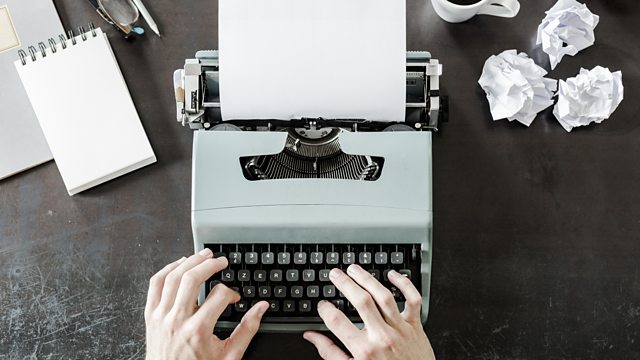
A Writers' Special
Three visually impaired writers talk about how they first came to put pen to paper. What impact has blindness had on their writing? What tips can they offer aspiring authors?
Peter White speaks to three visually impaired writers about how they got started. What tips do they have for someone hoping to get published themselves as a poet, a playwright or novelist? What part does blindness play in their creative work?
Our guests are Claudine Toutoungi, Mandy Redvers-Rowe and Tanvir Bush.
PRODUCER: Mike Young
Last on

More episodes
In Touch transcript: 22/12/20
Downloaded from www.bbc.co.uk/radio4
THE ATTACHED TRANSCRIPT WAS TYPED FROM A RECORDING AND NOT COPIED FROM AN ORIGINAL SCRIPT. BECAUSE OF THE RISK OF MISHEARING AND THE DIFFICULTY IN SOME CASES OF IDENTIFYING INDIVIDUAL SPEAKERS, THE BBC CANNOT VOUCH FOR ITS COMPLETE ACCURACY.
IN TOUCH – A Writers’ Special
TX: 22.12.2020 2040-2100
PRESENTER: PETER WHITE
PRODUCER: MIKE YOUNG
White
Good evening. In this strangest of years, one of our national sports seems to have been looking for crumbs of comfort – finding the things which in the more hectic past we hadn’t had time to do. And one of those has been writing apparently. One major publisher says that they’ve received three times the number of manuscripts from authors without agents, compared to last year.
So, for this pre-Christmas programme we thought it would be constructive fun to bring together three writers, all with visual impairments, and who have all published or written for performance, partly to tease out how their sight or the lack of it influences what they write and partly to encourage people who want to do it and want to have a go but who would welcome some tips.
So, joining me from their homes we have a poet, a playwright and a novelist, who’ve all written in other fields as well, to compare notes. So, why don’t I ask you all to do very brief self-introductions, starting with our poet.
Toutoungi
Hi, I’m Claudine Toutoungi, I write plays and poetry. My new poetry collection is just out, it’s Two Tongues and it contains quite a lot of eavesdropping.
Redvers-Rowe
Hi, I’m Mandy Redvers-Rowe, I used to be a comedy sketch writer but I’ve been working towards longer forms. I’ve co-written a radio play, had a TV drama with Jimmy McGovern and I’m currently writing with CBeebies.
Bush
And I’m Tanvir Bush, I’m a novelist. Before I was a novelist, I was a filmmaker and that’s actually fed into my writing.
White
So, a very talented and versatile group of writers. Claudine, if I can start with you. I could suppose that as a poet lockdown wouldn’t interfere with your work too much. Right or wrong?
Toutoungi
It’s both been good and bad for writing, I think, this year. I mean the hard part is who to share it with. I’m so lucky where I live, in Cambridge, I have spent probably about 10 years going to open mic and, of course, we can’t do any of that. But I can’t complain because I do seem to have been occupying myself with a lot of poetry. I think partly being in nature a lot.
White
How much has your sight or the lack of it influenced your poetry? I mean is it a factor because you have written some poems that are very specifically about it.
Toutoungi
I definitely make a virtue of confusion, I go with it because now my vision’s quite misty as a result of corneal issues but that’s quite liberating in a way and, you know, if you’re walking along and you see a garden gnome but you mistake it for a small child or a bollard that can be quite funny and I think that that kind of thing can set me off on a riff. Poetry’s your ideal medium if you want to veer away from too much visual observation. You don’t want to be kind of hamstrung by the need to be literally accurate, you can go off on flights of fancy, you can go into dream or remembered bits of language, it’s very freeing.
White
You have written Interior of Still Life, it’s called, haven’t you, which, if you can just set that up, we’ll hear it.
Toutoungi
I actually did a workshop where I was looking at still life with a lobster and was told that in the 16th-17th century they used fake lobsters in their still lives and that just set me off thinking about my own fake object being my cosmetic eye and riffing off of it lying on the side.
White
Okay, and you’ve read this for us. Here we go:
Interior of Still Life read by Claudine Toutoungi
I left my eye on top of the sideboard.
It had no complaints. It wanted a
breather. It wanted to flip out, flop
free, cut loose from the grip of my
co-dependent lashes, my socket’s
strictures and crap about keeping
up appearances. Screw all that! it
breathed, basking on tissue paper.
If it were a dog it might have rolled
over, but it didn’t bother. Blissed
out in that posture. Disposed to not
take in what was on offer:
wonky mirror, ceiling crack,
portion of a picnic by Cezanne.
White
Was that intended to shock or cause a shudder or just make people laugh?
Toutoungi
I mean I don’t ever have a fixed intention. I think I wrote a few different versions. I think if I enjoy saying the poem out loud and I get a sense from inflicting it on someone else that they weren’t appalled that they enjoyed it, then that’s a good sense.
White
Well, you inflicted it on Mandy Redvers-Rowe, what did you think of that Mandy?
Redvers-Rowe
Oh, I loved it, it’s great but I love Claudine’s poems – I’ve been reading a lot of them in preparation for this. I love the way you take an idea and develop it and take it into all different contexts, so yeah, really good.
White
Your writing background was very much in comedy, very overt comedy, how did you get started?
Redvers-Rowe
Really because I wanted to be an actor and there weren’t any parts for blind actors, so, myself and a few friends started our own comedy company – all disabled actors. We wrote comedy for ourselves. Our comedy’s quite silly but it was addressing lack of representation.
White
So, it was overtly political but…
Redvers-Rowe
Yes.
White
…in a way what you’re writing now has become more personal, hasn’t it, because, you know, plays – you wrote a radio play called Blind School about your teenage years after your sight deteriorated and now Second Sight, about the complications of sight being restored. What drew you to that?
Redvers-Rowe
Well, I think it’s really important to have an angle as a writer and to offer a unique perspective. I have been asked to write more personally and it’s been hard, actually, not to just make a joke about it and avoid real feelings. I mean I think that’s the whole skill of a drama is to actually really engage with those things and really try to be honest.
White
Because was the comedy, in a way, I know it was political but was it also a bit about avoiding – laughing at maybe what you originally, as you lost sight, found it quite hard to laugh about?
Redvers-Rowe
Oh definitely, the starting point for most of our sketches was absolute fury – real, real anger – which we turned to comedy. But yes, I think as you get older, it’s not – things don’t present in such clear ways and things do become more complicated and emotions and feelings and exploring those things.
White
Well yeah, you took on a complicated subject, in a way, with Second Sight. Let’s just hear an extract from that and then we can put it in context.
Clip Second Sight
I realise that I was looking at everything through my perspective. So, I’m here and I’m ready to listen. I want to know how you see things.
See, it’s such a small word but such a big thing and people say it all the time without even thinking but that’s all I’ve thought about. I’ve lost so many good things – things I love, things that make me happy. My job and Seb, Jamie and now you.
You haven’t lost us. Jamie will be alright, she’s a good kid, she’ll come through.
Barry, I still love you, of course I do, it’s just that I got lost and distracted.
And the thing about that scene is the things she’s lost she’s lost as a result of getting some sight back, hasn’t she?
Redvers-Rowe
She’s lost her blindness, yeah, yeah. I just really wanted to challenge people’s perceptions. Everyone says to us, all the time, wouldn’t it be great if you got your sight back and I often think – well, would it? That’s a sighted person’s perception and a lack of understanding of the quality of the life we have, that’s what I wanted to really explore, that actually our life is valuable, our experiences are valuable and to simply wipe them away and replace them with sight, just something I wanted to really explore there.
White
I can see why a lot of blind people might understand that, particularly people who’ve been blind for quite a long time. What about people with sight, are they going to get that do you think?
Redvers-Rowe
I really wanted them to, at least, think about it, whether they got it or not. I mean I think I got a lot of lovely feedback from the film crew and everyone and Casey and Ian were lovely and the other actors were amazing and they all really got quite excited about it because they hadn’t ever considered it as a thing.
White
Let me bring in Tamvir Bush. I’ll talk about your writing in a moment. Your sight has deteriorated over the years, I was just interested to know what you think about this idea of having sight restored.
Bush
It’s so interesting. I read Blind School, just the other night, and it actually made me cry because even though you were going through that back as a teenager, that’s where I’m at the moment, in that it’s going very, very slowly. But I can’t watch films now without audio description and text is getting tricky and having that huge tantrum at the world – I don’t want to go blind! And I can’t imagine how that must feel to somebody who’s never seen, Peter, it’s just like – how bizarre, what a strange thing to rage against the dying of the light.
White
I think that’s the complicated thing about visual impairment that we’re all so different because I guess, Claudine, you would look at this – because you still have your sight – but you obviously worry about the implications of what might be happening.
Toutoungi
Yeah, it’s very uncertain. I mean I don’t have any easy answers in my future really and I know it’s going to become more of an issue but then, you know, I suppose for all writers you’re kind of accessing the uncertain all the time and as Mandy says, you’re hopefully going there, in some way, with whatever your project is to shake people up and challenge them and present the human condition which is, in all its many different aspects, very uncertain.
White
Tanvir, we must talk about your book. Your most recent book is Cull, now that deals, more generally, with disability, although one of the main characters, in fact your heroine really, is visually impaired. It’s quite grim isn’t it? I wanted a clip from a scene in a job centre, which is supposed to be finding Alex, who’s your heroine, a job that suits her talent. Can you just set that up and read it for us?
Bush
Yes, so this is at Job Seeker Central and Alex and her guide dog have gone in to get some support and they’ve just been speaking to Lucy, who is her new empowerment officer, and she’s not making any headway and then this happens:
“Is there a problem?” Lucy’s supervisor has crept up behind her, like Nosferatu, only with a clipboard. He doesn’t introduce himself but leans over Lucy and picks up Alex’s file.
“I’m sorry,” Alex says, although she isn’t, she’s irritated. “You’re reading my file, so you obviously know who I am but you are?”
He is wearing gold-rimmed spectacles, purely so he can glare at people over the top of them. He does so now at Alex.
“My name’s Mr Timms and I’m Lucy’s supervisor. I see your file is marked with a silver star, that’s excellent, we’ve already been able to place you in work.”
Alex sighs. “Mr Timms, Lucy, I am in a placement, i.e., a temporary part-time experience. I did this kind of thing in my sixth form at school. As people who actually work in an employment office you must be aware that a placement is not a job, it doesn’t actually pay.”
Mr Timms is looking at Alex’s CV, she has a lot of qualifications and this seems to annoy him.
“It says here you had a job with BBC Voyager embedded with the troops in spite of your [errr]…” he waves vaguely at Alex’s face; his tone is suspicious. She doesn’t respond. “And Channel 14 films, goodness, all very glamorous.”
“Not really,” Alex mumbles, although it had been.
“And now a much sought-after placement with the Cambright Sun. Are we going to be having trouble with you Alex?”
White
Now that sounds, that was clearly in a job centre but a slightly dystopian job centre, but it sounds like it’s come from experience – is that right?
Bush
Absolutely. So, when you asked earlier about how your eyesight has affected your writing, when I was a filmmaker, I had to stop doing that and I found a huge amount of catharsis through writing, that was my first novel but of course I was just stuck. And so, I was on the dole, I couldn’t believe it – I couldn’t believe the cruelty, I couldn’t believe the way people were treated. What I decided to do was to write a satire looking at that but also looking at the really deep darkness underneath, which is the idea about eugenics and state sponsored eugenics. Like Mandy and Claudine, I have tried to put humour in there too, to tickle people into reading, I didn’t want to beat anyone over the head.
White
And running through it, it is this idea of people being treated in these situations as their disability rather than as themselves. Claudine, have you had to deal with this at all – Claudine – yet?
Toutoungi
I’m realising, I’m probably slightly earlier stage than Tanvir’s, it really hits the core of your identity and you have to go there, I think, as a writer because if you’re getting consumed by fury, which I also put my hand in the air and admit does happen, you have to put it in there and explore it.
White
Can I just ask you all, what advice you would give to people who are teetering on the edge of wanting to try this? I’m just wondering what you would pass on. I mean Tanvir, you do run courses for people.
Bush
Yeah, I do, I write creative writing courses and then they’ve been keeping me going through this last year as well because I haven’t been able to write, I’ve been so distracted and feeling quite low about things. So, for me, it’s all about starting small, doing little things to get the brain whizzing, even if that’s writing under your desk, as opposed from at your desk or actually having a conversation with your dog and then writing that down and really asking him profound questions about life. For me, everyone can write, everyone can play.
White
Mandy, what would you want to pass on, after your experience in so many different fields?
Redvers- Rowe
I think you just need to write and get involved in a group. So, for example, I’m heavily involved in DANK, which is Disabled Artists Network Community, and they run free writing courses, which you can book into every week to work with a writer, sharing your work. And then, obviously, if you want to move towards professionalism it is a hard road but it’s definitely one, if you’re driven to do that, and I do sort of feel you need to be driven because it’s a hard, hard road. I mean I was very lucky at the beginning of my career and I seemed to fall into being quite successful quite early but then I went through years and years of not being anywhere but still writing and working in lots of other jobs.
White
Claudine, one bit of advice?
Toutoungi
Similar to Tamsin really, just doing little – I think these little short bursts, as she said, a dialogue to a pet. But also, you don’t have to wait for the perfect moment, if you suddenly are having a bad day, that’s a good time to do a short burst because then you collect a kind of diary of your grumpy mood, your exuberant mood, your flat mood, your hungry mood – do it at different times of the day, little bursts. And also, if you don’t like writing by hand or typing, you can even just do it as monologue into your phone recorder, which I do a lot of. People do think you’re mad but it’s fun.
White
Right. Claudine, I want to end with a poem of yours, just because it is coming up to Christmas, we want some fun and this is another experience that I reckon that all four of us must have had. You tell us.
Toutoungi
Well, this came out of a naughty bit of eavesdropping in a basement clinic in – basically in Moorfield’s Eye Hospital – and it’s all light, it’s a docu poem, it’s all true.
White
Okay, here it goes:
These are the daylight hours but we absorb, beneath the surface, tepid lighting.
Shrink – feet please – for a husband wheeling woman
Fixate on trolleyed notes and staff who pass and pass
Does anyone believe in all this striding or the Litany of strange stranger names?
“Shahida Hulk, Dawn Carrier, Angela Chart?”
Something is up. Something is very definitely crawly and dark on the outskirts of our vision.
A girl tells Hazel in reception they were 9.15 and now it’s 12.08.
Gets back: “We go by numbers here not times.”
And X and V and Y start crawling and if it’s just a black dot on the horizon
Why is it following us?
What do we do if it ripens?
It’s hot, not letting up. We could strip.
“Quiet today,” says Hazel. “I like it.”
White
We could be there couldn’t we, in that waiting room. I think I was six when I had my first four hour wait in a waiting room.
Bush
Yes, we spent a lot of our lives there probably.
White
Absolutely. All of you, thank you so much for giving us only a peep into your world, we must perhaps invite you back to take a longer look. Many thanks to Claudine Toutoungi, to Mandy Redvers-Rowe, to Tanvir Bush and we would love you to tell us about your writing experiences – successes and failures – and I guess it’s never a failure if you’ve tried, which I think is what you were all saying.
You can email intouch@bbc.co.uk or go to our website bbc.co.uk/intouch where you can download this and previous programmes. From me, Peter White, producer Mike Young, all our wonderful guests and studio managers, Owyn Williams and Calvin Griffith, goodbye.
Broadcast
- Tue 22 Dec 202020:40BBC Radio 4
Download this programme
Listen anytime or anywhere. Subscribe to this programme or download individual episodes.
Podcast
![]()
In Touch
News, views and information for people who are blind or partially sighted