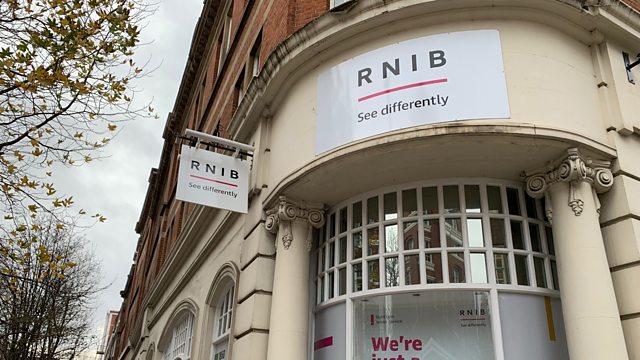
The RNIB's New Chair Of Trustees Anna Tylor
Anna Tylor, the new Chair of Trustees at the RNIB, talks to Peter White.
She's joined the charity after its gone through reputational and financial challenges in recent years.
Anna has previously chaired the Vision Foundation and Dyslexia Action.
PRODUCER: Mike Young
Last on

In Touch transcript: 15/12/20
Downloaded from www.bbc.co.uk/radio4
THE ATTACHED TRANSCRIPT WAS TYPED FROM A RECORDING AND NOT COPIED FROM AN ORIGINAL SCRIPT. BECAUSE OF THE RISK OF MISHEARING AND THE DIFFICULTY IN SOME CASES OF IDENTIFYING INDIVIDUAL SPEAKERS, THE BBC CANNOT VOUCH FOR ITS COMPLETE ACCURACY.
IN TOUCH – The RNIB’s New Chair Of Trustees Anna Tylor
TX: 15.12.2020 2040-2100
PRESENTER: PETER WHITE
PRODUCER: MIKE YOUNG
White
Good evening. There can be very few visually impaired people in the UK whose lives aren’t touched by the RNIB. Even if you don’t think you use its many services – its talking book and braille libraries, telephone counselling, selling specialist equipment – everything from white canes to high tech – it still tends to be the first port of call for those organisations who want to know what visually impaired people think, whether it’s government, public services or private companies. In other words, it has a huge impact on the policies that affect us.
So, when it appoints a new Chair In Touch is naturally keen to know who they are, what they think and in which direction they believe the organisation ought to be going. Which is why we’re devoting most of today’s programme to talking to Anna Tylor, who, last month, took over as RNIB Chair. She’s got plenty of chairing form, her previous roles have included chairing the Vision Foundation, which provides funding for VI Londoners, apart from quite a lot of other things; Dyslexia Action and also leading the roll out of the Disability Discrimination Act, now the Equalities Act, in its early days.
Anna Tylor, there’s no denying that the RNIB has had a bumpy ride over the last few years – reputationally and financially – much discussed on this programme. Why did you want the job?
Tylor
That’s a really great question to start with – why wouldn’t I want the job Peter? I’ve got skin in the game. I think that RNIB provides absolutely critical service delivery. There are going to be some really huge challenges coming down the line for visually impaired people. And how we shape the discussions around what society looks like moving forward and how we get our seat at the table. Why wouldn’t I want to be a part of that? I think it’s thrilling.
White
When you say you’ve got skin in the game – you mean you’re a user, as a visually impaired person presumably you’re saying I use their services?
Tylor
I’m a library service user because I’m an absolutely obsessive reader. I had a hand in Book Share, which is the educational collection and that began as work that we did through the Right to Read Alliance to address the issue of copyright around digital rights. And, for me, that opened up a world of reading which had been closed to me for several years, I thought well why wouldn’t I get involved.
White
Talking to you as a user that’s very relevant to what I want to ask you because when this job was head hunted it was said they were looking for someone to chair an increasingly beneficiary led organisation. Now that’s presumably you, as you got the job, I want to know what it means – what does beneficiary led or facing, what does that actually mean? I mean you’d expect it to be nothing else as the RNIB.
Tylor
At the heart of absolutely everything we do, we have to listen to our customers, what their wants and what their needs are – the two things are not always quite the same and that will inform the shape of our service offering moving forward. Also, it will help inform the shape of our social change agenda, what’s important to visually impaired people in order to achieve that parity with our sighted peers. It means that the trustee board also has visually impaired people on it, in order to help inform our understanding of lived experience.
White
But Anna, it’s still only employing around 10% of visually impaired people, doesn’t that need to be far higher to ensure a visual impairment perspective to policy and decisions?
Tylor
We’re always trying to recruit people with sight loss into all our appointments. But equally, the pool from which we recruit is sourced outside of RNIB, so it’s not just an internal issue. So, RNIB will look to recruit people who’ve gained experience in other areas. And we know that the pressures on people getting employment and education opportunities are enormous and that forms part of that social change agenda – is how can we influence our commercial friends and partners, our public sector friends and partners to up the numbers because that helps provide a pipeline of people who can then come into RNIB.
White
We’ve invited listeners to suggest questions to you, several have, including Adrian Peacock. Now Adrian and his wife, Claire, have a daughter Romilly, born blind, Adrian told us this:
Peacock
Since 2015 we have witnessed a steady decline in RNIB’s services for children and this despite RNIB promoting itself with images of blind children. An unhappy illustration of the damage done by RNIB’s poor governance in this area was its takeover of smaller blind charity Action for Blind People. We were so fortunate to attend monthly events put on for blind children, like our daughter Romilly, by this small charity and its group for children called the Actioneers. With the Actioneers Romilly got to visit theatres, musicals, she went rock climbing and visited KidZania in West London and all for free. But once Action for Blind People was absorbed by RNIB in 2017, its children services were almost immediately closed down and the Actioneers staff were eventually laid off. And now the library service, that is vital for our daughter, is also being cut back.
White
He's talking there about the large print library, that we’ve featured on the programme. Now this is very pertinent to you because I know up to 2017 you were a trustee with Action for Blind People and the suggestion is that the RNIB, in recent years, has absorbed smaller organisations and in so doing lost the individuality they brought. What do you say?
Tylor
I think the decision around that absorption was made before I got involved at Action, so that direction of travel was set.
White
But the argument was there were far too many visually impaired organisations – that’s what the previous Chief Executive believed.
Tylor
That direction of travel was set, we are where we are now…
White
So, do you not agree with it?
Tylor
I think it was a bit of a fait accompli, to be honest, Peter. We are where we are now and we have to now think about what are the services that people need and children and families, young people, is absolutely critical to RNIB, children are our future. And so, the question for us now to consider is what should the shape of those services look like as we move forward.
White
Okay, there’s a lot to get through, so, I’m going to put, perhaps, one – something that’s key. And it’s no secret that the RNIB has had financial problems over the past few years, at one point, four out of five years in deficit. We’re now being assured that there’s a strategy in place to stabilise the position but with your income falling by £10 million over the latest year for which there are figures, surely that can only be done by reducing costs, which in turn, surely, involves reducing services?
Tylor
Actually, I think that the leadership team have done a really terrific job in ensuring strong business practice, great efficiency and supporting the frontline staff in order to make sure that we continue with that rollout. And throughout this year, in fact, we’ve seen that those services have expanded – so, more calls than ever before to the helpline, the ECLO service has kept rolling…
White
Just spell out what ECLO is.
Tylor
That’s almost the jewel in the crown, I would say. The Eye Clinic Liaison Officers of which there are now nearly a hundred up and down the country. And that’s a key part of our mission to ensure that nobody gets a sight loss diagnosis without ensuring that they’re properly supported through that journey because it’s an absolutely critical moment in life. So, we’ve actually kept those services rolling and expanding this year.
White
But you can’t lose money and increase services, surely – I mean because those financial figures, they only take us up to the very start of covid, they go to the end of March, I think, 2020. I suspect that people will be assuming that the next lot of figures are bound to be worse. Charities have been saying, loudly, how much they’re struggling for survival during covid and the reason for the loss of income was a falling off, amongst other things, in people leaving money to you – legacies.
Tylor
Yes, all of these things I think are true. Charities do face an exceptionally tricky time at the moment. And it’s true to say, that I think the Charity Commission reckon that quite a lot of charities are going to go through their reserves over the coming year because of the pressures people have lived through throughout this year. Our fundraising has held up well and all of the efficiencies that the leadership team have been delivering over the last few years, have really helped us through what could have been a very, very difficult time.
White
But can you lose money and offer more services? It’s hard to see how you can.
Tylor
It’s absolutely right that we have to have financial stability and I believe that we are in that place, we do have financial stability and that gives us the best possible platform for which to move forward to continue to develop existing services and to think about what people need, as we move forward.
White
This brings us to a key question really about what the RNIB’s role is because you can’t do everything. Now you’ve recently withdrawn from providing residential care, after a school you were running had to close, well documented. That’s also taken you out of direct provision of education, certainly as far as any residential education is concerned. And for many years now, the RNIB hasn’t directly provided rehab services to improve blind people’s daily living skills. There was a point when there were actually two residential centres. And yet, these are all areas on which you offer advice to those who do provide those services. How can you justify advising people on services you can’t provide yourselves?
Tylor
It’s a really desirable prospect to see as many people who are experiencing a diagnosis of sight loss retain their independence. And that’s very often best done in the community, not in a residential setting. Much of that gets done through our local sight loss societies and we always try to share our practice with them in order to support that delivery of service. So, often, resourcing a third party can be a really powerful way of ensuring that we are reaching the people that we need to reach. And don’t let’s forget, Peter, we also do deliver a raft of living with sight loss provision and also the ECLOs provide a very, very strong service and signposting arrangement for people.
White
But, you know, residential care for elderly people, education for children, rehab for people of all ages, that just about covers the spectrum of what visually impaired people need doesn’t it?
Tylor
I think the statutory enquiry showed that we weren’t the best placed providers for those services and what we’ve done, as we’ve been through this time of transition, is to ensure that our customers, our service users, get the very best outcome in the positioning of those services with new providers. And I’m entirely satisfied that that was the right thing to do.
White
So, those are the residential care homes…
Tylor
Yes.
White
… and are they now all still being run for the benefit of visually impaired people?
Tylor
Yes, and that was a critical point in the arrangements that we made, that that sight loss consideration had to remain at the centre of what was happening for those residents.
White
I mentioned, right at the beginning, that the RNIB is the place that public and private bodies go when they want to know about policies appropriate for blind people. Andrew Walker questioned this, when he got in touch, he says: “I wonder with what authority the RNIB has to represent the wishes of blind and partially sighted people. They do great work in some areas…” he says, “…certainly, but they seem, often, to claim to represent sight impaired people and come up with ideas which I certainly don’t agree with.” I wonder what you say to that because I know what he means in the sense of I’ve lost count of the number of times I’m inquiring into something and I go to a company or someone and they say – oh well, we asked the RNIB. Are you saying that by doing that you’ve done everything you need to do to know whether something represents all visually impaired people?
Tylor
Gosh Peter, that’s a really tricky question isn’t it because we’re never going to get it right 100% of the time. We’re consulting with customers on a really regular basis. We have our service user panels, our customers panels in order to make sure that we’re keeping our eye to the ground, we’re constantly seeking advice and feedback from people with sight impairment in order to ensure that we’re getting the best possible intelligence to inform those decisions. I’m confident that the team have done a really great job in better understanding our customer base, better appreciating what customers’ wants are, what their needs are and that helps to inform our relationships with our commercial friends.
White
One final thing, Anna…
Tylor
Yes.
White
…after a year, or let’s be generous, after two years, what do the RNIB need to have done for you to think it’s going the way I want it to go, what are the things that you would regard as essential in the way that the RNIB moves from now on?
Tylor
We’ve been through a period of great introspection, we need to be outward facing, we need to be focused on delivering good quality relevant services and then I think there’s the second piece, which is the social change agenda. What is it that’s coming down the line and where should we put our energies to influence the structure and shape of services moving forward? So, that might be health, it might be education and undoubtedly there are big, big issues coming down the line around employment and we need to be there representing the interests of blind and partially sighted people.
White
So, does that mean which part of the spectrum do we work for most – given that you’ve got this huge range of people, including large numbers of older people who are visually impaired, there are demographic things, do you know enough, do you think, about the way visual impairment is developing in order to provide the services that fit with it?
Tylor
I think it’s not just a question of what we understand about the individual shape of sight loss but it’s about what policymakers are likely to do in order to address that and how do we then take what we understand to contribute towards that discussion.
White
Anna Tylor, thank you very much indeed and good luck.
Tylor
Thank you, Peter.
White
Just before we go. You’ll recall the assurances given by Transport for London that physical guidance of visually impaired people on the London Tube, which had been withdrawn for several months because of covid, was to be restored on November 23rd. But November has come and gone and we’re still hearing from people who are experiencing problems, including the man who raised it will us, Naki Rizvi. He has emailed his disappointment with progress. He says: “Very many members of staff still don’t appear to know the rules have changed and it’s taken me telling them before they even consider helping out. Some stations are refusing me assistance altogether and say that they aren’t obliged to explain the reason.” And he goes on to say: “Some staff have told me that even though rules have changed it’s optional.”
Well, we put these points to Transport for London and specifically we asked how the restoration of the service had been communicated to staff and whether compliance was indeed optional. Well, this is what they told us: “These complaints about the lack of service are being taken very seriously and are being investigated to make sure improvements are made, so that everyone feels safe, supported and comfortable whilst travelling on our trains and stations. Our staff understand their responsibilities and commitment to make ‘turnup and go’ available and its importance when requested.”
Well, that’s what they told us, I somehow still don’t feel we’ve heard the last of this.
And that’s all for this week. Your thoughts, of course, are very welcome on Transport for London, that issue and of course, the RNIB as well. We always welcome your communications. Our email is intouch@bbc.co.uk and you can find all sorts of other useful information and listen again to this and other editions of the programme via our website, that’s bbc.co.uk/intouch.
From me, Peter White, producer Mike Young and out studio managers John Cole and Owyn Williams, goodbye.
Broadcast
- Tue 15 Dec 202020:40BBC Radio 4
Download this programme

Listen anytime or anywhere. Subscribe to this programme or download individual episodes.
Podcast
![]()
In Touch
News, views and information for people who are blind or partially sighted