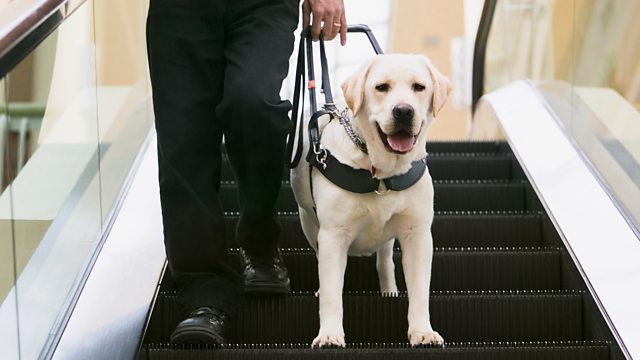
Accessible Town Centres; A New Guide Dog During The Pandemic
What can Australia teach us about making our town centres more accessible? And the challenges of getting a guide dog during the pandemic.
The battles to get our town and city centres more user friendly for the visually impaired. What can we learn from Australia? Brisbane based accessibility expert John MacPherson is our guest.
We hear from Peter Osborne of Guide Dogs about the renewed efforts to link up animals and owners during the pandemic.
PRESENTER: Peter White
PRODUCER: Mike Young
Last on

In Touch transcript: 08/12/20
Downloaded from www.bbc.co.uk/radio4
THE ATTACHED TRANSCRIPT WAS TYPED FROM A RECORDING AND NOT COPIED FROM AN ORIGINAL SCRIPT. BECAUSE OF THE RISK OF MISHEARING AND THE DIFFICULTY IN SOME CASES OF IDENTIFYING INDIVIDUAL SPEAKERS, THE BBC CANNOT VOUCH FOR ITS COMPLETE ACCURACY.
IN TOUCH – Accessible town centres and a new guide dog
TX: 08.12.2020 2040-2100
PRESENTER: PETER WHITE
PRODUCER: MIKE YOUNG
White
Good evening. Tonight, the battles to get our town and city centres more user friendly for visually impaired people. What can we learn from down under?
Clip
The idea is you locate the tactile dots, which are always in the same place, and navigate yourself, using your cane, keeping yourself in the middle of the mall, so crowds go around you.
White
And the joy of getting a new guide dog, particularly when there’s been a very long wait.
Clip
I guess it was love at first sight, I would say. He’s an incredibly affectionate dog and a brilliant worker.
White
More on Maxwell, the guide dog, in a few moments.
But first, in last week’s In Touch we reported on the lack of tactile paving at railway stations in the UK. More than a third of the total length of the UK’s platforms are still without it. This had emerged after a fatal accident in February involving a visually impaired man falling on to the tracks at Eden Park Station at Bromley in Southeast London. Well that platform had no tactile surface along its edge. And we’ve been hearing from some of you, telling us of near misses, which would have been avoided if textured surfaces had been universally available on stations.
Well, listener Dick Groves, from Bromley, has also been in touch with us. He says that his local council has been asking for ideas to redevelop the town centre there and he’s been advising them to learn from the example of Brisbane in Australia. Dick says, Brisbane has nailed accessibility for visually impaired travellers. Dick joins me now, as does John MacPherson who’s in charge of the accessible transport network in Brisbane.
Dick, first of all, you’re totally blind, what’s Bromley like for you now when it comes to accessibility?
Groves
It’s reasonably good. When I lost my sight, some 17 years ago, I did a survey of the town centre and found that there were little facilities for road crossings. I took this up with the council and they made big improvements – I’d like to see more.
White
But you’ve been to Brisbane, a few times I think, what is it that has so impressed you there?
Groves
They’ve got a long series of corduroy strips, probably about 18 inches wide, in which I can put my white cane down and know that it will not have any obstructions, no trees, no seats, none of those awful A boards, it’s straight and it’s safe. And it’s got intersections, it’s – actually it’s got everything. It’s got sign boards which are in raised lettering, colouring, braille – you name it, it’s got it.
White
Let’s bring in John MacPherson, who is in Brisbane. Just explain how this all came about and what other factors that you’ve got there, which are specifically aimed at visually impaired travellers.
MacPherson
Well, we had a grant from the federal government back in 1988 to celebrate the bicentenary of the founding of a penal colony. So, what are we going to spend the money on? And we were getting some strong messages from the visual impaired community that, look, it’s very hard to find our way through the pedestrianised section of Queen Street – which is the main streets of Brisbane. It’s about 400 metres, two city blocks. So, with the money we put down about half the length on one side of tactile paving, the corduroy paving that Dick just mentioned. Well, it was so popular that it wasn’t long before we put another section in, which took it the full length. It spilled out and just kept expanding. We now have about well over two and a half kilometres of this corduroy and blister paving. It links to audio tactile crossing signals, so they beep and then when the crossing signal changes for the green man it beeps louder and faster, so you get a signal – Cross – and then it changes to the homing signal, it says – Don’t you dare leave the kerb. There’s – otherwise you will be having a chat to a truck. The tactile signs, that Dick mentioned, they’re sitting above those crossing signal controls and they’ll tell you the street you’re crossing, they’ll tell you the numbers of the tenancies ahead of you, so if you’re looking for number 58 Queen Street it will tell you you’re on the right block.
White
So, it really literally can lead you to the door of where you’re going?
MacPherson
Very close to. What the guys told us also was keep it about two and a half to three metres off the shop fronts because people walk out of those doors at a great pace and they step on our canes or they walk straight into us. We’ve also got these beacons along the trail that are either smartphone or radio frequency triggered and they actually will have a little recorded message that’ll say – Well you’re at this spot. Now that technology is from 2008, it’s dated, so we’ll need to think about what might go in to replace it. There’s some interesting systems we’re looking at in Barcelona and so, we might see if that’s appropriate. We might not go with it but we’re looking.
White
Okay. Just stay there for a moment John because what I want to do is we wanted to hear from someone who’s actually using the accessibility improvements on offer in Brisbane.
Donoghue
Hi everyone, my name is Brendan Donoghue, I am totally blind and I currently use a white cane. I navigate through the Queen Street mall using a braille trail, navigating me straight ahead up through the middle to shops, eateries and other retail outlets. The idea is you locate the tactile dots, which are always in the same place, and navigate yourself, using your cane, keeping yourself in the middle of the mall, so crowds go around you. And I would encourage any other council, city or country to invest in such a trail, I believe it creates a diversity of people who can use the Queen Street mall safely and effectively on a daily basis. It is a great idea and is well worth the investment.
White
Well that’s Brendan Donoghue. People will recognise some of these features. I think what’s really interesting about what you’ve done, John, is introduce so many of them. You’re obviously updating them as you go along. How much has this all cost you? What’s been spent on doing what you’ve done?
MacPherson
A very good question. Wherever we can we’ve used grants or whenever a development is occurring you talk to the people who have the money to do the development, they’re going to pull the paving up anyway, so you just ask them to put this particular paving down. So, I would like to say it goes in cost free, it’s not, someone’s paying for it, but they would have paid for the paving anyway.
White
There are so many challenges though for modern cities and towns and we’ve had an email from a lady called Joy Croft. Now she lives in Norwich, which she says, and I quote: “Was once a model of accessibility for people with disabilities.” And Joy was so impressed with it back in the ‘90s that she earmarked it as a good place for a blind person, like her, to retire to. But now she says several pedestrian crossing lights have been removed to improve the traffic flow, shared access spaces are being created for cyclists weaving on and off pavements, pub and restaurant outdoor seating has covered more of the pavements and, of course, Joy says, this has increased further during the pandemic. And she goes on to say – now there are electric scooters being used. So, John, what I want to ask you now is how do you get the balance right for all users of a town or city centre? I mean, interestingly, one of the reasons people had trouble getting on and off paving was when drop kerbs were introduced to help people like yourself in wheelchairs, how do you get that balance right?
MacPherson
I suppose as with any balance it’s a bit of a see saw, so it swings back and forth. But the Brisbane approach is to push furniture, street trees, whatever, not towards kerbside. At the end of it, the councils are in charge of what goes where.
White
Which brings me neatly back to Dick. Dick, will Bromley and other British towns and cities ever match, do you think, what we’ve heard highlighted in Brisbane?
Groves
There’s no reason why we can’t match but there’s a lot of catching up to do. This is a worldwide system. I know of at least 12 other countries that have extensive corduroy paving. And for me, in Bromley, they asked for input and I’ve given input. The reality of it is there’s 200 metres already existing in a shared space area of corduroy edging, which is ideal. I’ve used it nn myself; I’m talking about putting in maybe another 50 metres on to connect a transport hub with a pedestrianised area and then maybe later on we can extend and make this better. And we’re talking to put in something that is stick on but usable, couple of thousand pounds.
White
Well that was Dick Groves in Bromley and John MacPherson in Brisbane.
And we would be very glad to hear from any of you, particularly perhaps people who think that your towns and cities in the UK are actually doing alright, so do get in touch.
And increasingly difficult urban environments may well be a factor influencing people to opt for a guide dog as their mobility aid of choice. But that’s been yet another service which has been interrupted by the pandemic of course.
Now back in June, we heard from Christophe Lazure, who’d had a long wait for a guide dog. Molly, Christophe’s previous dog, had retired after nine years of service and the wait he’d already experienced had been extended by the stopping of training due to social distancing restrictions.
Well Christophe got in touch with us the other day, just to say there is now some good news. So, Christophe, tell us what’s happened.
Lazure
Well about a couple of months ago I was introduced to Maxwell, a black Lab Retriever and it was – I guess it was love at first sight, they would say. He’s an incredibly affectionate dog and a brilliant worker. We’ve been training and successfully partnered a couple of weeks ago.
White
So, how is training going?
Lazure
Training, I’ve been absolutely fine. When – it was stretched over five weeks. We’ve done mostly local training, I haven’t done public transport yet because of the lockdown, but that can wait, there’s no rush for that. And Maxwell’s been introduced to all the local area and I’ve been able to do my shopping, go to the GP and chemist and so on by myself and it’s absolutely wonderful.
White
But how long was the gap that you had without a guide dog?
Lazure
I was without a guide dog for about nine months, yeah, because Molly retired at the beginning of February.
White
Now Guide Dogs Director of Operations, Peter Osborne, also joins us again because, Peter, when lockdown first began Guide Dogs told us they would have to stop all face-to-face guide dog training. So, what’s happening – is that back up and running now for a number of people?
Osborne
Yes, very much so. We have face-to-face training back up and running and I’m really pleased that we’ve been able to find the right dog for Christophe and indeed for many other people. So, by the time we get to the end of this year we’ll have matched around 300 people with their guide dogs. Far less than we anticipated being able to do this year but it’s been an extremely challenging year for everybody but I’m really pleased to say that in the majority of areas now face-to-face training is back up and running.
White
And how have you got that working while maintaining social distancing?
Osborne
We are working with suitable barrier equipment for our staff and also for our customers when needed, so that we make sure that we keep everybody safe as far as we possibly can. It’s also been a real challenge for us to reply and respond to the various protocols that have been coming out from government and from the administrations around the UK but we’ve now got that, we’ve got a very strong series of guidelines in place for our staff and for everybody, so, that our aim is to keep everybody – our staff, volunteers and our customers – as safe as we possibly can.
White
But in fairness, wasn’t that exactly what Christophe said all along was possible? In other words, he described to us how training often worked, the fact that there was often quite a distance between the owner, the dog and the trainer. Wasn’t he right actually and therefore couldn’t it have been done quicker?
Osborne
We think it’s been a situation where we’ve had to respond to a changing situation over the past sort of seven, to eight, to nine months, we’ve all been in that place where things have been shifting quite quickly between very local restrictions and indeed some more national restrictions, as we’ve all been experiencing. So, we’ve tried to respond to that as quickly as we possibly can and keep training on track for people as far as we possibly can in these difficult circumstances.
White
Now the waiting list for a guide dog was sitting, I think, at the 400 mark when we spoke to you in June and that was one of the problems that Christophe was highlighting. Where is it now?
Osborne
It was substantially more than that at the time actually and we’ve actually been continuing to accept people on to the waiting list. We think it’s really important to be in touch with as many people as possible, so that we can offer other services as well as our guide dog service. So, the waiting list is continuing to grow, we expected to do around about 700 partnerships this year and we’ve been able to match about 300 people, so you can appreciate that that actually has an impact on the waiting list. And I am very sorry that people are having to wait for quite a long time, in some instances, for a guide dog. We’re doing our level best to get ourselves back on track. We have over 400 dogs in training now, across all aspects of our training and we’re continuing to find ever new and more innovative of training, as we move forward. One key aspect of our training is that a large part of it can be done residentially and that’s been very difficult during the lockdown periods of time that we’ve all had. So, we are actually now looking at ways in which we secure that moving forward. So, even though we all know that there’s wonderful news about the vaccines, as we’re all hearing, we still think it’s going to be quite some time before things are back to anything like normal and therefore, we’re looking at ways in which we can secure residential training so we can train more people at a time.
White
You also acknowledge the fact that you lessened the number of instructors in a number of places. Are you recruiting more, have you got enough instructors now?
Osborne
We are actively recruiting, we have many trainees at the moment, we’re looking at a process to bring on even more trainees next year. We don’t have enough instructors, we don’t have enough guide dog trainers – we need to increase those numbers and we’re actively looking at how we do that in the coming year to a couple of years. It’s very important that we build ourselves to a place where we can create the thousand partnerships that we are talking about creating in our strategy.
White
Is that being, in any way, made more difficult by a spike in people wanting a guide dog because we did think it might happen with the complications created by social distancing?
Osborne
Yeah, we are seeing, roughly, the same sort of number of people applying for a guide dog as we would generally expect at the moment, we haven’t seen a huge change in that, though that’s not to say that we won’t moving forward. But what we do know is that there are many people who require a guide dog who would benefit from working with a guide dog, as I do myself and as I know Christophe does, and therefore we need to be in a position to meet that demand, which is why we want to recruit as many trainees as possible.
White
Let me just go back, finally, to Christophe. You say things are going well but you were obviously very badly affected by that gap and probably there are some people who’ve had even bigger gaps.
Lazure
Yes, absolutely, and I’ve talked to some people who’ve been waiting a lot longer than me. It’s waiting between dogs, which I think is a lot more difficult. And it’s that gap – it’s not just the mobility that goes, it’s the companionship and your confidence starts going downhill as well. And I’ve seen getting retraining with Maxwell I was very aware I have to pick up the pieces really and it’s great, it’s working out absolutely wonderful now.
White
We’re delighted it’s going well for you. Christophe Lazure, Peter Osborne of Guide Dogs, thank you both very much indeed.
Lazure and Osborne
Thank you.
White
And that’s almost it for tonight except to say that on next week’s programme I’m going to be putting questions to Anna Tyler. Now she’s the new Chair of the RNIB, the Royal National Institute for Blind People. If you’d like a question of yours to be considered, about its role, its services, the RNIB’s financial position, we’d love to hear from you. Do let us have those questions as soon as possible though, as we’re going to be pre-recording Anna next Monday.
Ooh, and just one more thing, a request from In Touch listener and contributor Holly Scott-Gardner. Now Holly has emailed and says: “Growing up I always knew that my mum has a blind cousin but I didn’t really know anything more about him. We’ve lost touch with that side of the family. As an adult, I’ve been trying to connect with him as it would be really great to know a family member of mine who is blind. His name is Michael King, I know that he’s from Portsmouth and that he has a twin brother. He would have probably been born in the late 1940s.” Well if Michael or if someone who knows him is listening do please email us and we’ll put you in touch with Holly.
Our email is intouch@bbc.co.uk and you can find all sorts of useful information or you can listen again to this and other editions of the programme via our website bbc.co.uk/intouch. From me, Peter White, my producer Mike Young and studio managers John Cole and Philip Halliwell, goodbye.
Broadcast
- Tue 8 Dec 202020:40BBC Radio 4
Download this programme

Listen anytime or anywhere. Subscribe to this programme or download individual episodes.
Podcast
![]()
In Touch
News, views and information for people who are blind or partially sighted