Hell-raising actor appears in Penzance
He was the most electrifying actor of the era, oozing charisma on-stage. Off-stage he was a hell-raiser with a private life dogged by drunkenness and scandal.
At his peak, Edmund Kean (1787–1833) entranced audiences with his superb performances, however it was a love-hate affair, as those who lauded him were also appalled by his immorality and arrogance.
![]()
Much ado near me
Hear more Shakespeare stories on BBC Radio Cornwall
![]()
Shakespeare Festival 2016
The BBC celebrates the genius of the bard


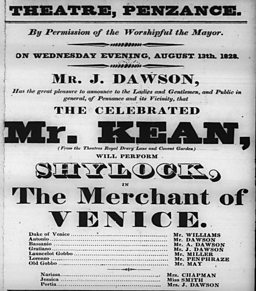
The poet Coleridge neatly summed up his brilliance "To see him act was like reading Shakespeare by flashes of lightning."
Edmund Kean visited the West Country a number of times. He was in Exeter around 1812 and then he visited Exeter again and Plymouth in 1816. Here he is in Penzance on August 13th 1828, in one of the roles that defined his career.
At his best in strongly defined roles such as Richard III, Lear, Othello, Iago, Macbeth and – in this instance as Shylock, Kean was a game-changer, introducing a different kind of acting and bringing dignity and pathos to this particular role.
His first performance at Drury Lane on January 26th 1814 was in his role and it brought the house down.
From 1681 a version of King Lear with a happy ending had superseded Shakespeare’s original, Kean restored the original version and surprised audiences with its tragic resolution.
For a while the audiences couldn’t get enough of him, however by the time of this playbill, his wildness and intemperate life were beginning to take effect.
Born to a small part actor and reputed drunkard, his father committed suicide when him was three years old, when he was taken under the wing of a minor member of the Drury Lane Theatre.
Taught to tread the boards from an early age, he became something of a child prodigy acting in from of Nelson and Lardy Hamilton as well as performing in front of George III at Windsor Castle.
He blazed his way through a number of Shakespeare’s tragic heroes, but his unpredictable behaviour, drunkenness and affair with the wife of a city alderman proved too much for London audiences.
After several brief visits to America where it was much the same story, he returned and despite failing health and powers, continued to act – and even toured from time to time.
At the height of his fame, his eccentricities were notable. He used to gallop around the countryside on his horse, Shylock, into the night. He had another pet, a tame lion that he liked to play with in his drawing-room.
This playbill dates from this period where his hard-drinking lifestyle had caught up with him, but when he was on form, he could be magnificent.
He returned to Drury Lane where on March 25th he made his last appearance, as Othello to his son Charles Kean’s Iago.
After collapsing on stage, he died a few weeks later.
Where's the theatre in Penzance?
"Is there no play,
To ease the anguish of a torturing hour?"
- A Midsummer’s Nights Dream (Act V, Scene 1)
With the closure of Penzance’s Georgian Theatre in 1831, it seems the hunt was on to find a suitable place for Shakespeare and other plays to be staged.
This is a quest that is reflected on two playbills that exist on microfilm in the British Library’s collection.
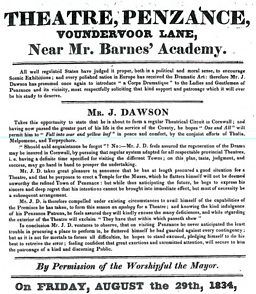
In August 1834, a Mr Dawson announced his intention to form a regular theatrical circuit in Cornwall. As he has passed the greater part of his life in the service of the county, he is searching for a good situation for a theatre and proposes to erect a 'Temple for the Muses' worthy for the refined town of Penzance.
However, and much to his surprise, he has struggled to find somewhere suitable and must make do with some premises he has taken, which he describes as an 'apology' for a theatre.
He begs the kind indulgence of his patrons will excuse its many deficiencies.
He is speaking of a building in Voundervoor Lane, near Mr Barnes’ Academy – unfortunately the playbill does not specify the exact building.
A summer later, another venue is listed on a playbill.
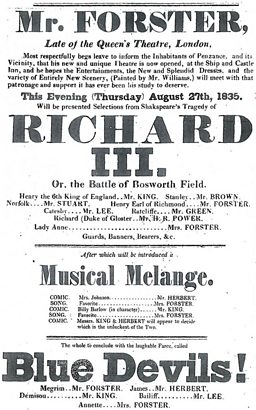
On August 27th 1835 there was a performance of Richard III at the Ship and Castle Inn.
The playbill shows that actors from the capital continued to visit the seaside town at least in the summer.
Mr Forster, late of the Queen’s Theatre, London is the biggest name on the bill, and he has organised the evening’s entertainment, a series of extracts from Richard III. He is playing Henry, Earl of Richmond and his wife is Lady Anne.
In a note of the playbill he refers to the venue as 'new' and 'unique', the costumes as 'new' and 'splendid' dresses, and the 'variety of entirely new scenery' which has been recently painted by a Mr Williams.
The playbill follows the convention of the time with the 'serious' play followed by a 'Musical Melange' and then a laughable farce called 'Blue Devils' to send spectators home with a smile on their face!
The Penzance Band was also in attendance.
Jolly though this evening sounds, by July 30th 1841 there was a new venue for play-goers.
The hunt for a space for a theatre has been resolved with the Corn Exchange now the venue for Shakespeare and other entertainments.
On this particular evening in summer, another husband and wife team are in situ and Mr Johnson is playing Hamlet and his wife, Mrs Johnson is Osrick.
About Shakespeare on Tour
From the moment they were written through to the present day, Shakespeare’s plays have continued to enthral and inspire audiences. They’ve been performed in venues big and small – including inns, private houses and emerging provincial theatres.
BBC English Regions is building a digital picture which tracks some of the many iconic moments across the country as we follow the ‘explosion’ in the performance of The Bard’s plays, from his own lifetime to recent times.
Drawing on fascinating new research from Records of Early English Drama (REED), plus the British Library's extensive collection of playbills, as well as expertise from De Montfort University and the Arts and Humanities Research Council, Shakespeare on Tour is a unique timeline of iconic moments of those performances, starting with his own troupe of actors, to highlights from more recent times. Listen out for stories on Shakespeare’s legacy on your BBC Local Radio station from Monday 21 March, 2016.
You never know - you might find evidence of Shakespeare’s footsteps close to home…
Craig Henderson, BBC English Regions
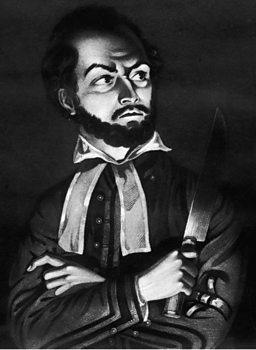
Scene of Trafalgar victory announcement and Georgian jewel
The theatre where Kean was performing was one of a small number of early Georgian theatres in the country.
According to the Theatre Trust’s guide to British Theatres, it was opened in 1787 by an actor-manager called Richard Hughes who was known as the 'father of Provincial Drama' and was linked to eight other theatres in the South-West.
It may share the same architect as the Theatre Royal in Richmond and the Georgian Theatre in Stockton-on-Tees.
It could hold about 500 people in two rows of galleries around a central pit. The raked stage was where 70 or so productions took place in the season.
It is built in part above stabling to the rear of a former coaching inn called the Union Hotel and this is fairly typical of the status of small theatres in the provinces.
Situated in the part of the town where the richest and most influential people lived and sought entertainment, it’s thought that the theatre was where the first public announcement of the victory of Trafalgar was heard in 1805.
However by the time of Kean’s appearance, the theatre was failing and it closed in 1831. Richard Hughes became the owner and manager of the Sadler’s Wells Theatre, one of the most prestigious theatres in the country.
He also ran theatres in Weymouth, Plymouth, Exeter, Guernsey, Devonport, Truro and Penzance. Each theatre was open for several months each year and his company moved from theatre to theatre.
Shakespeare on Tour: Around Cornwall
![]()
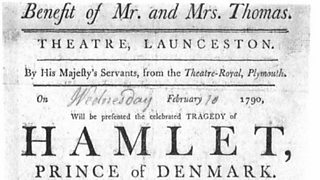
Shakespeare's tragic heroes appear in Launceston
Size not everything as Shakespeare's tragic heroes appear in remote town of Launceston
Related Links
Shakespeare on Tour: Around the country
![]()
Lancaster Theatre sparkles with Shakespearean talent
The Grand Theatre in Lancaster, which was once managed by Stephen Kemble
![]()
Reading’s Puritans turn away Shakespeare
Shakespeare's men paid not to play in Reading
![]()
Belvoir Castle
Belvoir Castle, home of the Duke of Rutland
![]()
Did Shakespeare visit Bristol in 1597?
Civic accounts show a high amount of performances in Bath