Section 3: Craters in shadow
Not all craters are best seen when the Sun is high in the lunar sky - in fact most aren’t.
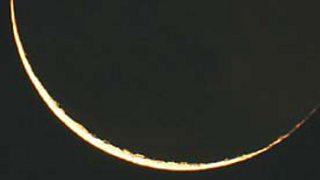
If craters aren’t particularly bright or dark, they tend to disappear into the background when the Moon’s phase is close to full. These craters are best seen when the 'terminator' is nearby, or when the Sun is low in the lunar sky as seen from the crater.
This causes oblique lighting to fall on the crater and create exaggerated shadows. Ultimately, this makes the crater look more dramatic and easier to see.
We’ll use this effect for the next section on lunar mountains, but before we do, there are a couple of craters that we’d like to bring to your attention. Actually, the Moon is covered with a whole host of wonderful craters that look amazing when the lighting is oblique.
The best time to see these features is in the summer and early autumn, during the later phases following a full Moon.
Unfortunately, this means viewing in the early hours but don’t worry as we’ve kept things simple. We just want to give you a taste of what a shadowed crater looks like, so the going here is really pretty easy!
Kepler and Copernicus:
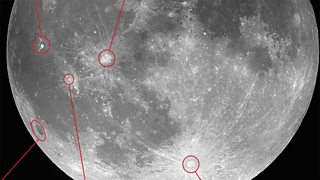
First, locate the two craters Kepler and Copernicus which were targets pointed out in Section 2. Their rays are less prominent when the terminator is nearby but the craters themselves, now partly filled with shadows, are much easier to see.
Eratosthenes:
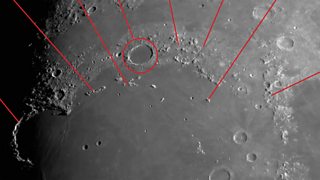
See if you can spot the 35 mile diameter crater Eratosthenes which lies to the east of Copernicus. Eratosthenes is smaller than Copernicus and larger than Kepler but doesn’t have the dramatic rays that draw your attention like the others. It does have a lovely central mountain complex though which can be seen with a small telescope.
It also sits at the end of a rather impressive mountain range which we’ll come on to in the next section.
Clavius:
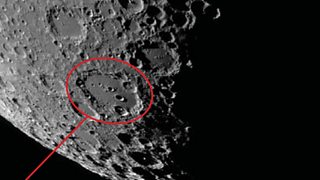
Head towards the southern end of the Moon’s disc and there’s a magnificent crater known as Clavius. Our rather brief look at craters in shadow wouldn’t be complete without a visit to its large complex rim and craterlet-covered floor.
Once its large 140 mile rim becomes obvious, you’ll wonder how you ever missed it. Two large 30 mile diameter craters interrupt the rim: Porter to the north and Rutherfurd to the south.
Clavius D:
Using a telescope, look north of Rutherfurd but stay within Clavius. Here you’ll find the 16 mile diameter crater, Clavius D. To the north-west of Clavius D lies 12 mile Clavius C. The progression continues in an obvious arc with ever smaller craterlets. This is a good test for telescope optics!
Visibility: A pair of binoculars is the minimum requirement to see these features.
When: Look for them when the terminator is close by, typically a day before last quarter.
See also
Other sections
![]()
Section 1: The lunar seas
You only need to use your eyes
![]()
Section 2: Bright and dark craters
You will need to use binoculars for this section
![]()
Section 4: Majestic mountains
You will need to use a telescope for this section
![]()
Section 5: Lunar specials
You will need to use a telescope for this section