Section 5: Lunar specials
The final section introduces you to a number of slightly different lunar features or Moon related phenomena.
Earthshine:
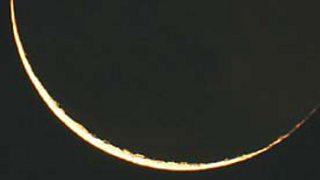
Earthshine is the effect you get when you sometimes see the faint dark part of the Moon glowing next to a fully illuminated lunar crescent. The effect is caused by the light from the Sun reflecting off the Earth and illuminating the dark lunar surface.
So if you were to trace the light from the Sun it would bounce off the Earth towards the Moon, bounce off the Moon’s surface back towards the Earth and finally enter your eye! It’s not a tricky thing to see if the crescent is visible in a clear sky, but during the summer you’ll probably have to get up early to tick it off the list!
Lady in the Moon and the Basketball Player:
Next up are a couple of figures included just for fun. The dark seas on the lunar surface are often connected together to make familiar shapes and patterns. Two of our favourites are the Lady in the Moon and the Basketball Player, complete with his ball represented by the Mare Crisium!
Using our guide picture, can you spot them close to when the Moon is full?
Reiner Gamma:
Most of the lunar features you see through a telescope are referred to as relief features. These are visible basically because they have height and cast shadows. Albedo features are different in that they are visible because they reflect light in different ways. One of the weirdest is known as Reiner Gamma.
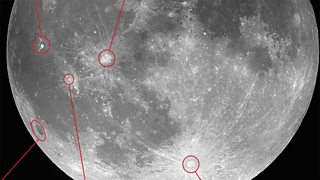
An easy way to locate Reiner Gamma is to draw a line from Copernicus through Kepler (these were both mentioned in Section 2) and extend it for the same distance again. Reiner Gamma initially looks like a bright patch on the Oceanus Procellarum.
A telescope shows it to look a bit like an eye with curving streamers extending to the east and west. Oddly, this feature has no height; the bright regions are simply light patches on the lunar surface.
What could have caused such an odd pattern? One theory suggests that something slammed into the back of the Moon at the opposite point on the surface to Reiner Gamma. The resulting shockwave then sent some lunar material up from the surface.
As it fell back, its position was influenced by a weak magnetic anomaly known to be present in this region. The pattern we see today is the end result.
Rupes Recta:
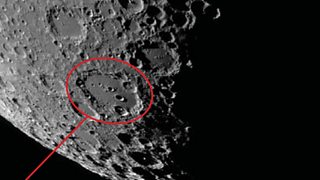
We change from curved to straight for our next special which lies 700 miles to the north of the crater Clavius. Known as the “Straight Wall”, this requires a telescope to be seen properly. It looks remarkable and it soon becomes evident why it’s called the Straight Wall - it’s incredibly straight.
Formally known as Rupes Recta, this is a linear fault, a region of the Moon’s surface where one part has dropped relative to the other.
At certain illuminations Rupes Recta shows as a striking dark line, indicating that a shadow is being cast. Other illuminations show it as a bright line as seen here. The difference is caused because it’s actually a slope rather than a cliff edge.
Remarkably, calculations indicate that it’s actually rather a gentle incline of just 8 degrees.
Boundary of Mares Serenitatis and Tranquillitatis:
You may well have already seen the next item but not even noticed it. Remember Mare Serenitatis and Mare Tranquillitatis from Section 1? Look at the boundary between them - there’s a really striking line caused where the lighter, younger and smoother lava of Serenitatis meets the older lava covering of Tranquillitatis.
Lots of interesting geology can be gleaned from subtle variations in lunar surface appearance such as this.
Stadius:
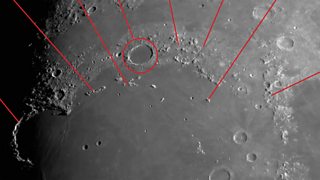
Our final marathon item is an in-filled crater just south of the mid-point between Copernicus and Eratosthenes (Section 3). Known as Stadius, this 42 mile diameter crater is completely smoothed over, as if someone has covered it in concrete and trowelled it flat.
In this case the covering is lava but the result is the same. This is an example of a lunar feature known as a “ghost crater”.
See also
Other sections
![]()
Section 1: The lunar seas
You only need to use your eyes
![]()
Section 2: Bright and dark craters
You will need to use binoculars for this section
![]()
Section 3: Craters in shadow
You will need to use binoculars for this section
![]()
Section 4: Majestic mountains
You will need to use a telescope for this section