Echoes of the past: did medieval hall host the Bard?
By Matthew Woodcock, REED editor, co-editing Norwich
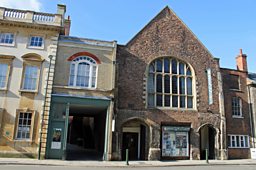
The Norfolk coastal town of King’s Lynn today not only boasts the largest surviving medieval Guildhall in the country – there is also compelling research suggesting Shakespeare himself performed there.
The town was a regular stopping off point on the East of England circuit for early modern drama groups, and St George’s Guildhall was one of two venues where plays were staged.
![]()
Much ado near me
Hear more Shakespeare stories on BBC Radio Norfolk
![]()
Shakespeare Festival 2016
The BBC celebrates the genius of the bard

Lynn’s burgeoning economy and relative ease of access made it an attractive place for travelling players seeking paying audiences – especially during the summer months when the actors would have spent time on the roads.
By virtue of some careful academic detective work, there are a number of compelling theories to suggest Shakespeare was himself performing
There were various acting troupes performing in the provinces at this time.
From the archive records of the Lord Chamberlain's troupe of players, together with the town council (or ‘corporation’) records, we can see that King’s Lynn was visited by The Queen’s Men group of players six times in ten years between 1586 and 1596; also by the Lord Chamberlain's Men in 1586; the Earl of Essex’s Men in 1591 and the Earl of Pembroke’s Men in 1592/3.
But it is this last visit which perhaps most excites the experts. By virtue of some careful academic detective work, there are a number of compelling theories to suggest Shakespeare was himself performing as part of the Earl of Pembroke’s tour in King’s Lynn, perhaps in the first half of 1593.
We know from an entry in the King’s Lynn Hall book that the Earl of Pembroke’s players were paid 20 shillings for performing during the year of office 1592/3.
Details in the text of these early plays suggest that the author must have been present and in the company when these were being performed.
We also know that this group of players was a grouping of a mix of factors from different groups, and included the great Shakespearean actor Richard Burbage.
And we know that Shakespeare himself was performing in 1592 because Norwich-born writer and dramatist Robert Greene had a critical ‘dig’ at a performance – famously referring in print to Shakespeare as ‘an upstart crow’.
And we know that when a number of Shakespeare’s early plays came to be published in 1593/4 (such as Titus Andronicus; The Taming of the Shrew and Henry V1 parts 2&3) …that they were performed by Pembroke’s men too.
And, here’s the detective work – details in the text of these early plays suggest that the author must have been present and in the company when these were being performed.
There are other good reasons why Shakespeare was probably on tour. The early history plays most likely being performed commanded a large company (so he was needed on stage); it was a way of getting out of plague-stricken London that year; and he was known to be a company man – as one of the principal playwrights he might well have wanted to be with his fellow actors as they toured the provinces.
Pembroke’s Men and their links to Shakespeare
A 1594 edition of Titus Andronicus shows that the group of performers known as Pembroke’s Men had Shakespeare’s plays in their repertoire.
The tour had not taken off and some actors even had to pawn their costumes
Indeed Shakespeare himself may well have been a member of the troupe in the early 1590s, just before he joined with the Lord Chamberlain’s Men.
The early 1590s was a hard time for many acting companies with bubonic plague forcing some of them out of London to perform in the provinces.
In 1593 this particular set of Pembroke’s Men set out on a provincial tour. Although they made some money along the way, it seems to have ended badly by the time they returned to London, according to the famous diarist of the time Philip Henslowe, who indicates that the tour had not taken off and some actors even had to pawn their costumes.
Sally-Beth MacLean, General Editor of Records of Early English Drama, writes: “When the Chamberlain's Men was first formed in late spring 1594, it is very likely that Shakespeare was indeed one of their actors, as well as a contributing playwright, possibly recruited from the remnants of Pembroke’s Men, a company known to have hit hard times the previous year.”
Shakespeare on Tour
From the moment they were written through to the present day, Shakespeare’s plays have continued to enthral and inspire audiences. They’ve been performed in venues big and small – including inns, private houses and emerging provincial theatres.
BBC English Regions is building a digital picture which tracks some of the many iconic moments across the country as we follow the ‘explosion’ in the performance of The Bard’s plays, from his own lifetime to recent times.
Drawing on fascinating new research from Records of Early English Drama (REED), plus the British Library's extensive collection of playbills, as well as expertise from De Montfort University and the Arts and Humanities Research Council, Shakespeare on Tour is a unique timeline of iconic moments of those performances, starting with his own troupe of actors, to highlights from more recent times. Listen out for stories on Shakespeare’s legacy on your BBC Local Radio station from Monday 21 March, 2016.
You never know - you might find evidence of Shakespeare’s footsteps close to home…
Craig Henderson, BBC English Regions
Black Death closes London Theatres
There were several outbreaks of bubonic plague during Shakespeare’s lifetime, and often a consequence was that theatres were forced to close down in order try to prevent the further spread of disease among crowds.
Theatres were forced to close down in order try to prevent the further spread of disease among crowds.
Such was the case in 1593, when London’s Theatres closed forcing acting groups to leave London and perform in provincial towns such as King’s Lynn, in order to make their living.
It was, therefore, a tough period for actors and Pembroke’s Men in particular found it hard to make ends meet.
The next major outbreak of ‘the Black Death’ to close the theatres happened some ten years later in 1603, just as a new king, King James came to power. It is estimated that around 33,000 people died in this one outbreak alone.
Bubonic plague was spread by fleas living on rodents and animals. Its victims would die within days.
Related Links
![]()
Shakespeare Lives
The nation’s greatest performing arts institutions mark 400 years since the Bard's death
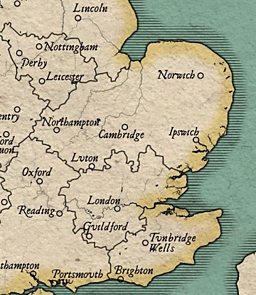
Shakespeare on Tour: Around Norfolk
![]()
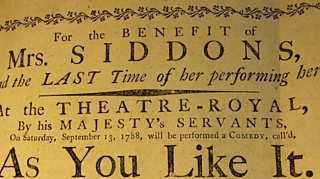
Sarah Siddons visits the Theatre Royal
Siddons' last Norwich performance of 'As You Like It'
![]()
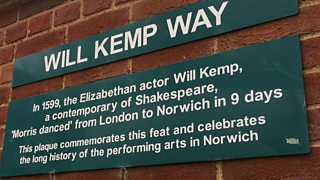
Shakespeare's former clown dances to Norwich
Why did Will Kemp dance 125 miles from London to Norwich?
![]()
Norwich gives Shakespeare's company the cold shoulder
Shakespeare's players paid 40 shillings not to perform
Shakespeare on Tour: Around the country
![]()
Lancaster Theatre sparkles with Shakespearean talent
The Grand Theatre in Lancaster, which was once managed by Stephen Kemble
![]()
Reading’s Puritans turn away Shakespeare
Shakespeare's men paid not to play in Reading
![]()
Belvoir Castle
Belvoir Castle, home of the Duke of Rutland
![]()
Did Shakespeare visit Bristol in 1597?
Civic accounts show a high amount of performances in Bath