A new king and rebranded Shakespeare’s players head first for Shrewsbury
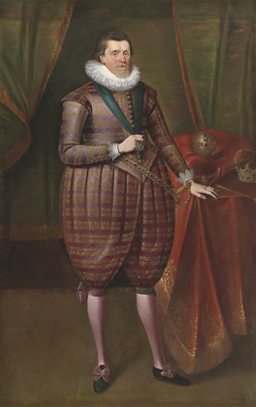
When King James arrived in London from Scotland in 1603 to take over the throne following the death of Elizabeth, one of the first things he did was to establish the 'King's Men' as his official group of theatre players.
The newly-formed King's Men no doubt included William Shakespeare among their number and one of the very first places they chose to perform was Shrewsbury.
![]()
Much ado near me
Hear more Shakespeare stories on BBC Radio Shropshire
![]()
Shakespeare Festival 2016
The BBC celebrates the genius of the bard

The King's Men were granted special status by the King to tour the country, and in no time at all they were on the road performing.
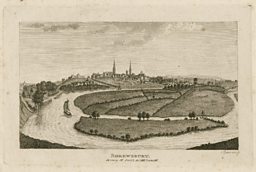
Located in the centre of Shropshire, and well-served by roads both North-South and East-West, the Shrewsbury of 1603 would have proved a pleasant destination
Records show that the King had awarded the group his royal seal of approval on May 17th 1603. They must have moved extremely quickly to equip and prepare themselves for a life on the road, for records in Shrewsbury show that one of the earliest payments recorded to the King’s Men was made sometime between May and September 1603.
But why Shrewsbury – and why the haste?
One reason for the King's Men's early plans to tour was no doubt the virulent plague that beset London at the time; it had closed the public theatres in the capital and in fact caused King James to delay his coronation until July 25th 1603.
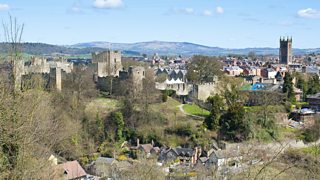
Another reason was that Shrewsbury was an attractive prospect at this time. Located in the centre of Shropshire, and well-served by roads both North-South and East-West, the Shrewsbury of 1603 would have proved a pleasant destination, situated on a peninsula formed by the winding Severn River. This afforded a measure of protection, and also an avenue for commercial shipping, since the river was navigable.
The town was prosperous; the population more than doubled between 1550 and 1620, prompting writer John Speed to wax lyrical in his 1611 description of the town: “her buildings faire, her streets many and large, her citizens rich…”
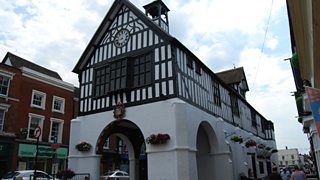
A final factor that might make Shrewsbury a favoured destination was the local love of theatre and other public entertainments. Not once in hundreds of years was there an attempt to control or inhibit playing. The town boasted a convenient and large 'Booth Hall' (so-named in the early records), located in the Market square, with a playing space sixty-five by twenty-five feet in size.
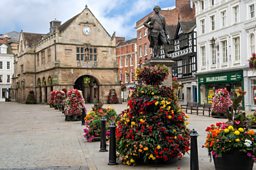
The plague tour of 1603
King James had arrived from Scotland to take up the Crown. Among his first acts was to officially appoint the King’s Men, formerly the Lord Chamberlain’s Men, as his group of royal players.
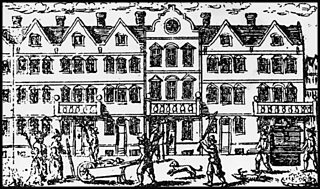
Wasting no time, for London was in the grip of the plague, the actors headed for the provinces… no doubt with Shakespeare among them.
The King’s Men took to the road for what appears to have been a well-organized Midlands tour; they appeared during the same time in Coventry, and in Bath on 25th July. After 29th September 1603, they were found at Oxford, and at Bridgnorth between 2nd January and 23rd May 1604.
An encouragement to tour might well have been the wishes of King James, their patron, as expressed in the letters patent, which requests all justices, mayors, other officers and subjects not only to allow the company courtesies as formerly granted but also “what further favour you shall shewe”, as a favour that “wee shall take kindlie at your hands.”
The King’s Men were thereby given a special warrant not granted to other companies to tour as, in effect, goodwill ambassadors for a foreign monarch who was, in 1603-4, new and unknown.
King James had been welcomed with enthusiasm when he made his slow journey south from Edinburgh to London, so perhaps the vigorous travels of his troupe were meant to capitalize on this by 'showing the flag' through the provinces.
The King’s Men certainly threw themselves in to touring with energy. In comparison to their activities under their previous patron Lord Chamberlain, the King’s Men toured far more and are recorded as performing eighty times in the provinces between 1603 and 1625. Given the probable loss of many provincial borough and household records, that number marks a remarkable achievement, beginning with performances at Shrewsbury and Coventry.
Shakespeare on Tour
From the moment they were written through to the present day, Shakespeare’s plays have continued to enthral and inspire audiences. They’ve been performed in venues big and small – including inns, private houses and emerging provincial theatres.
BBC English Regions is building a digital picture which tracks some of the many iconic moments across the country as we follow the ‘explosion’ in the performance of The Bard’s plays, from his own lifetime to recent times.
Drawing on fascinating new research from Records of Early English Drama (REED), plus the British Library's extensive collection of playbills, as well as expertise from De Montfort University and the Arts and Humanities Research Council, Shakespeare on Tour is a unique timeline of iconic moments of those performances, starting with his own troupe of actors, to highlights from more recent times. Listen out for stories on Shakespeare’s legacy on your BBC Local Radio station from Monday 21 March, 2016.
You never know - you might find evidence of Shakespeare’s footsteps close to home…
Craig Henderson, BBC English Regions
![]()
Shakespeare Lives
The nation’s greatest performing arts institutions mark 400 years since the Bard's death

Related Links
Shakespeare on Tour: Around Shropshire
![]()
Drunken robbers threaten the leader of Shakespeare's players
As he collects admission money at the door!
![]()
Poverty stricken Bridgnorth ‘splashes the cash’ on Shakespeare’s royal players
Why would a town clearly suffering hard times pay so much?
![]()
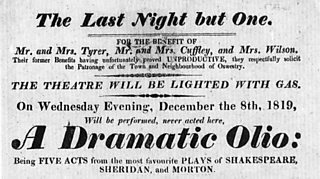
Shakespeare… by gaslight!
An 1819 playbill invites people to enjoy the newly-installed gas lighting in the theatre
Shakespeare on Tour: Around the country
![]()
Lancaster Theatre sparkles with Shakespearean talent
The Grand Theatre in Lancaster, which was once managed by Stephen Kemble
![]()
Reading’s Puritans turn away Shakespeare
Shakespeare's men paid not to play in Reading
![]()
Belvoir Castle
Belvoir Castle, home of the Duke of Rutland
![]()
Did Shakespeare visit Bristol in 1597?
Civic accounts show a high amount of performances in Bath