Not just a sci-fi gimmick: The serious side of the theremin
By Allan Campbell | 28 July 2015
“How daring can the screen dare to be? No adult man or woman can risk missing the startling frankness of The Lost Weekend.”
The tagline for director Billy Wilder’s gruelling account of an alcoholic writer - played by Ray Milland and probably inspired by Raymond Chandler - may appear sensational but the movie it was selling proved to be important on at least two counts.
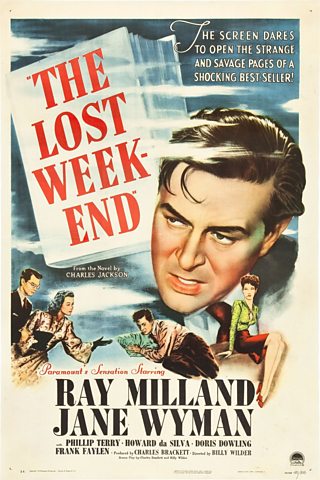
After years of comedy drunks, it was the first time that Hollywood examined the grim reality of alcoholism, DTs and all. It would also foreground a then little-known electronic instrument called the theremin.
For the first time, the original score for the film has been made available on CD and it’s a timely reminder that Léon Theremin’s eerie-sounding creation could be an instrument of serious musical intent, rather than the gimmick it would later come to be regarded as.
Although Dmitri Shostakovich had made some use of the theremin in a couple of his soundtracks in the Thirties, the instrument’s initial wave of popularity in the Forties would be reliant on two men: one a brilliant Hollywood composer, the other a chiropodist.
Hungarian-born Miklós Rózsa opted to use the theremin on two of his scores in quick succession; Spellbound (1945) for Alfred Hitchcock and The Lost Weekend for Wilder the same year.
In the latter, the peculiar electronic wailing sound would appear when Milland’s character struggled with his debilitating craving for alcohol. In Hitchcock’s film, Rózsa deploys the instrument to represent the disturbed mental states of a doctor played by Gregory Peck, most famously in a surreal dream sequence designed by Salvador Dalí. Hitchcock disliked the music. The score won an Oscar.
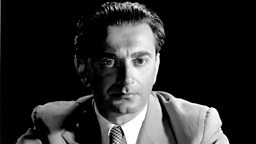
When Rózsa had first contacted Local 47, the Hollywood Musicians Union, to find a theremin player, they had only one on their books; a chiropodist and part time musician called Dr Samuel Hoffman.
As a result, Hoffman would play on both films, becoming something of a celebrity in his own right. He went on to record three albums and tour.
That the theremin was considered a selling point by Spellbound’s producer David O. Selznick was demonstrated in an anecdote Rózsa loved to recount.
Although Spellbound had been completed first, The Lost Weekend was poised to open in theatres before it. As a result, Rózsa received a call from Selznick’s secretary, asking him if it were true that Rózsa had also used the theremin in his new film: “Apparently, Selznick considered he had a monopoly on the instrument. I flew into a rage and told the lady yes, I had used not only the theremin but also the piccolo, the trumpet, the triangle and the violin. Goodbye!”
Few major contemporary composers seriously consider the theremin to be part of their musical palette
Hoffman would contribute theremin to numerous films up until the mid-Sixties, even playing on another classic of the genre, The Day The Earth Stood Still (1951). Scored by Bernard Herrmann, Hoffman was paired with another theremin player, the concertmaster Paul Shure, to create the otherworldly sound of an alien invasion which would become so beloved by later sci-fi directors.
But later entries in Hoffman’s CV illustrate the increasingly camp company the theremin would find itself in. The titles alone - The 5,000 Fingers of Dr T. (1953), The Mad Magician (1954), Billy the Kid versus Dracula (1966) – tell you all you need to know.
Few major contemporary composers seriously consider the theremin to be part of their musical palette. One exception is Danny Elfman who, as a 10-year-old, was inspired by Herrmann’s score for The Day The Earth Stood Still, which he pastiches in Tim Burton’s Mars Attacks! (1996).
As a frequent contributor to Burton’s off-kilter celluloid world, Elfman has made the theremin a natural fit, although now it is often synthesised with other instruments, making it a less distinctive sound.
But to experience fully the emotion of which the theremin is capable, return to Rózsa’s The Lost Weekend to feel raw human anguish - conjured using only the eerie howl of electricity.
The Lost Weekend, original score composed by Miklós Rózsa and conducted by Irvin Talbot, is available on Intrada.
What is a theremin?
The theremin is the only musical instrument that is played without physical contact. Instead, the player moves their hands around two metal antennae – one controls the frequency (or pitch) and the other the amplitude (or volume).
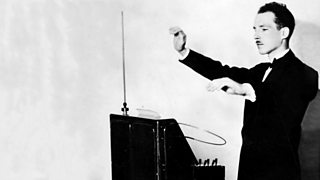
It was invented in 1920 by Russian physicist Lev Sergeevich Termen (better known in the West as Léon Theremin). In 1928, he brought his design to the USA, where he patented it and allowed RCA to begin commercial production.
It was widely used in film soundtracks and concert halls throughout the 1930s and 1940s, and though it fell out of favour with many musicians as more sophisticated electronic instruments became available, it has maintained a cult following ever since, with many variations available to buy ready-made or in kit form.
Hear more
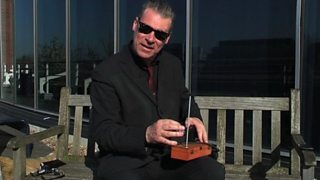
In this clip, Mark Kermode demonstrates the theremin for the Kermode Uncut blog. There are also a host of theremin performances on YouTube - check out Léon Theremin and Samuel Hoffman playing the instrument, the Dalí dream sequence in Spellbound and The Lost Weekend original trailer for starters.
Related links
Soundtracks on BBC Arts
![]()
Magnificent Obsession
The story of Bernard Hermann's classic score for Brian De Palma's 1975 movie
![]()
Space-age symphonies
BBC Radio 3's Matthew Sweet writes about the music of sci-fi film
![]()
The sound of silents
Matthew Herbert discusses the score for A Message from Mars
![]()
Manipulating emotions
How do film-makers use music to make us feel a certain way?