Space-age symphonies: The music of science fiction film
By Matthew Sweet | 3 December 2014
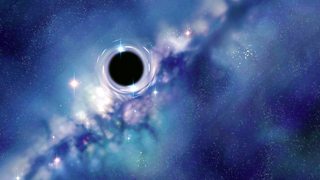
In space, no one can hear you scream. In the real world, that’s because the void between the stars contains no gas molecules to carry longitudinal waves of sound.
In the cinema, it’s because the human voice doesn’t stand a chance against the howl of the Moog, or the grand romantic heft of John Williams, or Hans Zimmer banging away on a 1926 four-manual Harrison & Harrison organ.
Nature abhors a vacuum, but the movies abhor it more - and the composer is the person charged to fill it. Over the decades, different styles have moved in and out of orbit.

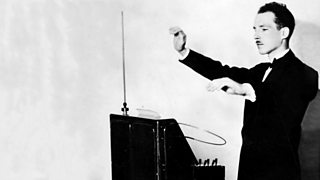
The aliens, as they watch crackly TV broadcasts of 20th-century science fiction films, are probably wondering why, for decades, their arrival was always heralded by the wail of the Theremin – that odd electric instrument that’s played by doing jazz hands at a pair of metal antennae.
The Russian physicist Lev Termen (known as Léon Theremin in the West) invented the device in 1919, and took it to the States in 1927, just in time for the invention of the talkies.
Franz Waxman let one shriek through The Bride of Frankenstein (1935) – where it was quite at home among the spark-generators and lightning conductors of Colin Clive’s laboratory.
Universal liked the music so much that they recycled it in the science-fiction serial Flash Gordon Conquers the Universe (1940).
The Theremin suited the lab and the rocketship because it sounded like the music of the future - but it also carried a note of dangerous exoticism. Ming the Merciless administered his empire from the planet Mongo, but he also stood for despots down here on the earth.
There’s a story to be told about the Cold War film-music space race; how, as engineers toiled on rival rocketry projects, screen composers were also drawing on the latest technologies.

Bernard Herrmann pioneered an early form of multi-track recording on The Day the Earth Stood Still (1951), laying down the sound of two Hammond organs, a vibraphone, an electrically-amplified violin and a pair of Theremins. (Their creator, by this point, had fallen from the Kremlin’s favour and was developing bugging devices in a laboratory in the Gulag.)
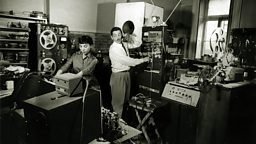
Seven years later, Louis and Bebe Barron, a husband-and-wife team of tape-twisters and oscillator-botherers, generated the world’s first all-electronic film score for Forbidden Planet (1958) – so ear-troublingly modernist that the studio billed them not as musicians, but creators of “electronic tonalities”.
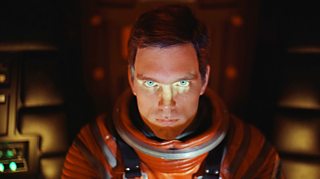
Oddly, though, cinematic space music began to look back to older traditions just as NASA was gathering its skirts for a moonshot. If we’re looking for a moment of Copernican change, it’s probably the point during the premiere of 2001: A Space Odyssey (1968) when the film’s original composer, Alex North, realised that his score had been dumped in favour of those famous pieces by Johann and Richard Strauss.
After Kubrick’s spaceships had waltzed to the Blue Danube, space became a place to encounter some version of the musical past – rather as Kier Dullea’s astronaut travels to the edge of the universe to finds himself in a room full of baroque furniture.
John Carpenter’s Dark Star (1974) sent country music through the Veil Nebula. For Star Wars (1977), John Williams channeled his inner Erich Wolfgang Korngold and produced a score fit for a 1930s swashbuckler.
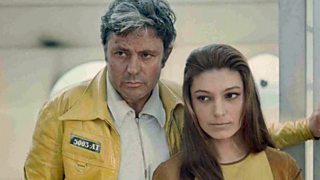
Eduard Artemyev’s music for Solaris (1972) combined JS Bach's Choral Prelude in F-minor, Ich ruf zu Dir, Herr Jesus Christ, with the rumbles of the ANS, a prototype synthesizer named after Alexander Nikolayevich Scriabin, which worked by conjuring sound from sine waves drawn on pieces of glass.
Since Danny Elfman’s larky score for Mars Attacks (1996), the Theremin has been fit only for comedy. Sending up a spaceship to the sound of Strauss would also now raise a knowing giggle – and giggles don’t seem to be required at the moment.
Aside from Guardians of the Galaxy (2014), contemporary science fiction isn’t much focused on fun. Instead, it’s developed a philosophical, spiritual side. And if contemporary cinema’s most interesting space scores share a common mission, it’s to transform organic, earthly sound-sources into music that suggests the metaphysical or otherworldly.
Hans Zimmer’s soundtrack for Interstellar (2014) takes us through a space-time wormhole using 34 string players, 24 woodwind, four pianos, a 60-strong chorus of voices and the organ from the Temple Church in London. Mica Levi’s hypnotic music for Under the Skin (2013) uses a sliding, lurching viola as the solo instrument on a score inspired by John Cage, strip-club tunes and dance music.
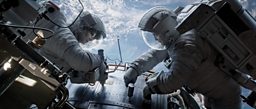
Steven Price’s Oscar-winning score for Gravity (2013) was shaped and moulded on a computer, but its sources are solid and terrestrial – somewhere inside the music that accompanies the destruction of the space station, for instance, are a group of violinists playing the string line from Eleanor Rigby.
Forty-five years after the moon landings, space exploration is pursued by our robot proxies. One reported back to earth a few weeks ago. As the Rosetta probe neared the Churyumov-Gerasimenko comet, it gathered data about the sound-world of its objective – a world that exists because this lump of rock and ice exudes sufficient gas molecules to carry a sound wave.
The sound was only detectable at an audio frequency of between 40-50 MHz, so scientists at the European Space Agency had to work on it in order to bring it within the range of the human ear.
A burst of chattering blips and clicks that might have come from the studio of a composer working on a science-fiction film. It seemed to hold an echo of Louis and Bebe Barron, or the gurgling of the Soup Dragon. A sound harvested in nature, and transformed by technology into music.

A Singing Comet
The sound of comet 67P/Churyumov-Gerasimenko. Audio courtesy of ESA/Rosetta/RPC/RPC-Mag.
Matthew's top 7 sci-fi soundtracks

- The Day the Earth Stood Still (1951). Gort the robot and his master Klaatu used impressive technology to land their saucer on the White House lawn. The film’s real power, through, surges from Bernard Herrmann’s battery of Theremins and Hammond organs.
- Quatermass and the Pit (1967). Something demonic erupts from the London Underground: Tristram Cary’s searingly atonal score, composed the year he set up the first electronic music studio at the Royal College of Music.
- Solaris (1972). The Soviet synth pioneer Eduard Artemyev takes Bach into outer space, and makes the music sound as if it’s coming to us from beneath the waters of some distant alien ocean.
- Alien (1979). A lonely trumpet, a swarm of scratchy strings, long, low discordant tones from the brass section - Jerry Goldsmith’s score was too avant-garde for the tastes of its producers. We had to wait until 1999 to hear it properly.
- Star Trek: The Motion Picture (1979) In total contrast to his Alien score, Goldsmith conjures the high romance of space adventure - this is a late nineteenth-century symphony that somehow found its way onto a William Shatner movie.
- Gravity (2013). Steven Price treats conventional instruments as Delia Derbyshire once treated white noise – and creates a soundscape as expansive as the void in which Sandra Bullock is drifting.
- Under the Skin (2013): Mica Levi’s music is the oddest sci-fi score in years – lurching, slithering strings and a drum like a dying heartbeat. Irresistibly weird.
More on sci-fi and music
![]()
Science Fiction Season
Journey into the universe of sci-fi across the BBC
![]()
Sound of Cinema
Matthew Sweet's BBC Radio 3 series exploring the music of film
![]()
Fearful visions
Film 2014's Danny Leigh on how sci-fi reveals our insecurities
![]()
Good Vibrations
Bill Bailey tells the story of the Theremin for BBC Radio 4
![]()
Manipulating emotions
How do film-makers use music to make us feel a certain way?