The sound of silents: Matthew Herbert on scoring sci-fi landmark A Message from Mars
By Tom Churchill | 11 December 2014
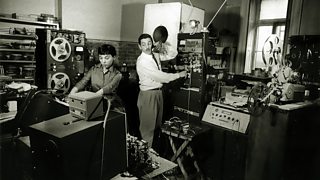
BBC Arts has collaborated with the BFI to restore Britain's first ever sci-fi feature, A Message from Mars (1913), with a new soundtrack by Matthew Herbert, which is available to watch online. Here the 41-year-old musician and sound artist – who is also Creative Director of the New Radiophonic Workshop, the new incarnation of the legendary sound design laboratory – explains how he scored a landmark in film history in under two weeks.

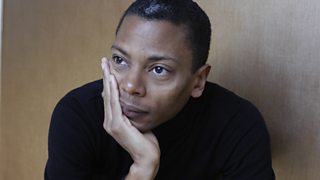
Matthew Herbert may not be the first modern-day electronic musician to soundtrack a silent sci-fi film – Detroit DJ/producer Jeff Mills has some form in the field, having scored Fritz Lang’s Metropolis and The Woman in the Moon in his trademark techno style.
But Herbert’s approach – as you might expect from a man who once made an album constructed entirely from the sounds of a pig – is slightly more unusual.
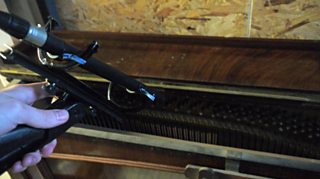
He explains: “I wanted to use instrumentation that was available at the original time, so I tracked down a piano dating from 1913, the year the film was made. But it wouldn’t have been possible to play it back then in the way I’m using it – the idea was to use all the amazing tools and technologies we have now to manipulate it and use it as a sound source for everything.
“I produced three sets of sounds from it: for one I sampled the piano in its raw state, the next was a ‘prepared’ version, and for the third I made a kind of drum kit out of all the noises other than actually playing it: the pedals, the lid and that sort of stuff.
“I sent some of it off to a couple of people in the New Radiophonic Workshop and they processed some of those noises to create an even more extreme sound bank. That was my palette, basically.”
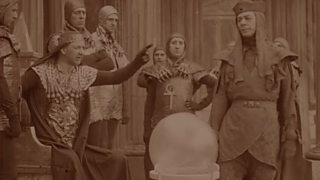
The story of A Message from Mars is loosely based on Dickens’ A Christmas Carol. It stars Charles Hawtrey as a selfish man who is taught a series of valuable lessons by a visiting Martian - who will only be permitted to return to Mars if he is successful in his mission to instil a change of heart in his subject.
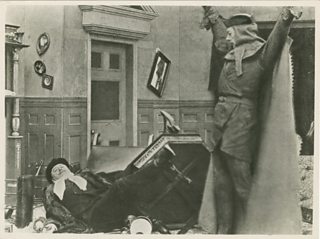
Herbert says: “The film’s quite a simple conceit in a way, and there was no expectation that this kind of soundtrack would ever exist on it, so I thought it was important that the music didn’t overpower it.
“For me the driving force of the film is the Martians observing Earth from another environment. And as I started to work on the music I realised that actually that’s what we’re doing now: we’re looking back and seeing details of the time, like how the streets look and what kind of clothes people are wearing, as well as the story they’re telling.
“So in some ways I feel like the music should help to increase that sense of alienation and distance rather than trying to fake some kind of naturalism, because we’re looking back through a very distorted hundred-year lens.
“The music also plays an important role in some basic functions of telling the story, because when I first saw it I didn’t really understand it all. The language of film was so different back then and I had to concentrate hard to keep up, so I think the music can help by assigning themes and textures depending on who’s on screen.”
The soundtrack is the latest in a series of increasingly high-profile projects for Herbert, who rose to fame as part of the underground techno and house scene in the mid 90s before embarking on a series of more experimental and political works.
These include The End of Silence, an album entirely derived from a single 10-second recording of a Libyan air force bomb; Tesco, based around sounds made from the best-selling items at the supermarket chain; and One Pig, which followed the life cycle of a pig from birth to plate.
As well as running the Accidental label, he has scored feature films, ballets and theatre, and collaborated with everyone from playwright Caryl Churchill to experimental chef Heston Blumenthal on a bewildering range of projects.
The fun stuff is always when you’re working in uncharted territory
He says: “The fun stuff is always when you’re working in uncharted territory. But the difficulty with that is that you don’t really have much in the way of guidance or comparisons. For example, when I made One Pig, I couldn’t look to see how anyone else had approached taking a farm animal’s life and turning it into music.
“What was exciting about that was that it felt like I was opening moral and social questions of conscience and tone which I hadn’t had to address in my music before. But of course you have to try and solve the problems on your own, so it can feel quite lonely.”
He adds: “I’m extremely lucky because one minute I’m doing a project like this, the next minute I’m DJing in a club in Berlin, and the next minute I’m doing a live show or an installation – I get to do a whole variety of different work and it’s quite a luxury to have that spread of projects.
“But essentially my favourite stuff is working with sound that I haven’t heard before and trying to think of new ways of putting it together.”
Related Links
'Unpicking the status quo'
Ironically for an artist who blazed a trail through the fertile experimental landscape of mid-90s techno, it seems that moving further into the arts establishment has allowed Matthew Herbert to become even more avant garde. And while he remains active as a DJ, he acknowledges the compromises that have to be made when performing to a club audience.
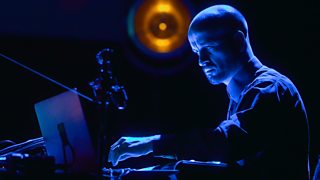
He says: “There’s definitely a place for innovation within dance music but it seems to have quite carefully prescribed borders. For example, you might turn up to a club where the crowd’s really hyped up from the guy playing techno before you, and it’s four in the morning and everyone’s having a good time, and if you come on and start to play really out-there stuff with funny time signatures or really unpleasant noises or strong political messages, you’re going to get bottles thrown at you.
“So the innovation has to be within certain parameters instead - it tends to be in a fixed time signature, fixed much more to a grid and then experimenting within that grid. The ambition is always to seduce people to listen to something different, or to give a different perspective to something.”
He adds: “I do feel like a lot of art in general has become quite complacent. There’s less of a sense of being part of a political struggle and it’s much more about the expression of an individual position, which is normally fairly introspective. Both art and music - and almost everything in our society, in fact - has come to reflect the predominant ideology, which is one of prioritising the self over the community.
“Naomi Klein was recently talking about her new book, This Changes Everything, and said that the only thing we have to do to change the planet forever with catastrophic consequences is to do nothing; for the status quo to remain as it is.
“So in fact the status quo becomes an incredibly dangerous position to sustain. I feel that’s part of our challenge as music and artists, to unpick that status quo, to try and present it in different ways. There’s a bigger issue at hand than just our individual perspectives.”
Keys to success
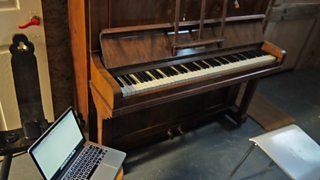
Matthew Herbert's hunt for an authentic 1913 instrument to use for the soundtrack led him to Llanelli, South Wales, where he found an antique piano for sale which had originally been custom made for Welsh composer Tydain Williams. The instrument - which features a walnut casing inlaid with a patterned wood effect and mother of pearl - was then transported to Herbert's Kent studio where it became the sole sound source for the score.
Watch the film
![]()
A Message from Mars
The 1913 feature brought back to life by the BFI's experts
More on sci-fi and music
![]()
Fritz Lang and Jeff Mills
The Detroit techno star's take on silent sci-fi
![]()
Space-age symphonies
BBC Radio 3's Matthew Sweet on the music of sci-fi film
![]()
Science Fiction Season
Journey into the universe of sci-fi across the BBC