Di 11 spacewalks wey make history
Wia dis foto come from, NASA
- Author, Richard Gray
- Role, BBC Future
- Published
- Read am in 13 mins
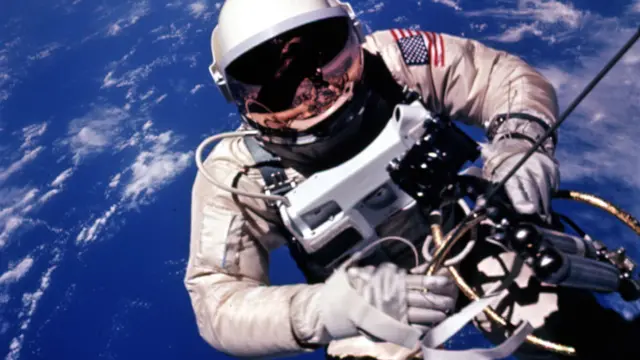
Billionaire Jared Isaacman don make history on SpaceX Polaris Dawn mission as e complete di first privately-funded spacewalk.
Di 12 minutes e spend outside SpaceX Dragon capsule go go down as one key milestone for commercial spaceflight.
Isaacman and SpaceX engineer Sarah Gillis wey wear one specially adapted spacesuits bin take turns to float outside of di spacecraft for orbit altitude of around 434 miles (700km).
Di two of dem bin carry out tests on di flexibility of di suits dem wear wey dey equipped wit helmet displays and helmet-mounted cameras.
As Isaacman comot di Dragon capsule hatch, im first impression of di view na say "from here, Earth sure look like a perfect world".
Both im and Gillis spacewalks dey smooth, but e no dey not without dia risks.
Unlike oda modern spacecraft, di Crew Dragon no get airlock, so dem gatz depressurise di entire capsule bifor di two of dem fit comot. Dis one mean say di remaining crew wey dey inside also dey exposed to di near vacuum of space, and so all of dem gatz wear di new spacesuits.
Now dem don successfully complete di mission, di spacewalk join a long list of iconic and memorable moments wen astronauts don brace di outside of dia spaceships wit little more dan few layers of fabric between dem and di expanse of space.
From say dem trap inside one airlock to nearly drowning inside dia own spacesuit, plenty drama don happun during di long history of extravehicular activities (EVAs), as dem dey call spacewalks before-before.
Here na some of di most notable wey don take place since di Soviet cosmonaut Alexei Leonov become di first human to "walk" in space almost 60 years ago.
Di first spacewalk
Wia dis foto come from, Getty Images
For di height of di Space Race during di Cold War, di Soviet Union bin don already beat di United States to a number of key milestones.
Di USSR bin put di first satellite into orbit wit Sputnik 1, di first mammal into orbit and den for 1961, di first human.
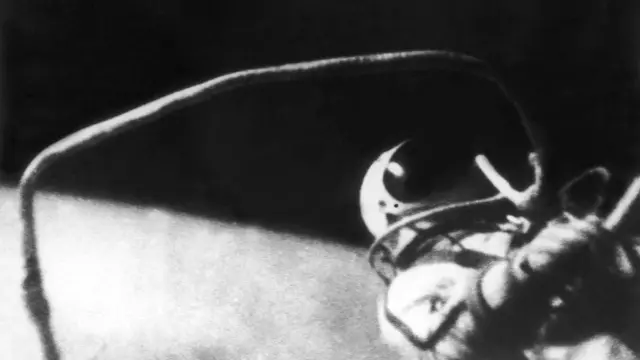
On 18 March 1965, di USSR bin achieve anoda space first – as dem send di first human outside of one spacecraft to "walk" for space.
As e comot di Voskhod 2 through one expandable airlock wey dem put for outside di spacecraft hatch, cosmonaut Alexei Leonov spend 12 minutes outside, attached via one umbilical cord.
But dis first ever extravehicular activity no completely go according to plan. Di spacesuit wey Leonov bin dey wear become stiff wen pressurised for di near vacuum of space, e become hard for am to move or take pictures.
Di cord wey connect am to di Voskhod 2 bin also twist, and e send am into a tumble wey make am hard to renter di airlock.
To get inside, Leonov gatz open di valves on di spacesuit to reduce di pressure so e go fit move enough to squeeze inside and shut di hatch.
Di adventure bin dey very tiring di time dem examine im spacesuit for Earth, e contain several litres of im sweat.
Di first American spacewalk
Wia dis foto come from, NASA
E go take more dan two months bifor di first American go fit step outside di relative safety of dia spacecraft into di vastness of space.
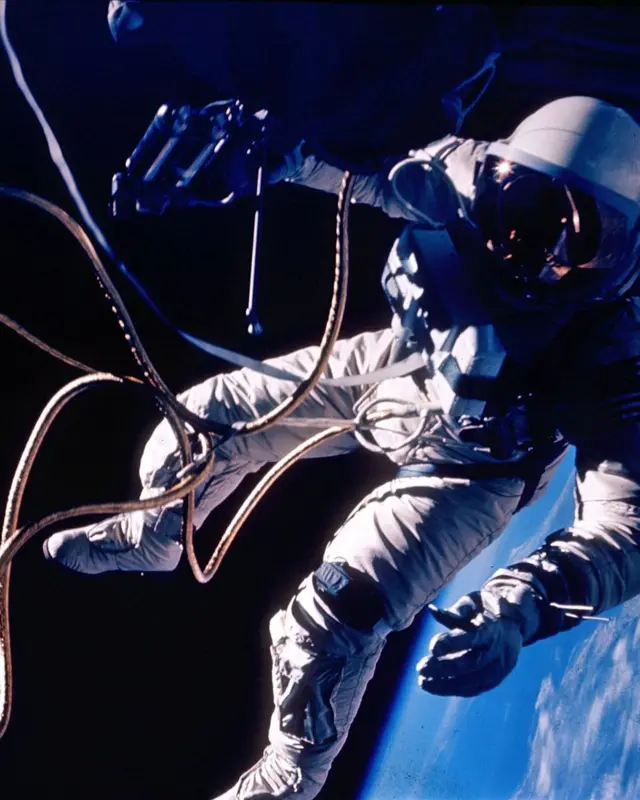
On 3 June 1965, Ed White bin open di hatch of di Gemini 4 spacecraft as e make di third orbit around di Earth.
Using one hand-held oxygen-jet gun, e manoeuvre imsef out of di capsule just as di spacecraft bin dey pass ova Hawaii. E spend 23 minutes outside, for di end of one eight metre (26ft) long tether.
At first, e manoeuvre himself back and forth to di spacecraft three times wit di jet gun, but fuel finish afta three minutes, so White bin dey forced to move around by tugging on di tether.
White go tragically die just under two years later wit two oda astronauts inside one fire wey sweep through di Apollo 1 spacecraft during one test on di launchpad.
The first space 'selfie'
Wia dis foto come from, NASA
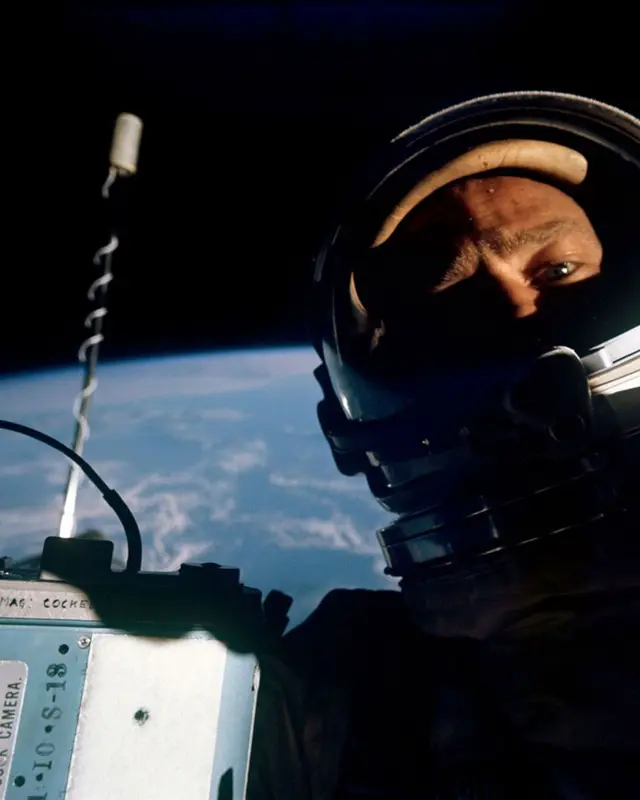
Edwin "Buzz" Aldrin fit dey beta known for anoda walk e take as di second human to set foot on anoda world during di Apollo 11 mission to di Moon. But e also dey responsible for wetin possibly be di first "selfie" taken during a spacewalk.
During di four-day Gemini XII mission for November 1966, e perform a number of spacewalks to photograph stars, test equipment and perform experiments. Bifor launching, Aldrin become di first astronaut to use neutral buoyancy training inside one swimming pool to prepare for these spacewalks.
Na dis preparation, e later claim say, help am overcome many of di manoeuvring problems wey e bin encounter during previous spacewalks. In total e clock up five hours 48 minutes of spacewalking, a record at di time.
Na just bifor di end of im first spacewalk on di second day of di mission wey Aldrin bin mount one camera on di edge of di hatch into di Gemini spacecraft and point am towards himself.
Di resulting "selfie" show one of im eyes and im forehead inside im helmet, wit di blue curve of di Earth ova im shoulder.
Free and alone
Wia dis foto come from, NASA
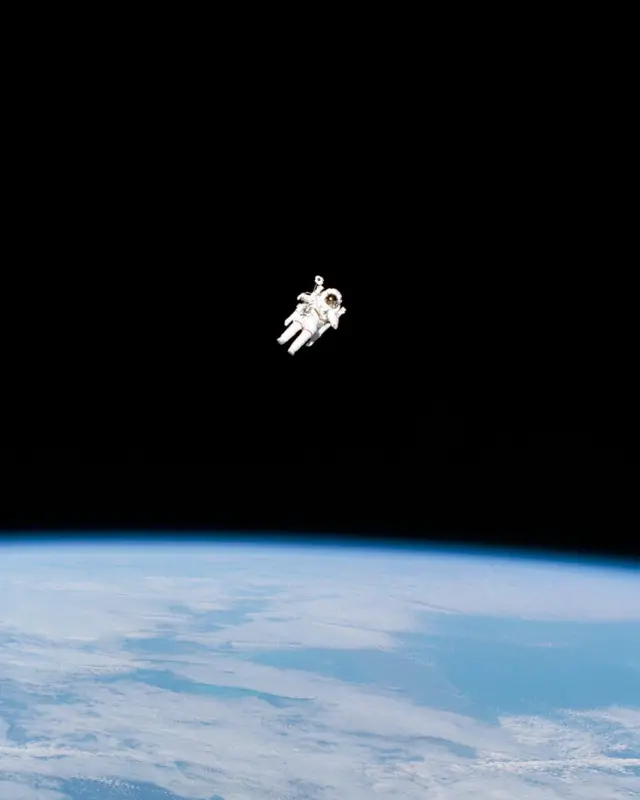
Astronauts don dey bravely step outside dia spacecraft for nearly 20 years by di time Bruce McCandless II bin perform im pioneering spacewalk for 1984.
In di past, astronauts and cosmonauts dey attach tether to dia spacecraft make dem for no float off into the di vastness of space.
Di difference wit McCandless na say im no go attach im spacecraft to anytin. Anyone wey see di 2013 film Gravity, wey feature Sandra Bullock, go understand just how fearful di tin be.
Fortunately for McCandless, e carry for im back one new nitrogen-propelled device wey dem fit control wit joysticks. Di Manned Manoeuvring Unit (MMU) bin get 24 nitrogen thrusters wey allow am to remain stable and move around in space.
During di STS-41-B Space Shuttle Mission on 7 February 1984, McCandless bin fly 91m (300ft) from di shuttle as e dey test di MMU for di first time.
Di picture above show am for im maximum distance from di Space Shuttle Challenger, one lonely figure for di black of space and di curve of di Earth beneath him.
"E fit be one small step for Neil, but na very big leap for me," McCandless bin tok at di time, as e refer to di words wey Neil Armstrong tok as e take im first steps on di Moon for 1969.
Space salvage wit a sting
Wia dis foto come from, NASA
Following McCandless success wit di MMU, Nasa kon put di backpack to work.
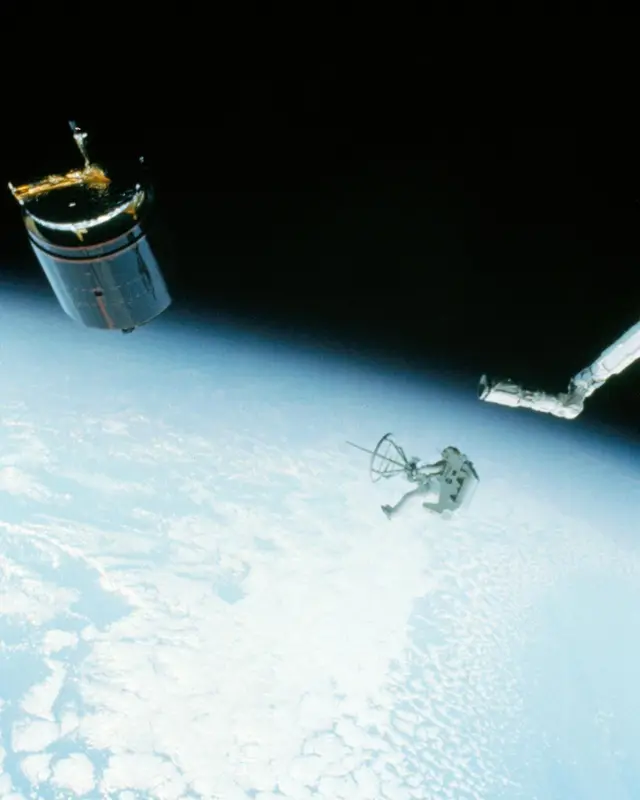
For November 1984, dem send astronauts Dale Gardner and Joseph Allen from di Space Shuttle Discovery for one mission to recover one pair of faulty satellites from orbit for di first time. Dis go be di first time salvage mission go dey performed in space.
Wit di MMU for im back, Allen leave di relative safety of di shuttle remote manipulator arm to cross di 11m (35ft) gap to di Palapa B-2 communications satellite.
Dem bin deploy am alongside di Westar VI communications satellite for one earlier shuttle mission dat same year, but di two of dem bin fail to reach di correct orbit.
Allen and Gardner work na to "sting" di slowly spinning satellites through di motor nozzle wit one docking device wey dem carry wit dem.
Na Allen go go first, e go insert di specially constructed Apogee Kick Motor Capture Device into di Palapa B-2 satellite motor.
E go kom use im MMU jets to slow di rotation of di satellite. Mission specialist Anna Fisher go den help am to manoeuvrer di failed satellite into Discovery cargo bay.
Wia dis foto come from, NASA
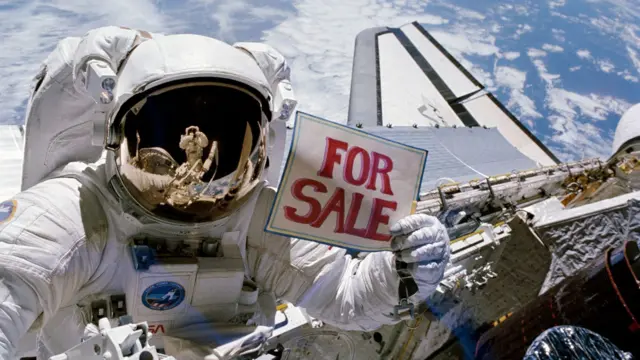
Next up na Gardner and di Westar VI, wey go undergo di same procedure. Once di two stricken satellites bin dey safely nestled for di space shuttle cargo bay, Gardner bin take one moment to pose for a cheeky photograph wey hold one "for sale" sign.
Na in reference to di scrap-yard salvage nature of di mission. Insurance companies go later resell di two satellites and dem go eventually dey refurbished and relaunched for April 1990.
Di highest repairman for di world
Wia dis foto come from, NASA
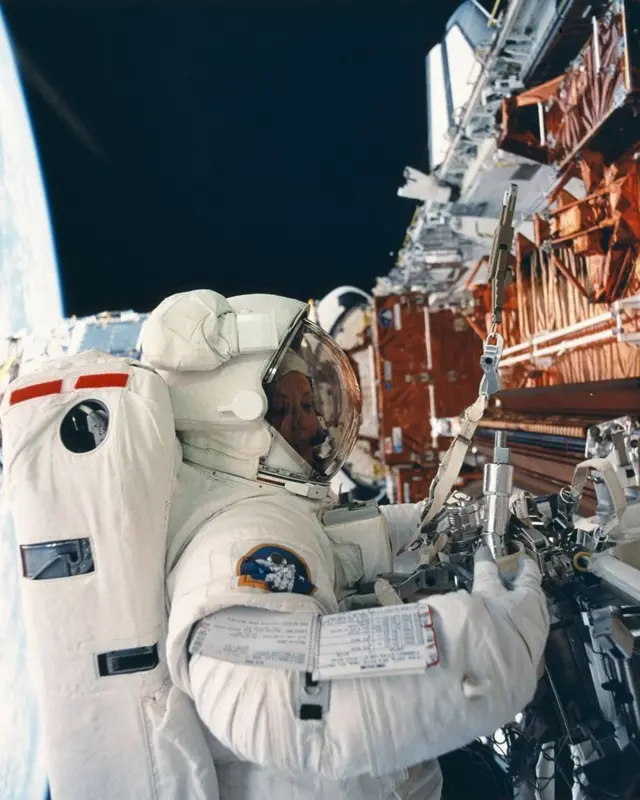
In di three years afta e dey launched into orbit for 1990, di Hubble Space Telescope don dey turn to joke.
Even though e cost more dan $1.5bn (around £1bn at di time), e dey beam back blurry images to Earth sake of one minute flaw for dia main mirror.
For December 1993, dem dispatch one team of astronauts onboard Space Shuttle mission STS-61 to carry out urgent repairs on di telescope. E go become one of di most challenging and complex missions ever attempted.
During five back-to-back spacewalks, two teams of astronauts bin spend a total of 35 hours and 28 minutes as dem dey carry out di first ever in orbit service of a space telescope.
Dem bin use di remote manipulator arm of di Space Shuttle Endeavour to position di 13m-long (43ft) Hubble above di shuttle payload bay.
Dis allow di astronauts to conduct vital hardware repairs and upgrades, wey include new solar arrays, gryroscopes and fuse plugs.
Mission specialist Kathryn Thornton set record wit di longest time spent spacewalking by a US woman during di repair mission, clocking up a total of 21 hours and 10 minutes outside of di spacecraft.
Mission specialist Tom Akers also set one EVA record, wit 29 hours and 39 minutes of spacewalking.
Di walk of friendship
Wia dis foto come from, NASA
Wit di dissolution of di Soviet Union for December 1991 plus di end of di Cold War, di years wey follow see growing cooperation in space between Russia and di US.
From 1994 to 1998, di US Space Shuttle make 10 visits to Russia Mir space station. During dat time, seven American astronauts live and worked on board Mir, accumulating nearly 1,000 days in orbit alongside dia cosmonaut colleagues.
Di fourth American to live on Mir na medical doctor and astronaut Jerry Linenger for 1997.
Im time on Mir bin dey stressful. E and five oda crew onboard bin face wetin probably be di most serious fire to occur for space afta one fire break out for di oxygen generating system.
Although e last only for few minutes, di fire bin fill di space station wit smoke and cut off access to one of di two Soyuz escape vehicles.
Later, one Russian Progress M-34 resupply ship also jam di space station during one docking attempt, wey puncture Mir hull and cause di first decompression on board an orbiting spacecraft. Dem also face di failure of several vital pieces of equipment during di mission.
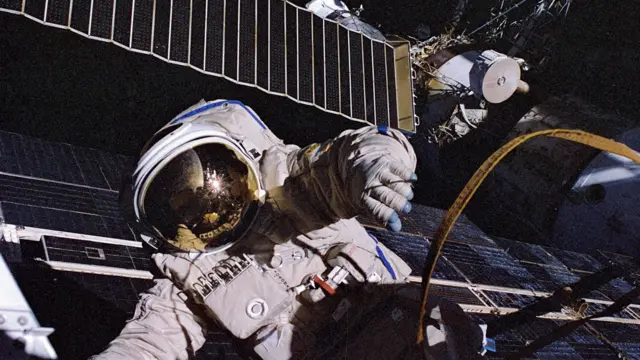
But before all dis drama, Linenger perform di first spacewalk by one US astronaut as dem wear one Russian spacesuit.
Di five-hour EVA on 29 April 1997 see Linenger and Mir-23 commander Vasily Tsibliyev as dem install scientific instruments to di outside of di space station.
Constructing a new space station
Wia dis foto come from, NASA
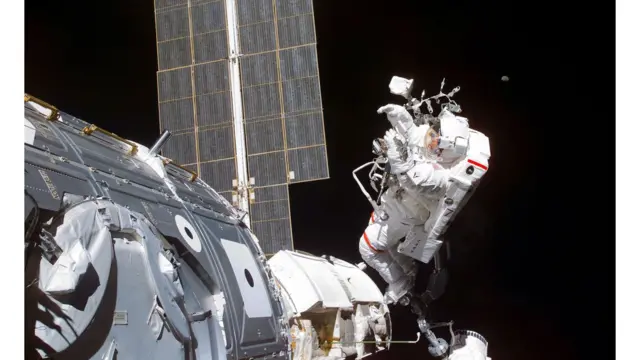
For 1998, work bin start on wetin fit be contender for di most expensive structure humans ever build – di International Space Station. Astronauts onboard di space shuttle Endeavour go undertake a 12-day mission to connect di first two modules of wetin go eventually provide a permanent human residence in space.
Di ISS of 2024 boasts 16 modules and na di same length as a football field. But in 1998, astronauts James Newman and Jerry Ross gatz perform three long spacewalks as dem use di shuttle robotic arm to capture di Zarya control module and connect am to di 12.8-tonne Unity module.
Di process bin no dey without its hitches though. As di two astronauts connect cabling and handrails, nudge stuck antennas and remove restraining pins, di two of dem lost several construction items wey drift off into space to join one growing amount of "space junk" wey now pose as a threat to satellites and spacecraft.
By 13 December 1998, however, dem finish dia work and Endeavour bin disengage dem from di fledgling ISS, wey go leave di space station free to fly.
Two years later, di ISS go become permanently occupied, wey go enable a constant human presence for orbit ever since.
A spacewalking record
Wia dis foto come from, NASA
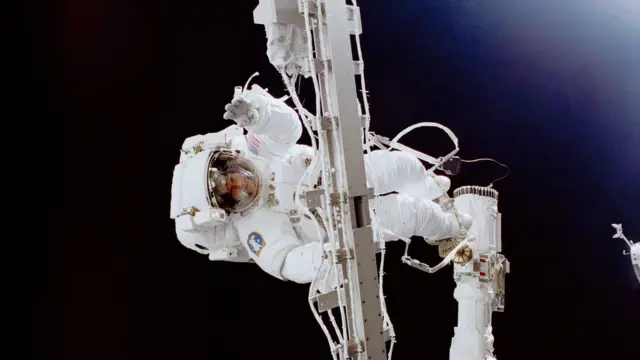
One eight-hour working day feel like long time even wit your feet planted firmly on solid Earth. So how US astronaut Susan Helms go feel afta performing di longest ever spacewalk for history for March 2001, spending eight hours and 56 minutes outside di ISS.
She and her fellow astronaut James Voss bin dey tasked wit installing hardware to di outside of one laboratory module on di ISS, wen dem make dia epic spacewalk. Dia record still stand today.
Under di space shuttle
Wia dis foto come from, NASA
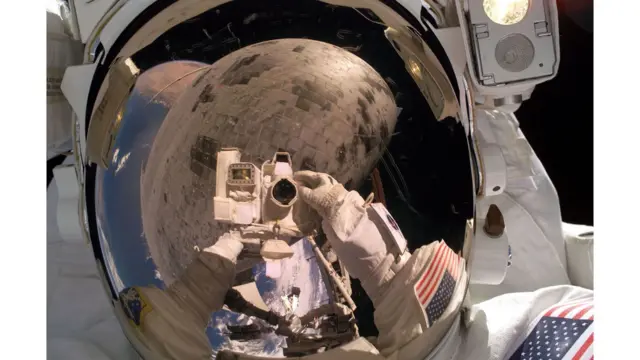
Di flight of space shuttle Discovery on mission STS-114 for July 2005 na di first launch of di space shuttle since di tragic loss of di shuttle Columbia for 2003, wia all seven on board bin die as e disintegrate on re-entry.
Nasa bin spend nearly three years as dem dey try to improve di safety of di shuttle and dem particularly focus on di craft protective tiles wey dey intended to keep am safe from di extreme temperatures e dey regenerate as e dey re-enter di atmosphere.
Di launch of Discovery na serious one. Dem cancel di first attempt afta one fuel sensor fail during di countdown.
Wen e finally comot di launchpad, imagery show one piece of foam wey dey comot from di external fuel tank as well as smaller pieces of tile, as e raise concerns say di heat shield of di shuttle fit don spoil.
Upon arrival for di ISS, dem send astronaut Stephen Robinson to assess di situation, inching his way along di grey, thermal-protection tiles.
Using im fingers, e pull two protruding gap-fillers out from between two of di heat-shield tiles. Dis na di first repair of a spacecraft while in orbit bifor e dey due to return to Earth.
Di work bin pay off – di shuttle bin land safely for Edwards Airforce Base for California on 9 August 2005.
A near drowning in space
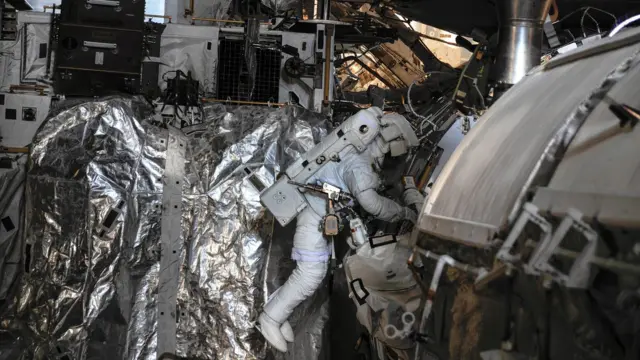
Na routine EVA e suppose be. Six hours outside di International Space Station dey prepare cables for di arrival of one new Russian research module.
But as Italian astronaut Luca Parmitano work on di task, he notice something wey go mark di start of one of di most serious accidents for spacewalking history – water dey gada for di back of im helmet.
Na about 44 minutes into di EVA on 16 July 2013 wen Parmitano bin calmly report say I dey feel "a lot of water for di back of my head".
Unable to identify di source, e continue to dey work on im cable routing task. On di off chance e dey come from one drink bag inside im suit, e drink am dry.
But di water continue to dey increase in quantity, and e dey affect im communications cap. Just ova an hour into di spacewalk, Mission Control decide to cancel di spacewalk, and dem order Parmitano and fellow spacewalker astronaut Chris Cassidy to go back di airlock.
But as Parmitano move, di water shift, and cover im vision wey force am to ask Cassidy for help finding im way back to di airlock.
Cassidy, wey dey secure for anoda part of di space station, gatz take different path back.
For di near-zero gravity environment of orbit, di blob of water for di back of Parmitano head bin don shift as e turn towards di airlock. Now e cover im eyes, ears and nose.
As di water dey interrupt im communications systems and dey block im ears, e struggle to alert Cassidy and Mission Control to im growing distress.
"At a certain level of subconsciousness, I dey afraid," e later tell BBC World Service. "We dey trained to control dat fear or use dat fear and divert am somewhere else. Instead of to focus on di problem – which was I dey alone, I no fit see, I no fit hear, dem no fit hear me and I fit drown wit di next gulp of air – I start to dey tink of solutions."
Wia dis foto come from, NASA
Once e dey inside di airlock, Parmitano bin face one agonising five-minute wait for Cassidy to arrive. E go take 10 minutes to lock di hatch and anoda 13 minutes before dem go fit repressurise di airlock and remove Parmitano helmet.
Dem see say an estimated 1.5 litres (2.6 pints) of water don fill im helmet as e dey inside am.
One investigation go later identify a blockage for Parmitano fan pump separator wey lead to water spilling from di cooling loop inside di ventilation loop and then into di helmet.
Engineers go later add one absorption pad to di helmets of spacesuits and one snorkel to help astronauts deal wit water leak incase e happun.
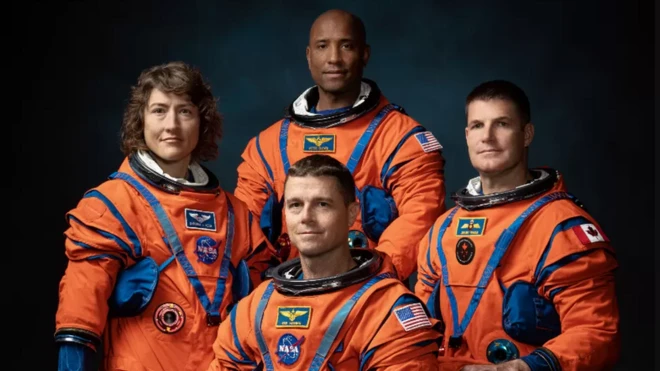
As Nasa now look to di next stage of space exploration wit dia Artemis programme, di lessons wey Parmitano and di brave spacewalkers wey come before and after am go learn go help dem inform dia decisions.
To date, only around 260 pipo don get di privilege to "walk" in space – barely enof to fill all di seats on one single London Underground train.
As dat list grow, di adventure too go grow.