Please note: The Kirklees Park Estate is private property and prior permission must be sought in writing before making any visit. The author would like to thank the Kirklees Estate Staff for help in constructing this article : David Hepworth, Ray and Lynne Wilde.
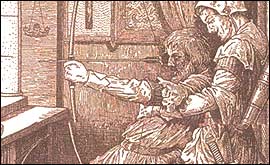
"Bury me where my arrow falls..." are traditionally Robin Hood's last words to Little John before dying in one of the rooms of the Gatehouse of Kirklees Priory.
The tale The tale of Robin Hood's death is one of betrayal and mystery.
Robin had been ill and went to the Priory because the Prioress was famed for her medicinal skills.
Because the Prioress was a relative he was put up in the Gate House of Kirkless Priory.
His friend Little John was probably a quarter of a mile away in the Priory Guest House.
The medieval form of blood transfusion involved blood letting to get rid of the bad blood (don't try this at home!).
The blood collects in a bowl and once the bowl is full the wound is sealed. However, the Prioress had made a hole in the bowl so Robin Hood didn't notice how much blood was actually draining from his body.
Just why she wanted Robin dead remains a mystery.
When he was sufficiently weak the Prioress called for an accomplice to finish the job and put Robin to a sword.
However, Robin managed to kill the accomplice and call Little John on his horn.
The damage had been done though - Robin had already lost too much blood - he asked for Little John to fetch him his long bow so that he could fire one last arrow out of the Gate House window uttering the words... "Bury me where my arrow falls."
Common beliefs The present monument to the south-east bearing the name Robin Hoods Grave where the outlaw is traditionally held to be resting in peace lies 650 metres from where it is traditionally held the last arrow was shot by Robin Hood - between two and three times the maximum distance held by reconstructed modern medieval archers that an actual medieval archer within the time-slot above could have shot over with an arrow.
It was noted by the author that the distance at Kirklees between the present Robin Hoods Grave from where the arrow was traditionally shot was exactly double the length of the famous shot mentioned in the old ballad Robin Hood and Guy of Gisborne.
What would Robin Hood or Little John have seen looking out of the upper east-facing windows of the old Kirklees Priory Gatehouse when preparing to loose a final arrow? The answer - of course - is Kirklees Priory.
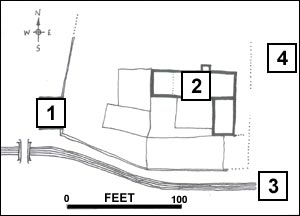
Looking out of the upper storey windows of the Priory Gatehouse last year I tried to imagine the Priory in front of me using a survey drawn up after modern excavations, pictures, photographs and period illustrations of what religious houses such as Kirklees Priory looked like.
Could a simulation or a reproduction of Robin Hoods last arrow be possible? On my last visit to the Gatehouse I borrowed a short plant-stick from the nearby barn about the length of an arrow and rather like a magicians wand used it to note a few measurements for a proposed future experiment.
So; what does the reconstruction prove? The reader is perhaps thinking by now Ive gone to a lot of trouble and an awful long way around to prove what was already well known before I started; an English medieval arrow cannot be shot from an English medieval bow over a range of over 600 metres.
Finding the man who actually said Bury me where my arrow falls was always far beyond the scope of my experiment - but during estate improvement work in the mid-18th Century human bones from an unmarked grave were removed from the area of the old Priory burial grounds; knowledge of the whereabouts of these remains has been lost.
Human remains But - the unknown human remains in the forgotten grave would have been exactly where my experimental arrows shot from the Gate House dropped if plotted on the map of old Kirklees Priory.
A sketch-map by the author of Kirklees Priory, AD 1250-1350: 1.Gate House, 2.Church, 3.The Nun Brook, 4.Site today of The Prioress Grave
This article is abbreviated from the chapter Kirklees - A Grave Mistake? in the book On The Outlaw Trail Again! by Richard Rutherford Moore. Read a more detailed article of Bury me where my arrow falls.