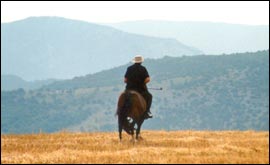
|  | Local man Richard Rutherford-Moore has ridden a horse down the actual ‘Valley of Death’ along the route taken by the Charge of the Light Brigade in October 1854 becoming the first Englishman to do so since the end of the Crimean War in 1856.
The Nottinghamshire author, historian and battlefield tour guide has a special association with the Balaklava area in the south-west Crimean Peninsula and was engaged as both historical and filming location guide and battlefield interpreter on this particular project. 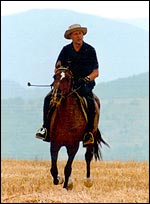 | | Richard Rutherford-Moore |
It formed an episode of a new television series named Battlefield Detectives; exploring the sites of past conflicts and using traditional archaeology in association with cutting-edge technology techniques in an attempt to re-interpret and re-discover past events.
Richards knowledge of the topography, the people, the history, period, tactics and weapons and the inherent hazards of traversing the Crimea have been established through over a 120 visits to the Balaklava battlefield since 1991.
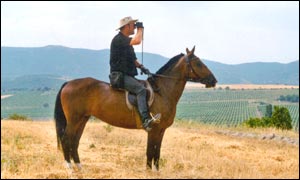 | | Richard Rutherford-Moore with the Charge Valley in the background |
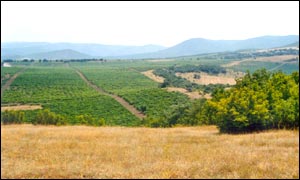 | | The Russian attack route |
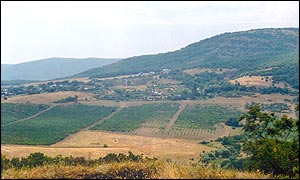 | | Kamara Heights : Where the battle began |
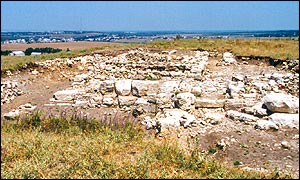 | | Bezzymanya - Remains of a Turkish redoubt |
--- Richard explains the background to the Crimean War of 1854-56, his past experiences in the Crimea and the television project.
Do you find that people are generally interested in military history?
War makes rattling good History
I cant remember who said this often-used quote but its certainly true ; I do social, political and economic history too but the military aspect is the most popular. I speak about it from the perspective of a common soldier as few people without personal experience have the ability to read between the lines and realise what a terrible thing warfare really is. Some people in Nottingham outside any interest in military history may have heard of the Crimea or the city of Sevastopol through the two Russian cannons in the Arboretum, but even if they dont know where it actually happened in the world everyone has heard of The Charge of the Light Brigade. A local man rode in it - I seem to recall his name was Morley - and although it isnt certain if the bugle-call Charge was ever blown by a trooper on the day, but if it was blown on the day the bugle that probably blew it is presently in the Lancers Regimental Museum in Belvoir Castle, not far from Nottingham. I first went out to Balaklava in the Crimea whilst working in nearby Yalta in August 1991 totally on the spur of the moment and all alone. I wasnt aware at the time that it would raise so many questions that it would be followed by over a hundred more visits over a ten-year period. I took the first of my tours out that same year and ever since. The old nickname Lawrence of the Crimea given to me has since been dropped but it summed up a little of what it was initially like for me out there.
In addition to great natural beauty, the spot has seen action over a long historical period. Since Hellenistic times, waves of invaders have appeared and fighting ensued.
I dont know in as much detail the conflicts that took place here pre-18th Century; early settlers usually made their homes along the coast but later invaders including the Mongols came into the Crimea across the Perekop isthmus and drove in by land. In the 14th Century the Genoese first created defensive works in stone at Balaklava - then called Chembalo - around the harbour to defend their trading post. But just around the coast going west from there the Romans built a castle on the earlier Greek walls at a city-site named Hersonesse, a famous spot now known as the new Pompeii for the relics found there through archaeology. The Crimea was occupied by the Turks in the 18th Century - who gave Balaklava its present-day name - when Catherine the Great sent General Kutusov and Admiral Suvarov down there in 1770 to clear them out ; which they duly did in a short but bloody campaign. The year 1780 marked the beginnings of the great city of Sevastopol based around the enormous natural harbour, which by 1800 was a powerful base for the newly-created Russian Black Sea Fleet.
Russia and Turkey were still at war intermittently through the first part of the 19th Century. By 1854, the Ottoman Empire was collapsing and Russia saw an opportunity to gain the passage of the Bosphorus at Constantinople - modern Istanbul - and release the Black Sea Fleet to explore and create new trading areas in the Meditteranean. Britain allied with France opposed this expansionist move ; when the Black Sea Fleet surprised and sank the Turkish fleet anchored at Sinope Bay and then sent troops across the Danube the Allies declared war on Russia.
Europe had been at peace since Waterloo in 1815. The horrors of war had been largely forgotten and when public opinion clamoured for revenge, the British Government moved. By the time the Allied expeditionary force had been made ready, the Russians had retreated back to their own territory after failing in Silistria. But - having gone to all that trouble and expense, the British army had to be sent somewhere to teach the Russians a lesson and the decision was made at a rather sleepy British Government cabinet meeting to capture Sevastopol and destroy it. The initial problem was that most of the soldiers didnt know where the Crimea was, let alone Sevastopol !
The Allies - Britain, France and Turkey - planned the operation and landed in the Crimea in September 1854. Although victorious at a heavy price against the Russian army at the Battle of the River Alma, through bad staff work the Allies failed to capture an undefended Sevastopol and in moving east and then south around the city to Balaklava, gave the Russians just enough time to create stout perimeter defences that would then take the Allies over a year to break through and get into the city. Richard has explored the Sevastopol area thoroughly many times and in 1998 after a ground-breaking tour The Crimean War Research Society named Richard as their recommended guide to the Crimean War sites of 1854-55.
The areas fought over in 1854 and 1855 are indifferently mapped today so I tended to use period maps ; these maps sometimes have a few understandable glitches which you find out when using them to get around. My first overall explorations were by jeep - which got nicknamed Enterprise through Boldly going where No-one had been Before - then detailed these journeys on foot, followed by a few longer explorations overnight on horseback to get further and faster into and around large areas wholly unsuitable for vehicles.
As the siege of Sevastopol developed, the Russians attempted to break through the weak Allied back door and destroy the only British supply base in the Crimea - in Balaklava harbour.
Had the Russian October 1854 attack succeeded in full, the British army would have virtually had its throat cut. Everything the British soldiers ate and drank, every boot and shoe, every shell and every bullet they used came off the transports ships at Balaklava. As it was, the Russians achieved enough of a victory to make the 1854 winter absolutely miserable for the British soldiers ; as a result these men died in their hundreds.
The Battle of Balaklava is remembered mostly through The Charge of the Light Brigade immortalised by Lord Tennysons poem. The television program will show how the battle was a series of separate actions surrounded afterwards by denials, arguments and misunderstandings which evolved into a confusing story for years combining both myth and legend.
To get at the truth there is no better way than to explore the actual ground and take the battle apart little by little and hour by hour. Some parts are easy to examine ; but others certainly arent. You need to look at the ground from as many angles as possible with the eyes of gunners, troopers, the infantry and the field commanders of both Allies and Russian. The only enemies you have out there now are Time and Bad Weather.
The Turks defending the Causeway Heights redoubts are supposed to have run away at the first sign of the advancing Russians. This was a period view which was begun by a false press report and is not one supported by written evidence.
The isolated, inexperienced, starving and thirsty Turkish troops in Redoubt Number One held out under heavy artillery fire for an hour and then stood against the first Russian infantry attack. Had they not done so, the Russians may have captured Balaklava early in the day. It was the first battle they have ever been in but they got no credit from anyone for sticking it out as they did and instead were slandered afterwards and made into scapegoats by getting a virtual death sentence.
The British Heavy Cavalry Brigade later made a successful charge against the odds and pushed back the Russian cavalry ; a single British infantry regiment supported by Turkish troops also prevented a Russian cavalry force reaching Balaklava itself.
The British Heavy Cavalry exploit against a numerous enemy and the Highlanders stand in what became known as the thin red streak tipped with steel restored the balance of power on the battlefield and deserve to be remembered better than they are ; but both of these events were completely eclipsed by what happened next.
As the Russians withdrew to consolidate their gains, a series of misunderstandings led to an under-strength cavalry brigade of 670 troopers comprising the British Light Brigade of Cavalry being sent unsupported down a two-mile long valley against a Russian artillery battery and a cavalry force heavily outnumbering them and running a terrible close-range gauntlet of artillery and rifle fire from both sides to reach it.
Only the initial surprise of the Light Brigades move saved them from being even more heavily engaged on the way down the North Valley towards the Russian guns. They reached the gun battery after taking heavy casualties and then should have been annihilated by the Russians ; the gun battery itself was a 40 foot long roadblock that couldnt be jumped by a horse with only a two-metre gap between each of the eight guns - unlike the horses jumping over the guns in the Errol Flynn film about the Charge and in addition to the casualties taken, the battery itself must have disordered the poor tired horses and troopers of the 17th Lancers and the 13th Light Dragoons terribly. But like all other Russian battle plans of 1854 and 1855, things went horribly wrong in the execution of them and the survivors of the Light Brigade were allowed to escape back the way they came. A combination of French initiative and Russian ineptitude let the Light Brigade get away. The Russians initially thought the Light Brigade troopers to be drunk on army rum to do what they did and were amazed to find them all absolutely sober.
However, the Light Brigade of cavalry was essentially destroyed as a fighting force. The recriminations that followed the charge still echo today.
The five regiments making up the cavalry brigade were actually less in trooper numbers than a regiment at home in England at the time. They lost under 120 men on October 26th - around a fifth of those who chaged, or 20% - but lost so many horses that the formation was judged militarily useless a short time later and sent to help the over-worked transport department. After the battle at Inkerman, the surviving horses of the Light Brigade broke their backs and hearts hauling badly-needed supplies from Balaklava up a terribly bad road in increasingly awful weather ; as a result of this single road and the lack of transport British soldiers died in their hundreds in the 1854-55 winter. But - its not fair to judge the actions of individuals over a hundred and fifty years ago using the military parameters of the early 21st Century. Although the Russians won the battle, the British and French at the time would not admit on top of admitting the loss of The Light Brigade that the Russians had won ; it may come as a surprise to many but viewers will see from the television program it certainly wasnt a British victory as claimed in the past. The last author who wrote about the Charge of the Light Brigade after seeing the actual Balaklava battlefield was Prime Minister Winston Churchill back in 1945 when he was given permission to visit the place by Josef Stalin after the Yalta Conference. Since then there have been other books on the battle of Balaklava - but no site visits by the authors prior to writing about it, hence the many errors.
During the television program amongst the other practical aspects, Richard shows how the visibility on the battlefield affected the way orders were given on October 25th 1854.
The commander in chief saw quite a different battlefield from the one the field commanders were looking at simultaneously. Lord Raglan was over a hundred and fifty feet higher than the troops on the ground ; Lord Lucan and The Earl of Cardigan, the infantry commanders and the British and French troops on the ground by comparison could see relatively nothing of the enemy. It took an average of between fifteen to thirty minutes for an order to be first written and then delivered, and after delivery perhaps another ten to fifteen minutes to get the troops ready to carry it out. On the whole, the British field commanders stood in the worst places possible to see the enemy and only the gunners from both sides appeared to be in the right place at the right time.
The program also looks at sites and relics remaining from the battle. Richards expertise came in very useful in the briefing given to the Science Team on the program before their arrival in the Crimea.
Before the arrival of illegal metal-detectors in 1994, I saw 1854-55 relics in the form of badges, bullets and buttons everywhere. But the first thing to be aware of before you walk the ground, touch or pick up anything is the amount of unexploded and unfired ammunition, shells and bombs left over from World War Two. Two enormous conflicts took place in 1942 and 1944 over the same ground - over ten tons of high explosive was dropped or fired for every square meter of ground around Sevastopol between 1942 and 1944. The vineyards at Balaklava are filled with shell splinters, bullets and cartridge cases but they also hold live explosives in unexploded bombs and shells and unfired cartridges. Using my map, just here is a Russian 105mm artillery shell and here a German 88mm artillery shell. Two unexploded mortar bombs are just here, and an unexploded 150 pound bomb lies just under the surface, right there
when the grass on a sunny bank burned off in the terrific summer heat of 1992, a hidden unexploded bomb blew up ; luckily, there was no-one around at the time. Im a trained armourer and for awareness sake I collected and blew up some battlefield munitions prior to filming to prove to the film crew these things were around and still very dangerous. A far more deadly example occurred back in 1955 when a Russian cruiser named Novorrossk was sunk entering Sevastopol harbour by a left-over unswept German mine with the loss of over a thousand Russian seamens lives.
The Balaklava vineyards also enclose more grisly remains of these conflicts. Richard has been involved in some unpleasant scenes in the past with illegal treasure-hunters. Richard showed me for an example photographs of one grave he discovered in the Crimea and during an on-site examination gave an impromptu interpretation, some details of the actual man himself and a graphic and atmospheric account of the soldiers probable death.
Whenever you walk anywhere here, you must remember what might lie just beneath your feet. A soldier was found by archaeologists 250 metres away from this particular spot ; the man died from a piece of shrapnel which visibly passed right through his skull and although not visibly wearing any identification tag could be identified through the remains of his paybook, an army postcard and an unfinished letter found beneath him ; he was a German soldier, killed in action in mid-1944. The German soldier in the photograph here was probably killed just here during the latter part of an eight-hour Russian assault on March 7th 1944 which came in from over there. From the scars on his bones - which are all present - he appears to have been killed or mortally wounded by splinters from a fragmentation grenade or a bomb ; he is lying on his stomach in the bottom of a shell crater or scrape with a few stones piled up in front here, with the immediate area surrounded by hundreds of spent rounds from an MG34 or MG42 machine gun, some German Kar-98 rifles, a few from Soviet Moisin-Nagant rifles and a handful of sub-machine gun rounds from a Soviet PPSH. Only eight inches of thin topsoil covered the body - when this man was found, he was wearing his identity tag, his belt buckle and webbing - that might be the remains of his pistol holster - a few white metal pebble-dashed buttons remain - this is one of the buttons - but no helmet ; he wore a beautifully crafted and engraved home-made brass ring on his left ring-finger and had a KRIM campaign badge on his left sleeve. Part of his uniform cloth can be seen ; fragments of a dark green leaf-pattern camouflage smock and what remains of a pair of lace-up leather boots. The open ground in front favours a defence against an advance on foot uphill by enemy foot-soldiers as the Soviet tanks couldnt get up there ; three men made up a machine-gun team and if this soldier was the actual machine-gunner he had a wide field of fire with a range of over one thousand metres ; he used up lots of belt-fed ammunition and he probably caused a great deal of trouble to the enemy before being hit. Heres his identity tag : still in one piece and not with half of it removed as was the practice in burial ; from that I can find out his name and his military record. It turned out he was trained as a Gebirgsjager (a Mountain Trooper) and his unit was posted from the island of Crete where he had been serving since May 1941 to the Crimea in mid-1942 to participate in anti-partizan operations in The White Mountains. But - I dont think this was a grave ; I think this particular soldier was dead when his position was finally over-run by the enemy, the weapons removed and his body later hidden or partly-buried by the explosion nearby of a heavy bomb or shell ; perhaps that large crater just over there. The remaining bits and pieces found here went into store with the archaeologists and the cartridge cases dispersed over a wide area to prevent looting by anyone using an illegal metal-detector. I left this soldier where he lay with the nearest thing to an Edelweiss I could find up there in that wild, lonely and windswept but very beautiful and evocative spot. Although he is over a thousand miles from home, there are worse places to spend eternity and I remember this man every time Im up there.
Richard told me that German archaeologists worked here before the Second World War seeking and finding evidence of a Teutonic or Aryan ancestry which was later included in Nazi doctrines and influenced their military strategy in 1941. The archaeologists returned in 1942-3 during the occupation.
At first the German invasion of the Ukraine was welcomed as a liberation from the Soviet regime as Josef Stalin had liquidated most of the leaders of the Crimea and suppressed the Ukrainian culture - many older Crimean inhabitants remembered the more liberal German occupation in 1918 during The Great War. The German general and future Field-Marshal Von Manstein conducting the siege of Sevastopol in 1941-2 had his headquarters ten miles away from here in the El Burun mountain and due to the heavy losses his troops incurred fighting against the stubborn Russian defence at Sevastopol the Germans used for the only time in World War Two both chemical weapons and gas. After the fall of Sevastopol, Adolf Hitler made plans in 1943 to remove along with exterminating the Jews the indigenous Russian and Tartar population from the Crimea during the war and then re-populate what was seen by the Nazis as an ancient and historic German homeland solely with Germans, renaming it Gothland. These plans came to nothing as the Red Army swept westwards in 1944, but by that time SS Einstazgruppe D had purged the Crimea - by using firing squads and transportation - of over 130,000 civilians. Sevastopol was finally liberated in May-April 1944 and over 200,000 Germans became prisoners, many of whom never returned from captivity after the end of the war. Its still a very touchy subject with the older generation in the Crimea and so far Ive never heard any German archaeologist working there today voice an opinion on that topic.
Richard has his personal views on Crimean grave-sites and archaeology.
Some things here are time-capsules. Vehicles, munitions, weapons, explosives and stores were recently found here in an underground storehouse, abandoned and forgotten since 1942. After ten years I still havent got used to discovering bodies at Balaklava and other sites near there when exploring or conducting guided tours. I personally dont see an Englishman from 1854 as being any different from a Russian in 1942 or a German in 1944 - they are all soldiers who died doing their best and are entitled to that respect. Our unit excavated four sites containing human remains on the television project ; a small number from the 125,000 dead soldiers estimated to be in this area. In one small area in the North Valley, the Russians in October 1854 buried over two hundred British and Turkish casualties after the charge of the Light Brigade from the Allied battlefield loss of around 800 men. When I find a dead soldier, I treat him with respect - but Im very sorry to say Im in the minority out there in the Crimea. After illegal excavation and removal of the items that are wanted, disturbed bodies are then left unburied or even scattered. I fully understand the desires of modern archaeologists but Ive seen at times in the past a tiny fragment of pottery or metal treated with more care than the bones of a dead soldier. Its a personal thing and I dont really want to say any more about it.
Will the television program make an impact on viewers?
That I cant say as I havent actually seen the finished programme but linking military history with archaeology and adding a pinch of nostalgia seems to be a winning combination on television. I gave the director my ideas and suggestions at the time of filming but its really up to the director and the editor to put all the footage together into an interesting, entertaining and informative production that fits into a fifty-minute time-slot. I know theyve also invested in computer graphics and a bit of real-person recreation so how much of me is actually in the programme I dont know ! When I mention Crimea to most people, they think of Florence Nightingale and know little else about it ; most folk dont even know where the Crimea actually is so the production crew are perhaps up and running already with an exclusive. Although the producers have filmed in the UK in addition to location, its the very first time a film crew have actually filmed a documentary about the Charge of the Light Brigade on the battle of Balaklava by visiting the actual battlefield of 1854. Thats a very big first and I was very pleased to be asked to present it on-camera by the television company - particularly as the television producers through my presentation realised without me actually saying so that the British actually lost the battle in addition to losing The Light Brigade.
Whats the magic lantern show about?
Victorian people in Britain years after the time of the Crimean War referred to this sort of lecture or talk as a magic lantern show. I took a lot of new slides last time out in the Crimea and when Im invited to speak on this subject I offered to use these slides and a map to explain what happened at the battle of Balaklava in 1854 - and the last time I performed this particular talk I dressed in Victorian costume.
Will you be returning to the Crimea?
I dont know if any camera crew will ever film there again. On the television trip there was an average fourteen-hour outdoor filming schedule each day in 100-degree heat and necessitating carrying at least three litres of drinking water around on your person ; except for one unlucky day when a terrific thunderstorm swept in and the rain came down in bucketfuls for just under an hour. I habitually carry my outdoor survival and foul-weather gear all the time so I was reasonably comfortable - everyone else stuck out in the open had just a t-shirt and a pair of shorts and they got soaked.
Richard celebrated his ten-year anniversary by recreating one of his past explorations, riding a horse from The MacKenzie Heights via the Fedoukhine Hills to Balaklava, fifteen miles over the Crimean battlefields. Part of the ride was recreated for the television programme in 2002.
It was just one of my adventures out there in the early days but the horse-ride of 1992 made a little piece of history when I did it. I found amongst other items when walking on the Balaklava battlefield a British cavalry stirrup, a spur and a horseshoe - these gave me the idea of recreating a ride in the spirit of the original by wearing these old items. The television crew filmed my ride so could be in the programme. It was pretty atmospheric when I first rode the horse over the Fedoukine hills then down into and along The North Valley following right in the hoof-prints of The Light Brigade of Cavalry in 1854. Logistically, it wasnt an easy trip to make ten years ago but Ive learned an awful lot about operating out there since. The Earl of Cardigan - when the dust had settled on the battlefield in October 1854 - went back to his yacht in the harbour for a hot bath and a bottle of cooled champagne. I would have enjoyed something similar after my ride but I had to continue for another twelve hours so only the poor horse got a rest.
What does the future hold?
Next year - September 2004 - is the anniversary of the first battle of the war. A commemorative event with recreated soldiers is planned on the actual site and there are also plans to recreate in commemoration the Charge at Balaklava in October.
Richard Rutherford-Moore can be seen riding down the Valley of Death along the route taken by the Charge of the Light Brigade in October 1854 and presenting an episode of Battlefield Detectives on Channel Five on Wednesday, 6th August 2003. |