 | 13 November 2014 |

| |
| BBC Homepage | | |
| |||
| Contact Us | | |
Local historyYou are in: Nottingham > History > Local history > Notts treasures: Byron's body Notts treasures: Byron's bodyAfter Lord Byron died in 1824, his body was taken to Hucknall after burial was refused at Westminster Abbey. 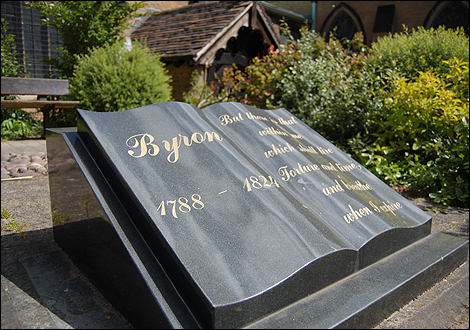 Had it not been for Byron's 'questionable morality' he would have been buried at Westminster Abbey. Help playing audio/video However, the Abbey's loss was Hucknall's gain. 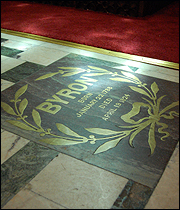 Byron plaque, near to entrance of tomb Today, if you stand in the chancel of St. Mary Magdelene Church, Hucknall, you will only be a few metres away from the body of one of Britain's greatest poets. Rock starByron has been judged in some quarters as the first modern rock star, a man who craved publicity and took part in numerous affairs and scandals. Help playing audio/video He was actually a national embarrassment and it wasn't until 1932, when John Drinkwater wrote 'The Pilgrim of Eternity', that perceptions changed. Ken Purslow from the Byron Society, says: "People started thinking differently about Byron, more positively, about what he wrote, what he did and what he stood for - he was a national hero in Greece." In fact, the Greeks would have happily accepted his body. In the chancel of St. Mary Magdelene lies a marble plaque donated by the King of Greece in recognition of Byron's heroics in his country's war of independence. 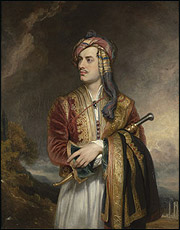 Lord Byron by Thomas Phillips © Crown copyright The conflict in which Byron lost his life. The cryptIt was always believed the plaque marked the entrance to the crypt but after repairs were carried out to the church's central heating system, it was discovered this wasn't the case. During the work Ken actually got a peek. He says, "You could see into the crypt [and] you could see the coffins." Ken says, even if he had the permission he doesn't think he would have wanted to lift the lid of Byron's coffin. However, one man who did just that was Canon Thomas Barber who visited the tomb in 1938 - over 100 years after Byron had been buried. Byron's faceHe opened the coffin with the hope of confirming whether Byron was actually in there. Ken tells us how he was identified: "It was certainly by his [clubfoot]. They also said that Byron's features were quite distinguishable and were surprised that he hadn't deteriorated more.  Ken Purslow looks up to a Byron bust "It was pretty obvious who he was." Canon Barber wrote a book about the event titled 'Byron and Where He is Buried.' He noted: "[The] almost happy expression on his face made a profound impression on me." Ken says: "We get so many people that come here from all over the world to pay homage to Byron. It certainly is a treasure." The BBC is not responsible for the content of external websites Nation's favourite poetIf you're passionate Lord Byron, you can have your say in the BBC's vote to find the Nation's Favourite Poet. The shortlist was compiled in consultation with The Poetry Society and The Arts Council. The vote will close at midday on Tuesday, 1 September 2009 and the result of the vote will be announced on the Poetry Season website on Monday, 7 September 2009. last updated: 21/05/2009 at 10:08 SEE ALSO
You are in: Nottingham > History > Local history > Notts treasures: Byron's body Treasure huntThis feature is part of our Nottinghamshire treasure hunt. Every link above takes you to 'treasure' as chosen by the county's local 'experts'.    |
| | About the BBC | Help | Terms of Use | Privacy & Cookies Policy |
