 | 13 November 2014 |

| |
| BBC Homepage | | |
| |||
| Contact Us | | |
Local historyYou are in: Nottingham > History > Local history > Notts treasures: Oldest chippy in the world 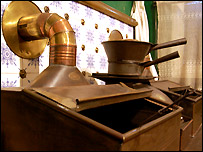 Notts treasures: Oldest chippy in the worldRuddington Village Museum is home to the world's oldest surviving fish and chip shop. Mick's Fish and Chip Shop dates back to the early 1900s. It was located in a cottage on the corner of Ruddington High Street and The Green and remained open until 1941. Forty years later it was discovered gathering dust but untouched. Help playing audio/video Ruddington's best kept secretLily and her son Mick Glazebrook were the original proprietors. When Mick died in the 1930s his eldest son Albert took over the running of the shop with his mother. In 1941 Albert was called up to join the war effort. The night before he left, mother and son cooked their last fish and chip supper and shut up shop for the duration. Albert survived and came back to live in the house but his mother had died whilst he was away. He never opened the business again. The shop was discovered on Albert's death by his sister. 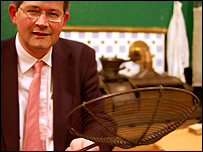 Curator Gavin Walker She had married an Italian, something a lot of women in Ruddington did in the 1940s as the village had a lot of POWs. She'd moved abroad but returned to sort out Albert's affairs. Chip shop finds new homeCurator Gavin Walker has been a volunteer at Ruddington Village Museum for over a decade. "There was a lot of press and museum interest when it was discovered. The sister was very keen to keep it in the village." It took six months of work to restore it to its original state; work which was overseen by the Industrial Museum at Wollaton Hall. The chippy is on permanent display in the museum, which explores Edwardian Ruddington through a series of reconstructed shops. "It's an interesting and important display from our point of view because it is what defined the look of the current museum." History of fish and chipsThe actual fryer dates back to 1904/05. Although fish and chip shops began life in the 1870s they didn't have any specialist equipment until this piece of equipment came along. Fish would have just been fried on ranges in big vats of fat. 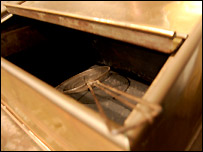 Gavin says this shop doesn't look much different from present day fish and chip shops: "The real difference was that it was coal fired. Maintaining the frying at the correct temperature was the real art in that period. "We've reconstructed the shop in very much the same space that it was in in the front room [of the cottage], which formed the shop." Price of a fish and chipsDespite being the world's oldest fish and chip shop we don't know its value. "The range is beautiful, alternating copper and brass banding and the blue and white tiles but thankfully there aren't big collectors of fish and chip shop equipment." The BBC is not responsible for the content of external websites last updated: 13/05/2009 at 17:57 SEE ALSOYou are in: Nottingham > History > Local history > Notts treasures: Oldest chippy in the world Treasure huntThis feature is part of our Nottinghamshire treasure hunt. Every link above takes you to 'treasure' as chosen by the county's local 'experts'.    |
| | About the BBC | Help | Terms of Use | Privacy & Cookies Policy |
