

Explore this turbulent period of Irish history when Londonderry took centre stage in the battle for supremacy between two Kings.





10th June 1688
Birth of James II's son alarms Protestant subjects
James II's religious views are tolerated, while he fails to produce a male heir and Mary Stuart, James' Protestant elder daughter, continues to be next in line to the throne. The birth of James' son, a Catholic heir to the throne, greatly alarms many of James' subjects.
A number of Protestant noblemen ask William of Orange, Mary's Husband, for help.



5th November 1688
William of Orange lands in England
William lands at Brixham with 5,000 horses and 15,000 soldiers and marches towards London. Many Protestant soldiers defect from the English army and William's advancing forces meet with little opposition.
As the army close in on London, support for James ebbs away and influential noblemen come out in support of William.
William's expedition is endorsed by Pope Innocent XI, who supports him as leader of the Grand Alliance, a coalition of European countries that oppose the French King Louis XIV.

23rd November 1688
Lord Mountjoy leaves Londonderry for Dublin
The Earl of Tyrconnell moves Lord Mountjoy and his regiment from Londonderry to Dublin so that the Protestant officers and men could be replaced by Catholics.
Tyrconnell orders the Earl of Antrim to send a replacement regiment to Derry.
The Earl of Antrim's men are delayed and the town is left undefended for a fortnight.

3rd December 1688
The Comber Letter is discovered
"Good My Lord, I have written to you to let you know that all our Irishmen through Ireland is sworn; that on the ninth day of this month, they are all to fall on to kill and murder man, wife, and child...".
The letter, most likely a forgery, forewarns of a massacre by the Irishmen on the 9th December. Copies of the letter are distributed throughout Ireland.
With the 1641 Rebellion still in living memory, the letter causes great fear amongst Protestants.

6th December 1688
Earl of Antrim's Redshanks army approaches Londonderry
When the Earl of Antrim's Regiment (known as 'Redshanks') reaches Newtownlimavady, Colonel Philips, a former governor of Londonderry, is worried by the intimidating appearance of its soldiers.
Already unnerved by the Comber letter, he sends a messenger to Derry to tell the citizens to shut the city's gates.
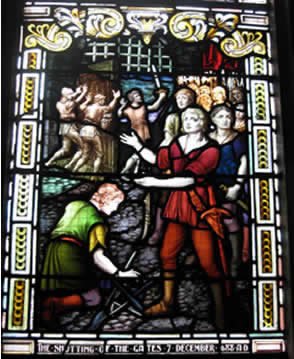
7th December 1688
The gates of Londonderry are shut
The city's elders receive a copy of the Comber letter and Colonel Phillips' warning. The eldermen and the clergy debate whether or not to close the gates. Meanwhile the Earl of Antrim's Regiment (known as 'Redshanks') appears across the river from the city and two officers are ferried across to the gates to arrange for entry of the garrison. The intimidating appearance of Redshanks, coupled with the news of the Comber letter, throws the city into panic.
Although the Anglican Bishop of Derry, Ezekiel Hopkins, wants the citizens to allow the regiment into the city, a group of thirteen apprentices take matters into their own hands and close the gates against the Redshanks.

8th December 1688
The Declaration of the Citizens of Londonderry
The elders continue to debate the situation. The Redshank officers remain inside the walls and try to take the ammunition magazine, but the Apprentice Boys seize it and arm themselves.
Finally the council draw up a declaration and expel the Catholics from the city.
"... Wherefore, we do declare and remonstrate to the world, that, as we have resolved to stand upon our guards, and defend our walls, and not to admit any Roman Catholics...".

11th December 1688
Counsellor Cairns sent to London to ask for assistance
The citizens of Londonderry send Councillor David Cairns to London to ask for assistance.
"We most humbly beseech you, ... to assist this gentleman how best you can to secure us from common danger."
When Colonel Phillips and the Earl of Antrim arrive at Derry, Colonel Phillips enters the city and becomes governor. The Redshanks army withdraw and the Earl of Antrim orders them back to Coleraine.

11th December 1688
James II attempts to flee the throne
James is unnerved by William's approaching army.
Fearing a similar fate to that of his father, he flees the palace throwing the Great Seal of the Realm into the River Thames.
He attempts to flee to France but is captured in Kent and placed under Dutch protective guard.
12th December 1688
Lord Mountjoy appears at Bishop's Gate demanding entry
Richard Talbot, the Earl of Tyrconnell, on hearing that the Earl of Antrim's regiment has been refused entry, orders Mountjoy and his army back to Londonderry. Initially, Lord Mountjoy is refused entry into town.
Negotiations for the garrison's admittance continue and end in the Articles of Agreement.
It is agreed that Mountjoy will publish a pardon within fifteen days. Until then, only two companies of Protestant soldiers are to be quartered in the city, commanded by Lieutenant-Colonel Robert Lundy.
Mountjoy instructs Lundy to take his other companies to Strabane and to remove Catholics from the ranks. Supporters of King James are now called 'Jacobites' (Jacobus is the Latin for James) and those supporting King William are called 'Williamites'.

13th December 1688
Forces are assembled in Enniskillen
The people of Enniskillen discover that the Jacobite, Sir Thomas Newcomen, is marching towards their town with two companies of infantry. A force of four hundred men is assembled.

16th December 1688
Men from Enniskillen and Jacobites clash at Lisbellaw
The men from Enniskillen, rather than wait for their town to be attacked, sally out and attack the advancing Jacobites at Lisbellaw. The Jacobites quickly disperse and flee to Cavan.

17th December 1688
James withdraws from the Palace
William orders his Blue Guards to march on London and surround St James Palace. James withdraws from the palace. William asks Tyrconnell to yield his sword of office and orders that Irish papists be arrested in London and elsewhere.
21st December 1688
Articles of Agreement are signed
Discussions between Lord Mountjoy and the citizens produce the Articles of Agreement which are signed on 21st of December. These articles state that Lord Mountjoy publishes a pardon within fifteen days, until then only two companies of men commanded by Lt-Colonel Lundy are to be admitted into the city.
It is further declared that at least half of the companies' men should be Protestant and, until 26th of March, no soldiers of the Earl of Antrim's men should be quartered in the city. On signing the Agreement, Tyrconnell orders Lord Mountjoy back to Dublin.
24th December 1688
King James flees to France
James flees to France where he is received by his cousin and ally Louis XIV. In James' absence William convenes a Convention Parliament to debate the situation. They declare that James has abdicated the throne.

2nd January 1689
Londonderry Corporation reinstated
The old Londonderry Corporation, displaced under Tyrconnell, resumes authority and John Campsie is reinstated as mayor. Lt-Colonel Robert Lundy is appointed military governor and urges the corporation to prepare for a Jacobite attack.
He points out the many weaknesses in the city's defences and persuades the corporation to improve these.
Repairs are made to the walls, and houses and trees close to the city's defenses are cleared. Two 'grait dunghills' are also removed. These had been almost as high as the walls themselves.
Money is raised and supplies purchased in anticipation of a siege. Alliances with Enniskillen and other pockets of resistance are made.
13th February 1689
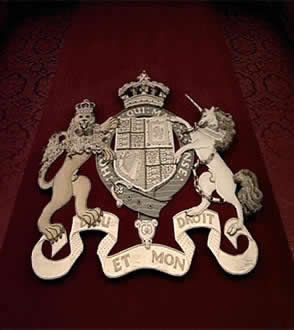
William and Mary are formally proclaimed King and Queen
The Convention Parliament declares that James' flight is an act of abdication, leaving the throne vacant. Parliament offers the throne to William and Mary, James eldest (Protestant) daughter rather that James' eldest (Catholic) son, James Francis Edward.
William and Mary are declared joint sovereigns of England and Scotland and are crowned in Westminster Abbey on 11th of April.
Spring 1689
The Council of the North is called at Hillsborough
A collective response from all the British Protestant settlers is needed, so early in 1689 the Council of the North is formed in Hillsborough. The Ulster gentry are worried by rumours of the arrival of Tyrconnell's army and assemble their followers into regiments.
Lord Mount-Alexander of County Down (though having no military training) is chosen to lead the forces. The council corresponds with other northern rebels.
7th March 1689
Tyrconnell sends his men north to subdue the Williamite rebels
Tyrconnell issues a proclamation promising a free pardon to all who lay down their arms and submit. He sends the Presbyterian clergyman, Alexander Osborne, to give his terms to the Williamite rebels.
Tyrconnell orders Lieutenant-General Richard Hamilton north with a thousand regular soldiers, two thousand new recruits and a few artillery pieces.
Their aim is to head north, subdue the rebels and return Ulster to James' allegiance.

12th March 1689
James II lands in Kinsale
Louis XIV persuades James to go to Ireland to recover his kingdom.
An alliance with King James gives Louis the opportunity to increase his influence over Europe by distracting William from his continental campaign. James sees Ireland as a stepping stone back to his kingdom.
When James lands at Kinsale in County Cork he is met "with all imaginable joy" by his Catholic subjects.
He is accompanied by English, Scottish and Irish supporters, a number of French generals and Comte d'Avaux, Louis XIV's special ambassador to James' court.
James calls a council of war with Comte d'Avaux and Lord Melfort, his own first minister, and, with local troops, forms the men into regiments and sends them to Dublin.

14th March 1689
Jacobite success at the Break of Dromore
The Council of the North declines Tyrconnell's offers and sends Sir Arthur Rawdon to meet Lt-General Richard Hamilton's men. Rawdon's men are defeated in County Down at the 'Break of Dromore' and Lisburn, Belfast and County Antrim fall to the Jacobites.
Rawdon regroups his men and heads to Coleraine.
News of Hamilton's approaching army spreads fear amongst the Williamite settlers. Hamilton himself acknowledges the lawlessness of some of his men: "whatever power he might be able to exercise over his soldiers ...[he] could not keep order among the mob of camp followers". The settlers burn their furniture, pull down their houses and move north- " the flight became wild and tumultuous."

14th March 1689
Lundy orders withdrawals
Lt-Colonel Lundy orders "that the garrison at Dungannon should break up" and the stores fall into Jacobite hands. Lundy places orders for further withdrawals from Cavan, Monaghan and Sligo.
Most of the withdrawing Williamite troops make their way North to the walled city of Londonderry.

17th March 1689
Lundy meets with Sir Arthur Rawdon's men at Coleraine
Lt-Colonel Lundy meets with Sir Arthur Rawdon's men at Coleraine but declines to provide help, telling them it is "advisable to quit the town, as soon it should be attacked".
Rumours are rife in the city suggesting that Rawdon and his men are to defect to the Jacobites. Lundy draws up a Declaration of Union quashing the rumour.

20th March 1689
James II leaves Cork for Dublin
The Irish give James a rapturous welcome on his way to Dublin.
"All along the road the country came to meet his majesty with staunch loyalty, profound respect, and tender love as if he had been an angel from heaven.
All degrees of people and of both sexes were of the number, young and old; orations of welcome were made to him at the entrance to each town, and rural maids danced before him as he travelled."
21st March 1689
Lundy and fellow officers sign a Declaration of Union
Lt-Colonel Lundy, Sir Arthur Rawdon and fellow members of the council of war sign a declaration pledging allegiance to William and Mary, the new King and Queen, in order to dispel rumours of defection to the Jacobite side.
21st March 1689
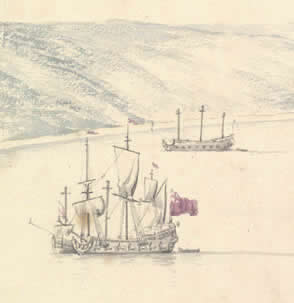
Williamite relief arrives in Lough Foyle
Captain James Hamilton (a Williamite and later the Earl of Abercorn) arrives in the Deliverance with supplies and a commission for Lt-Colonel Lundy.
Lundy is given orders to improve Londonderry's defences and to administer the oath of allegiance to William and Mary. Lundy swears an oath of allegiance privately with Hamilton, onboard the Deliverance.
The next day " ...the committee of Derry , and the Officers ... desired Lundy to take the oaths before them all, for their greater satisfaction...". Lundy refuses, causing further suspicion.
24th March 1689
James II enters Dublin
James enters Dublin on Palm Sunday. He is given an enthusiastic reception by the citizens and is presented with the keys of the city by the Lord Mayor and the corporation.
James chairs a council of war with the Earl of Tyrconnell, Lord Melfort and Comte d'Avaux.

27th March 1689
The Jacobite army reaches Coleraine
Lt-General Richard Hamilton's Jacobite army reaches Coleraine. His troops set up two batteries within fifty yards of town.
The first attack is unsuccessful.
When Hamilton hears that the French General, Pusignan, is ordered north with eight regiments to join him, he decides to leave a small force covering Coleraine and press onwards to Londonderry.
The Williamites destroy the bridge over the Bann at Portglenone, forcing the Jacobites to look for an alternative crossing.
4th April 1689
Jacobites drive Rawdon's men from Moneymore
When Sir Arthur Rawdon hears that Jacobite troops have arrived in Dungannon and are about to cut off the garrison of Moneymore, he resolves to march immediately to Londonderry.

7th April 1689
Jacobites close in on Londonderry
Jacobite forces close in on Londonderry. Lt-General Richard Hamilton's men cross the River Bann while Jacobite reinforcements are en route from Tyrone. The Commander of Coleraine, Gustavus Hamilton, recalls his men from the Bann and orders Lord Beresford to pull out of Coleraine.
The Wiliamite forces begin their march to Londonderry to avoid being cut off by the advancing Jacobite troops.
The roads to Derry are full of settler refugees heading for sanctuary.
8th April 1689
James II leaves Dublin
James leaves Dublin for Londonderry with 2,500 men. He sends orders for General Pusignan and Lt-General Hamilton to proceed to Strabane, where they can cross the Foyle and march northwards to Londonderry.
10th April 1689
Articles of War are drawn up
Councillor Cairns returns from London with a letter from William pledging support for the people of Londonderry. The letter is read aloud by Lt-Colonel Lundy to his Council of War; encouraged by the letter they draw up Articles of War:
Article 1: "That a mutual engagement be made between all officers of this garrison and the forces adjoining, and to be signed by every man. That none shall desert or forsake the service, or depart the kingdom without leave of a Council of War. If any do, he or they shall be looked upon as a coward and disaffected to the service."

13th April 1689
Lundy orders his men to defend the strategic passes at Cladyford and Lifford
Lt-Colonel Lundy assembles his forces to defend the strategic 'passes' of Cladyford and Lifford to prevent the Jacobites from reaching the Londonderry side of the Foyle. Lundy announces that by 10 o'clock on the morning of the 15th of April that all "... that can or will fight for their country and religion against Popery shall appear on the fittest ground near Cladyford, Lifford and Long Causeway, as shall be nearest to their several and respective quarters". However, Cairns and his men feel that this action should have been undertaken sooner.
15th April 1689
Londonderry Garrison is overwhelmed at Lifford and Cladyford
Lt-General Hamilton's men join forces with those of another Jacobite, General de Rosen, at Strabane. To reach the Londonderry side of the Foyle, the Jacobites have to cross the Finn and Mourne rivers, upstream of Lough Foyle near Lifford and Clady. Although the Jacobites are greatly outnumbered, Lt-Colonel Lundy's men are not sufficiently organised to take advantage of the opportunity.
The battle is won by the quality of the Jacobite cavalry which is the equal of any in Europe.
The Williamites lack the skill, training and experience to fight such skilled horsemen and are forced to abandon their positions in the face of cavalry charges.
17th April 1689
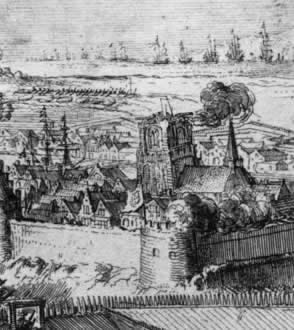
Lt-Colonel Lundy declines Williamite supplies and reinforcements
Colonels Cunningham and Richards arrive on the 15th of April with supplies and reinforcements from England. They offer Lt-Colonel Lundy the support of two extra Williamite regiments. Lundy calls a Council of War.
However, the council declines the offer of extra troops and instead discusses the city's surrender.
"Upon inquiry, it appears that there is not enough provision in the garrison of Londonderry for the present garrison, and the two regiments on board, for above a week, or ten days at the most. And it appearing that the place is not tenable against a well-appointed army, therefore it is concluded upon and resolved ... not ... to land the two regiments... in hopes that the inhabitants, by a timely capitulation, may make better terms with the enemy."

18th April 1689
Surrender negotiations fail and James II is rebuffed
Lt-Colonel Lundy summons another Council of War to tell the assembled officers and gentlemen that they must surrender. However, the council and the townspeople are angry with Lundy for refusing Williamite relief. The Jacobites encircle the city, making a show of strength in order to frighten the inhabitants into surrender. James rides towards the city and offers terms of surrender.
He "offers the citizens their lives, their estates, their religion and a free pardon for all past offences." The King rides at the head of his troops to Bishop's Gate. The majority of the town's inhabitants do not trust James and when the soldiers see him approaching they shout "No surrender" and fire on him and his army. The Jacobite Lt-General Richard Hamilton presents two choices for the city, surrender or slaughter, but Colonel Murray assures the townspeople that "he would stand by them in defence of their lives and the Protestant interest, and assist them immediately to suppress Lundy and his council, to prevent their design of surrendering the City".
The crowd overwhelmingly support Murray's stance over Lundy's and authority passes to Murray. Lundy and his council slip away and keep to their chambers.

BBC iD
BBC iDBBC navigation
BBC links

Copyright © 2015 BBC.The BBC is not responsible for the content of external sites. Read more.
This page is best viewed in an up-to-date web browser with style sheets (CSS) enabled. While you will be able to view the content of this page in your current browser, you will not be able to get the full visual experience. Please consider upgrading your browser software or enabling style sheets (CSS) if you are able to do so.
