

Explore this turbulent period of Irish history when Londonderry took centre stage in the battle for supremacy between two Kings.





4th August 1689
Major-General Kirke receives a Guard of Honour
Kirke enters Londonderry and is received by the Governors of the town. The streets are lined with cheering people, as Kirke walks in procession to Governor Mitchelburne's house.
The officers of the garrison stand at the head of their troops of half starved soldiers. Of the 7,500 men regimented inside the walls at the beginning of the siege, only 4,300 are left alive and a fourth of those are unable to serve.
The sick and dying lie in their damaged houses unable to view the ceremony. After 105 days of siege the population of the town has been severely reduced by starvation and famine and the backyards, gardens and cellars are filled with graves.
The Jacobites had lain before the city for fifteen weeks with estimated loses of between 2,000 and 8,000.



13th August 1689
Williamite Duke of Schomberg's army arrives at Ballyholme Bay, Co.Down
The Jacobites fail to seize Derry but they are still in control of many parts of Ireland.
King William sends Schomberg with an army to Ireland to destroy Jacobite resistance.
Schomberg takes control of the North of Ireland but, due to Jacobite military tactics, fails to take Dublin before Winter.
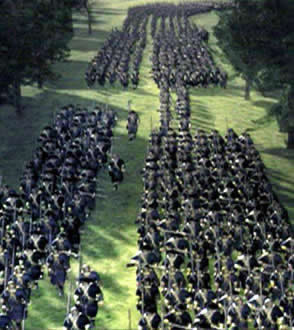
14th June 1690
William's fleet arrives in Belfast Lough
The Duke of Schomberg's lack of success in Ireland forces William to personally command his army.
He arrives with a fleet of three hundred vessels in Belfast Lough. William disembarks at Carrickfergus, with an army that would eventually number 36,000 men.
The Jacobites move south from Dundalk to take up battle positions on the south bank of the River Boyne, just west of Drogheda.
William marches south and deploys his troops on the north side of the river.

1st July 1690
William III defeats James II at the Battle of the Boyne
The Jacobites and Williamites face each other across the Boyne.
The battle begins with artillery barrage. William orders a detachment of his forces inland to create a diversion while he orders a frontal assault across the river. The superior firepower and numbers of troops, allied to tactical errors by James, ensures victory for the Williamites.
The Jacobite troops are overwhelmed and James retreats to France soon afterwards. It takes another year of campaigning before William's forces have completed the re-conquest of Ireland. The last battle is fought on the plains of east Galway, at Aughrim, on the 12th of July 1691.
After the French commander, the Marquis de St Ruth, is killed by a cannon ball, the Jacobites are defeated by the Dutch general, Baron de Ginkel - 7,000 Irishmen die in one afternoon.
With this defeat, James could no longer consider using Ireland to regain the throne and Louis XIV's aspirations of European domination are ended.

BBC iD
BBC iDBBC navigation
BBC links

Copyright © 2015 BBC.The BBC is not responsible for the content of external sites. Read more.
This page is best viewed in an up-to-date web browser with style sheets (CSS) enabled. While you will be able to view the content of this page in your current browser, you will not be able to get the full visual experience. Please consider upgrading your browser software or enabling style sheets (CSS) if you are able to do so.
