Environmentalist Kerry Leonard writes the next in his series of exclusive wildlife reports for Breathing Places.
The Masked Bandit in the Hills
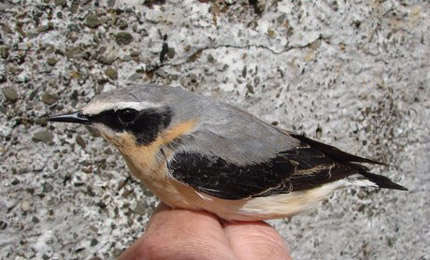
After a walk in the hills above Larne today it struck me that many people may be unfamiliar with one of our commoner summer migrants, the Northern Wheatear. Wheatears breed on mountain slopes and are a common site on our grassy hills in the summer. Slightly bigger than a Robin the male has a bold black ‘bandit’ eye patch, grey back and buff orange throat. Both sexes have a large white rump. Often the only view of the species is the flash of its white backside as it disappears behind a rock – you have just seen a Wheatear. Happily they have a tendency to sit conspicuously on rocks and fence posts, scolding loudly as hill walkers or birdwatchers wander past!
Wheatears prefer short grasslands with rocky outcrops where they usually nest in holes or burrows. They predominantly feed on small invertebrates. In Northern Ireland look for them on the short grassy slopes at the base of hills and mountains, often areas where there are sheep fields and stone walls. The highest concentration of breeding birds is in the Glens of Antrim. For many people who may not venture into the hills the best chance of seeing a Wheatear is on migration. Typically coastal grasslands and rocky shores will have migrant birds in April and May, with a return migration that’s stretches from July to September. Wheatears may also occasionally turn up inland on football pitches and in fields. They are one of the earlier migrants to make their appearance on out shores in the spring.
There are several races of Northern Wheatears, one of which is the Greenland race. ‘Greenland’ Wheatears make one of the most remarkable migrations of any small bird. It migrates from wintering quarters in sub-Saharan Africa across Northern Europe and out across the Atlantic to breeding grounds in Greenland and Canada. This amazing flight is against the usual prevailing direction of the weather and wind, a non-stop flight of 2400km.
Radio 4 World on the move – the Wheatear
www.bbc.co.uk/radio4/worldonthemove/reports/springs-first-wheatear/
RSPB - Wheatear
www.rspb.org.uk/wildlife/birdguide/name/w/wheatear/index.aspx
Radio 4 - Brett Westwoods' guide to birdsong
www.bbc.co.uk/radio4/science/birdsong.shtml
Listen to Kerry Leonard talk about moths and butterflies when he visited Creggan Country Park.
|