The black and white picture above is an early photo of 78 Derngate, Northampton - a house that has for years, excited architects, historians, artists and designers. 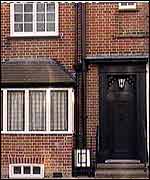 | | From outside, 78 Derngate looks very ordinary |
With help from the Heritage Lottery Fund, 78 Derngate has now been restored to its former glory and reopened to the public. "This house is very important architecturally," says its curator Sylvia Pinches. "Charles Rennie Mackintosh is now regarded as one of the chief architects of the early 20th Century and this is the last extant piece of his work and it's a complete piece of interior design."
Lots of fizz 78 Derngate was the only Mackintosh domestic commission outside of Scotland.  | | Sylvia Pinches, curator |
He was invited to remodel the Georgian house by the renowned model-maker Wenman Joseph Bassett-Lowke in time for his wedding in 1917. "Bassett-Lowke was a man of great energy," says Sylvia. "He had lots of interests, lots of fizz - he was always rushing around.
" He was very concerned with modernity and everything being efficient and speedy. He didn't want anything in his house that was older than himself and he spotted in Mackintosh that classic cutting-edge talent."
Ahead of its time
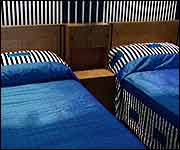 | | Playwright George Bernard Shaw saw stripes before his eyes in this bedroom |
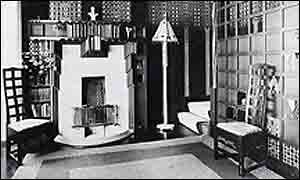
According to Sylvia, Mackintosh's designs for 78 Derngate were ten years ahead of their time: "It's a very modern house. If people look at some of the interior here, they say it's a 1920s house but it was done in the 1910s."
The house was also modern in many other ways: It had central heating, indoor plumbing and lots of electrical gadgets in the kitchen.
Mackintosh's initial design included a striking black room: the hall-lounge, with a yellow-stencilled wallpaper motif of inverted triangles. Another tour de force was the guest bedroom decoration of bold ultramarine, black and white stripes. The playwright George Bernard Shaw stayed there. "Some rooms don't look out of place now, and it's nearly 90-years-old," says Sylvia. | 




 View
View