| 24 September 2014 |

| |
| BBC Homepage | | |
| |||
| Contact Us | | |
Abolition Of The Slave TradeYou are in: Norfolk > Abolition Of The Slave Trade > Thomas Fowell Buxton: The fight for abolition 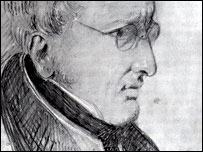 Buxton at anti-slavery convention, 1840 Thomas Fowell Buxton: The fight for abolitionHistory will always show William Wilberforce as a leading light in the fight for slaves' freedom, but his successor - Norfolk's Thomas Fowell Buxton - is yet to receive the true credit and recognition he deserves, argues author Howard Temperley. It will come as a surprise to many, not least to people in Norfolk, to learn that the ending of slavery in Britain's colonies came as a result of a campaign led not by William Wilberforce - but by a Norfolk man - Thomas Fowell Buxton. Most people's reaction on hearing this is one of scepticism. Why, they ask, do we hear so much of Wilberforce and nothing at all of Buxton? The short answer is: what gets into the public memory depends very much on what a society chooses to put there. Often it is the result of the initiative of some group or interest. Not infrequently it bears little relation to what actually happened. Sometimes, too, there is an element of luck involved. Wilberforce was exceptionally well served by having his sons write his biography. 200th anniversaryWe will hear much of his achievements as we come up to the 200th anniversary of the 1807 Act, ending Britain's participation in the slave trade. Hull and London both have major projects for 2007 and there are to be events in other cities. Given the nature of the occasion it is unlikely that much will be said about what the 1807 Act failed to address, namely the situation of the 800,000 slaves already held in British colonies overseas. Tactical manoeuvresThe decision to attack the trade rather than slavery itself was essentially tactical. The idea of getting rid of slavery had been in the minds of the movement's Quaker founders well before Wilberforce took up the cause. It was in Wilberforce's mind too, although to have admitted as much would have greatly diminished his chances of his achieving anything at all. Important though it was, Britain's withdrawal from the slave trade was merely one among a succession of achievements, just as Wilberforce was only one among a succession of anti-slavery leaders. Before him there was Granville Sharp, who in 1772 initiated a court case that effectively ended slavery in England. Then came the 1807 Act. Far from "abolishing" the slave trade, as is often assumed, it opened the way for others to muscle in with the result that slaves continued to be carried across the Atlantic, mainly to Cuba and Brazil, for a further 60 years. Buxton's campaignThe movement's third phase began in 1821 with Wilberforce's retirement and Buxton's launching of the campaign that led to the freeing the 800,000 slaves held by Britons overseas. 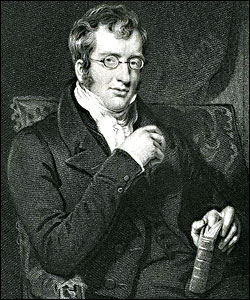 Engraving of Thomas Fowell Buxton, 1835 By the time he took over from Wilberforce, Buxton already had a well-established reputation as a social reformer. He features on the back of the current £5.00 note - the tall figure on the left - as an associate of Elizabeth Fry. Although born in Essex and MP for Weymouth, he was essentially a Norfolk man. He moved to the county in his late teens, and throughout his subsequent career it was always to Norfolk that he returned when his responsibilities allowed. Initially he shared Wilberforce's reluctance to attack slavery directly. Regulating trade was one thing, but slaves were property and defending property was widely regarded as Parliament's principal responsibility. There were costs to be considered too, for if property were to be confiscated compensation would have to be paid and on a scale that the country could ill afford. Where was the Government, still heavily burdened with debts arising out of the Napoleonic Wars, to find upwards of £20,000,000 - a sum not far short of the annual cost of maintaining the army, the navy and, indeed, of running the entire country? It was all very well to argue, as some did, that the planters deserved nothing and that compensation, if any, should be paid to the slaves. But the planters weren't the only ones involved. Many were either in debt, or at the very least had used slaves as collateral in the course of other transactions. If £20,000,000 simply vanished, others besides the planters would suffer. The whole British banking system would be hard hit. So Buxton initially adopted a moderate approach by having Parliament pass laws limiting owners' ability to administer punishment. That did not work. Defiant stanceMuch as the American colonists had done before, slave owners adopted a defiant stance, claiming that their liberties were being infringed and asserting their right to self rule. There was even talk of their seceding and joining the United States. This was never a serious possibility, but what with their defiance and an increasing number of slave uprisings, it was plain that the situation in the West Indies was getting out of hand. However it was not just in the West Indies that alarming things were happening. The final stages of Buxton's campaign coincided with the struggles in Britain over the 1832 Reform Bill. An influential group of abolitionists broke away and began demanding immediate unconditional emancipation. There were stormy meetings in which some began saying "The People must free the slaves for the Government never will." Subjected to these external pressures and facing a revolt by MPs newly elected under the 1832 Reform Act, the Government finally agreed to put up the £20,000,000 required and to free all slaves as of 1 August, 1834. 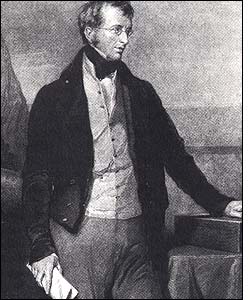 Thomas Fowell Buxton, c. 1833 Moment of gloryThis was Buxton's moment of glory. His achievement is commemorated by a statue in Westminster Abbey, an elaborate drinking fountain in Parliament Fields, and a baronetcy. So why, as compared with Wilberforce, who is not only commemorated in Hull but whose name is practically synonymous with the antislavery movement, is Buxton not commemorated or even remembered in Norfolk? Why is there a slavery museum in Hull's Wilberforce House and not one in Norwich's Earlham Hall - home of the Gurney family from 1786-1912. Buxton's NorfolkBuxton's association with Norfolk is rather the opposite of Wilberforce's with Hull and, in contrast, features very prominently in accounts of his life. Arriving in his late teens, he fell under the spell of the Gurneys, married one of the daughters, and was thereafter a Norfolk resident. His letters to his family, besides lamenting the time he has to spend away, bear testimony to his dependence on the "Northrepps Ladies," mostly family members, who researched and not infrequently wrote his speeches. Thus, unlike Wilberforce who in later life was increasingly nomadic, Buxton maintained what was effectively a political office in the county, shuttling successive drafts of speeches back and forth by the Norwich Mail. After leaving Parliament in 1837 he retired to Northrepps and is buried in Overstrand. His descendants still play a prominent part in the life of the region. Public profileThere are, of course, many possible reasons why Wilberforce has the higher public profile - one being that those who help initiate movements tend to get remembered more than those who bring it to fruition. On the other hand it would be hard to argue that stopping the importation of slaves was more important than the abolition of slavery itself. None of this, however, explains why Hull, rather than Clapham or Kensington has laid claim to Wilberforce - or why Norwich and Norfolk have failed to lay claim to Buxton. Hull City Council's acquisition of Wilberforce House in 1906, just in time for of the centenary of the 1807 Act, was presumably the result of local political initiative. So clearly is the launching of Hull's £3.7 million Wilberforce Development Project in anticipation of the City's part in the 2007 celebrations. When the centenary of emancipation came around in 1933 there was much national celebration and not a little national self congratulation. Just as Hull had laid claim to Wilberforce in 1907, Norfolk could have laid claim to Buxton on that occasion, but apparently never did. The 2007 celebrations offer an opportunity to draw attention to Buxton's subsequent and arguably more significant achievement. But given that 2007 will be Hull and Wilberforce's year it may be that we will have to wait until 2033 for Buxton - and Norfolk - to get the recognition they properly deserve.
Engraving of Thomas Fowell Buxton courtesy of Norwich Castle Museum last updated: 09/04/2008 at 12:29 SEE ALSOYou are in: Norfolk > Abolition Of The Slave Trade > Thomas Fowell Buxton: The fight for abolition
|
| | About the BBC | Help | Terms of Use | Privacy & Cookies Policy |