Summary

  1. UNESCO World Heritage Site damaged in Tehranpublished at 01:14 GMT

    Ghoncheh Habibiazad
    Senior reporter, BBC Persian

    A building covered in intricate tiling and colourful mosaics is seen against a clear blue sky.Image source, Getty Images
    Image caption,

    Golestan Palace, pictured in 2018

    Tehran’s historic Golestan Palace, which is listed as a United Nations Educational, Scientific and Cultural Organization (UNESCO) World Heritage Site, has been damaged following strikes on the capital, according to Iranian state media.

    UNESCO has expressed concern over the protection of heritage sites, external following reports that the palace was damaged.

    Local news outlets had reported on an explosion in Tehran’s Arg Square, near the palace.

    Golestan Palace served as the royal residence of Iranian monarchs during the Qajar dynasty and later became the official seat of the Pahlavi dynasty.

  2. Oil shipment rates hit all-time highpublished at 01:00 GMT

    Osmond Chia
    Business reporter

    The cost of hiring a supertanker to ship oil from the Middle East to China has reached an all-time high of more than $400,000 (£298,300), according to data from the London Stock Exchange Group.

    That value is almost double of what it was last week when the US threatened to attack Iran.

    Iran has targeted ships passing through the Strait of Hormuz, a crucial waterway in the south of the country, through which about a fifth of the world's oil and gas is shipped.

    The record fees are for the biggest oil-carrying vessels that can haul up to two-million barrels of crude.

    These values are just one of the ways we are seeing prices surge since the Israeli and US attacks on Iran over the weekend.

    A crude oil tanker at seaImage source, Getty Images
  3. US embassy in Riyadh hit by drone attackpublished at 00:45 GMT

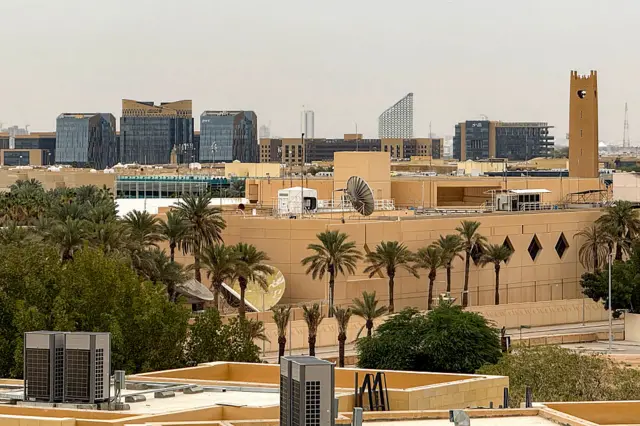
    Saudi Arabia's Ministry of Defense has confirmed that the US embassy in Riyadh was attacked by two drones, according to initial estimates.

    In a statement shared to X, the ministry said this resulted "in a limited fire and minor material damage to the building".

    The US Mission to Saudi Arabia has issued a shelter in place notification for Jeddah, Riyadh and Dhahran, and says it will limit non-essential travel to any military installations in the region.

    It is currently just after 03:00 local time (00:44 GMT) in Riyadh.

  4. 'The US struck in a defensive posture', says House Speaker Mike Johnsonpublished at 00:31 GMT

    US House Speaker Mike Johnson has described the attacks on Iran as being "defensive in nature".

    "The US struck in a defensive posture," Johnson said on the operation, adding that he believes the current military operation will be "limited in scope" and "short in duration".

    Johnson made the remarks to journalists following a defence and intelligence briefing of the so-called "Gang of Eight", a congressional leadership team made up of Democrats and Republicans.

    Mike Johnson speaks to the media after a classified briefing with lawmakers at the US CapitolImage source, EPA
  5. Explosions reported in Saudi capital Riyadhpublished at 00:16 GMT
    Breaking

    We are now getting reports of explosions in the diplomatic quarter of Riyadh, Saudi Arabia's capital city.

    According to Reuters quoting sources, a fire has broken out at the US embassy, which is located in that area.

  6. Air base used by Australian forces near Dubai hit by drone at weekendpublished at 23:57 GMT 2 March

    Helen Livingstone
    Reporting from Sydney

    Australia's defence minister has confirmed that an air base used by Australian forces near Dubai was hit by a drone at the weekend, adding that no Australians were injured in the attack.

    "On the first night there was a strike at the Al Minhad Air Base, but all the Australians who are there are safe and accounted for," Richard Marles has told reporters.

    The UAE air base is used by multiple western militaries, and is the Australian Defence Force's Middle East headquarters. Marles says Australia has 100 personnel in the Middle East, with most stationed in the UAE.

    Australian Prime Minister Anthony Albanese has previously said his country backs the US and Israel "acting to prevent Iran from obtaining a nuclear weapon and to prevent Iran continuing to threaten international peace and security".

  7. BBC Verify

    How the US-Israel war with Iran is jeopardising shippingpublished at 23:38 GMT 2 March

    The Strait of Hormuz is a crucial artery for the movement of global energy supplies.

    Iran has warned it will "set fire" to ships passing through strait - only about 50km (31 miles) wide at its entrance and exit - threatening key supply chains.

    BBC Verify's Ben Chu takes a look at what's been happening to marine traffic in the strait since the US-Israel war with Iran broke out.

    Media caption,

    How the US-Israel war with Iran is jeopardising shipping

  8. Iran fires missiles towards Israel, IDF sayspublished at 23:15 GMT 2 March

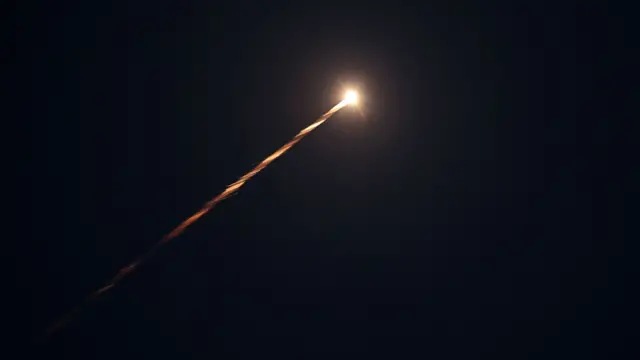
    Iran has launched missiles towards several areas of Israel, the Israeli military warns, after sending out phone alerts across the country for people to take shelter.

    Anti-air defence systems are "operating to intercept the threat", the Israel Defense Forces (IDF) says.

    An Iranian missile flies towards Israel as Israeli air defence operates, amid the U.S.-Israeli conflict with Iran, as seen from Hebron, in the Israeli-occupied West BankImage source, Reuters
    Image caption,

    Israeli defences intercept Iranian missiles as seen from Hebron, in the occupied West Bank

  9. State Department urges Americans to depart much of Middle Eastpublished at 23:10 GMT 2 March

    The US State Department is now urging Americans in much of the Middle East to depart now via commercial means due to "serious safety risks".

    The advisory applies to citizens in Bahrain, Egypt, Iran, Iraq, Israel, the West Bank, Gaza, Jordan, Kuwait, Lebanon, Oman, Qatar, Saudi Arabia, Syria, the United Arab Emirates and Yemen.

  10. Israel attacks Iranian state broadcasterpublished at 22:54 GMT 2 March

    Ghoncheh Habibiazad
    BBC Persian

    Head of Islamic Republic of Iran Broadcasting (IRIB), Peyman Jebeli, says parts of the internal premises of the broadcaster in Tehran have been hit.

    The Israel Defense Forces (IDF) also says it has targeted the IRIB’s complex.

    "The Israeli army targeted the Islamic Republic of IRIB complex, the beating heart of the IRGC's machine of lies and repression," a post on the IDF in Persian X account said.

    Iranian outlets reported yesterday that some buildings of the state broadcaster had been targeted.

    The state broadcaster was also targeted by Israel during Iran-Israel 12-day war back in June last year.

  11. Global News Podcast: What comes next?published at 22:39 GMT 2 March

    Global News Podcast logo on red background

    What will happen in Iran now that Supreme Leader Aytollah Ali Khamenei is dead? Will we see regime change? Or a changed regime?

    The Global News Podcast speaks, external to the BBC's chief international correspondent Lyse Doucet, who has covered Iran for years and is one of the few Western journalists to report from inside the country in recent months.

  12. 'I've never been so scared': Exhausted passengers land in London from Abu Dhabipublished at 22:22 GMT 2 March

    Tom Symonds
    Reporting from Heathrow Airport

    Outside Terminal 4, a couple smile at the camera while holding their luggage, with the woman holding her thumbs upImage source, PA Media
    Image caption,

    Jeff and Rebecca Moses, from Manchester

    I'm at Heathrow, where an Etihad Airways Airbus A380 carrying hundreds of passengers from Abu Dhabi has arrived. Exhausted passengers say they watched missiles pass overhead while hoping to get a flight home.

    Penny Harrison, on a trip with friends in Dubai, tells me: "We heard explosions, we heard the hotel shake, we saw columns of black smoke, we saw drone interceptions. While we were having breakfast there was black ash falling on the breakfast table."

    An exhausted Fay McCaul, arriving with her 7-year-old son Moss, says there were a lot of military jets flying over, and little information about what was going on. "They were talking about having to do an evacuation through Saudi Arabia. I was on my own just with my son," she says.

    For Alison Ager, an alarm went off on her phone on the first night, and families with children went to the basement of their hotel. "We just laid there and thought we’ve got to get through this," she tells me.

    "I just wanted to get home to see the family, that's just what we kept thinking. I’ve never been so scared in all my life," Alison says.

    "You go to the Middle East and you think the Emirates are safe but clearly they're not," she adds.

  13. Rubio asked about reports that a school was hit on Saturdaypublished at 22:04 GMT 2 March

    Tom Bateman
    US State Department correspondent

    I just asked Rubio what the administration knows about Iranian reports that a school was struck on Saturday, reportedly killing dozens of civilians including children.

    He said he had seen the reports and the Department of Defense would be investigating "if that was our strike".

    I pressed him whether they knew it was the result of a US strike. He said: "The United States would not deliberately target a school," accusing the Iranians instead of targeting civilians in the region. I asked for his response if children had indeed been killed. He said that would be "a tragic outcome if it’s happened" but said he didn’t have the details about what led to it.

    Iranian officials on Saturday said a girls' school was struck in Minab, while video showed distraught crowds gathered around a destroyed building. The site is near an Islamic Revolutionary Guard Corps (IRGC) base which has previously been a target.

    Iranian officials said least 153 people including children were killed. The US military's Central Command (Centcom) said on Sunday it was looking into reports of the incident.

  14. Analysis

    Rubio's justification miles away from Trump's speech on Saturdaypublished at 21:51 GMT 2 March

    Tom Bateman
    US State Department correspondent

    The administration says it struck Iran, when it did, because it was pre-empting Iran’s response to an Israeli attack.

    This is a curious, evolving explanation that is likely to meet heavy scepticism from opposition lawmakers among those being briefed by Rubio here in Congress.

    He just told us gathered reporters that people seemed confused about the offensive and its timing. He offered the justification: The administration knew there was going to be Israeli action against Iran and the US would suffer "much higher casualties" from Iran’s response if the US didn't strike first.

    This is a pre-emptive defence argument that appears to pin the initiative on Israel, not Trump. This is miles away from Trump's combative speech on Saturday, which at least in part framed the US action as timed to draw on popular discontent and bring about regime change.

  15. Rubio: US attacked Iran 'pre-emptively' knowing Israel would strikepublished at 21:46 GMT 2 March

    Secretary of State Marco Rubio says the US attacked Iran "pre-emptively" on Saturday because they knew Israel was going to strike, which he says would have meant Iranian retaliation against US forces.

    Speaking a little earlier, he tells reporters: "We knew that there was going to be an Israeli action. We knew that that would precipitate an attack against American forces.

    "And we knew that if we didn't pre-emptively go after them before they launched those attacks, we would suffer higher casualties and perhaps even higher those killed," Rubio says.

    “I'm not going to give away the details of our tactical efforts, but the hardest hits are yet to come from the US military,” he adds.

  16. Iran issues warning to ships passing through Strait of Hormuzpublished at 21:27 GMT 2 March

    Ghoncheh Habibiazad
    BBC Persian

    Two large tankers, one further in the distance, in a deep blue seaImage source, Reuters
    Image caption,

    Oil tankers passing through the Strait of Hormuz in December 2018

    An Iranian official says Iran will "set fire to anyone who tries to pass through” the Strait of Hormuz.

    The warning comes from Ebrahim Jabbari, an adviser to the Commander-in-Chief of Iran's Islamic Revolutionary Guard Corps (IRGC), speaking on state TV.

    He says that the strait is closed and warned ships: "They should not come to this region. They will certainly face a serious response from us."

    Jabbari also says Americans are "thirsty for the region's oil" and that Iran will "strike their pipelines in the region and will not allow oil to be exported from this area".

    The Strait of Hormuz is one of the world’s most important shipping routes and the most vital oil transit choke point. About one-fifth of the world’s oil and gas passes through the strait.

  17. Number of US service members killed rises to sixpublished at 21:06 GMT 2 March
    Breaking

    An update from the US Central Command (Centcom) says six US service members have been killed in action as of 16:00 eastern time on Monday.

    The update says US forces recovered the remains of "two previously unaccounted for service members from a facility that was struck during Iran's initial attacks in the region".

    "Major combat operations continue," the update adds.

  18. Rubio: US goal is destruction of Iranian ballistic missilespublished at 21:04 GMT 2 March

    Rubio speaking with a blurred background behind himImage source, Reuters

    US Secretary of State Marco Rubio has just been speaking.

    He tells reporters: "Our mission is the destruction of their ballistic missile capabilities, and their ability to manufacture them, as well as the threat posed by their navy to global shipping. That's the objective."

    "That said," he continues. "We would not mind, we would not be heartbroken, and we hope that the Iranian people can overthrow this government and establish a new future for that country. We would love for that to be possible.

    "But the objective of this mission is the destruction of their ballistic missile capabilities, and their naval capabilities," he says.

  19. US embassy in Jordan evacuated over security alertpublished at 21:00 GMT 2 March

    The US embassy in Jordan has issued a statement saying all personnel have "temporarily departed" due to a security threat.

    The message, posted on the embassy's website, contains no other details. But yesterday, the embassy posted a similar memo, instructing personnel to shelter in place at the compound "as it may be targeted".

  20. Oil prices surge and stocks waver as investors assess the conflictpublished at 20:48 GMT 2 March

    Danielle Kaye
    New York business reporter

    Oil and gas prices surged on Monday as tensions escalate in the Middle East and the conflict disrupts global supply chains. At the same time, gold futures rose as investors seek assets that are seen as safe havens in times of volatility.

    Brent crude, the global oil benchmark, was more than 6% higher in afternoon trading at nearly $78 (£58) a barrel. It had briefly hit $82 (£61) a barrel earlier in the day.

    At least three ships were attacked near the Strait of Hormuz over the weekend, fuelling concern about access to the crucial waterway through which about 20% of the world's oil and gas is shipped.

    "The market will be watching for signs that traffic through the Strait of Hormuz returns, which would see oil prices subside again," Saul Kavonic, head of energy research at MST Marquee, tells the BBC. But some analysts have warned prices could keep surging in the event of a prolonged conflict, which could have a knock-on effect on inflation and interest rates.

    In the US stock market, reaction to the attacks by the US and Israel - and Iran's retaliatory strikes across the Middle East - was relatively muted by the afternoon. The S&P 500 and the Nasdaq had opened sharply lower, but both indexes pared back their losses over the course of the day.

    Airlines, which are grappling with airport closures and widespread global disruptions, have seen sharp losses. American Airlines' shares fell more than 4% on Monday, while AirFrance-KLM fell more than 9%.