Summary

  1. Analysis

    Democrats, and even some Republicans, are not happy with Trump's actionspublished at 20:40 GMT

    Tom Bateman
    US State Department correspondent

    Here in Congress, we’re waiting for Secretary of State Marco Rubio to show up.

    He’s due to brief Republican and Democrat leaders in a Sensitive Compartmented Information Facility - a so-called “SCIF” room.

    There’s a clamour from Democrats against the way Trump launched the attack on Iran which is without Congressional approval. Some lawmakers are calling it illegal.

    The Democrats are trying to force a vote later this week under the 1973 War Powers Resolution which Congress passed during the Vietnam war as a check on executive authority. That effort is almost certain not to succeed.

    But perhaps a bigger problem for Trump are the loud voices in parts of his Republican base who see the military action as a betrayal of his promise not to launch foreign “forever wars”.

  2. More than a dozen US service members 'seriously wounded' in Iran operationspublished at 20:31 GMT

    As of Monday morning, 18 American service members have been "seriously wounded" in its operation against Iran, the US Central Command (Centcom) tells the BBC's US partner CBS News.

  3. US aircraft leave Spain after ban on using bases for Iran strikespublished at 20:24 GMT

    Sergi Forcada Freixas
    in Madrid

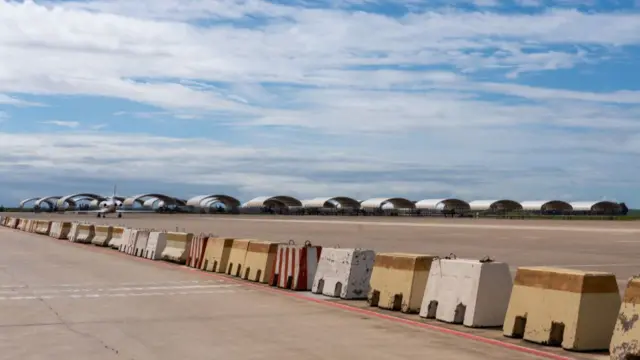
    Images of the Eurofighter hangars at the Moron Air Base in southern SpainImage source, Getty Images
    Image caption,

    Rota and Morón military bases are jointly operated by US and Spanish forces

    Several US aircraft have departed the Rota and Morón military bases in southern Spain after the Spanish government denied Washington permission to use the jointly operated facilities for military action against Iran.

    Foreign Minister José Manuel Albares said Spain would not authorise the use of its territory for “anything that is not in accordance with the Charter of the United Nations”.

    The decision places Spain at odds with several European partners.

    Although Nato Secretary General Mark Rutte told BBC News that Europe is “absolutely supportive” of US action in Iran, Spanish Prime Minister Pedro Sánchez has condemned what he called the “unilateral military action” carried out by the United States and Israel against Iran.

  4. Centcom provides details of assets and targets of Iran operationspublished at 20:15 GMT

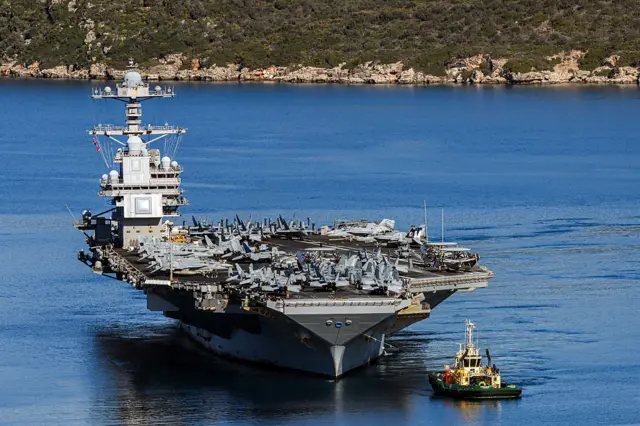
    A US aircraft carrier with jets on board in the middle of the seaImage source, Getty Images
    Image caption,

    The US Navy aircraft carrier USS Gerald R. Ford pictured near the Island of Crete at the end of February

    US Central Command (Centcom) has issued a fact sheet providing further details on "Operation Epic Fury".

    In the first 48 hours since the launch, it says US forces have been "striking targets to dismantle the Iranian regime's security apparatus" and "prioritising locations that pose an imminent threat". Here's more from Centcom's breakdown:

    • The operation is described as having launched at 01:15 ET on 28 February
    • More than 1,250 targets have been struck in the first 48 hours, according to Centcom
    • A list of US assets employed includes B-1 bombers, F-16 fighter jets, nuclear-powered aircraft carriers, and guided-missile destroyers
    • The US also says it has employed "special capabilities we can't list here!"
    • As for types of targets, Centcom says this includes Iranian Navy ships and submarines as well as integrated air defence systems and anti-ship missile sites
    • Also listed as targets are the Islamic Revolutionary Guard Corps joint headquarters, and the IRGC aerospace forces headquarters
  5. Photos show explosions across the Middle Eastpublished at 20:01 GMT

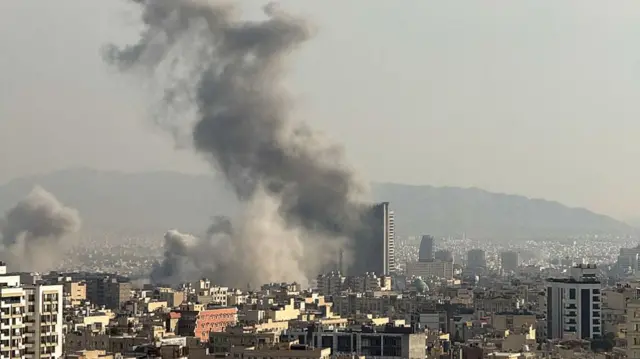
    smoke rising from buildings in the dense city of Tehran. A central grey cloud billows upwards from close to a high-rise building while a smaller plume is visible to the right of the frameImage source, AFP via Getty Images
    Image caption,

    Plumes of smoke rise following reported explosions in Tehran earlier today

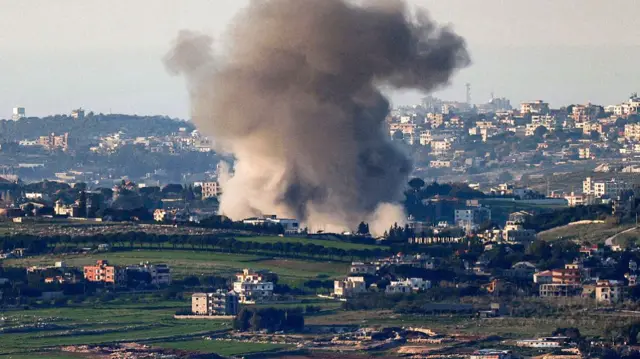
    Smoke rising from a town with buildings and patches of green grassImage source, AFP via Getty Images
    Image caption,

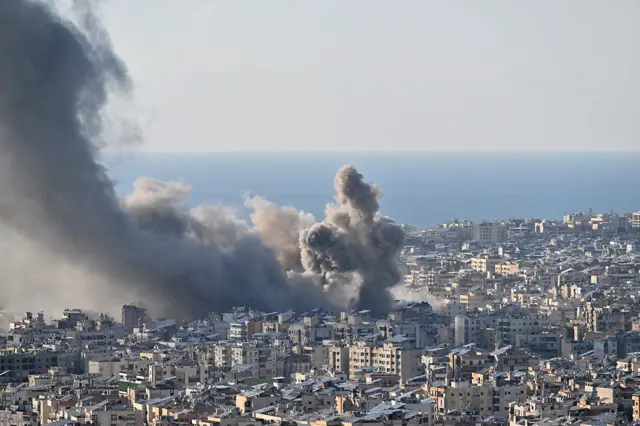
    Israel has also launched a fresh wave of strikes on Lebanon, heavily targeting its capital Beirut and the south of the country

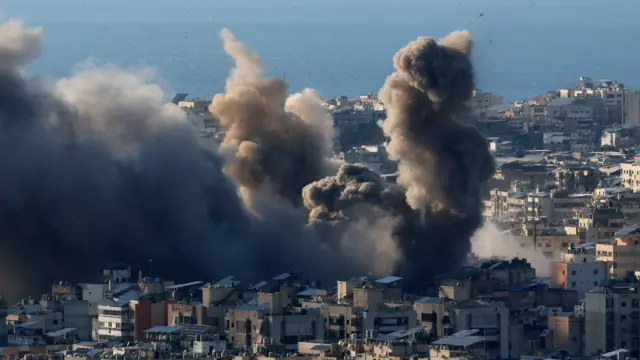
    Large cloud of black and grey smoke emerges from among houses in Beirut following a strikeImage source, EPA
    Image caption,

    Lebanon's health authorities say 52 people have been killed in Israeli strikes so far

  6. BBC Verify

    Satellite imagery indicates damage to Iranian Navy vessel in portpublished at 19:51 GMT

    By Barbara Metzler

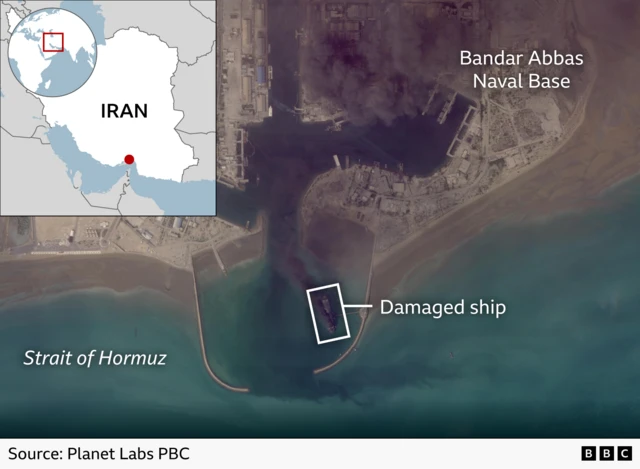
    Satellite images captured today show damage at an Iranian naval port on the Strait of Hormuz, near the city of Bandar Abbas.

    In the imagery, at least one vessel appears to have sustained damage, with dark smoke rising from it.

    At about 230m (750ft) in length, it is among the larger ships typically seen at the port in southern Iran and has visual characteristics matching a Makran-class forward base ship operated by the Iranian Navy.

    Satellite image shows a damaged ship near the entrance to Bandar Abbas Naval Base, with smoke over nearby facilities and a map inset locating the site in Iran.
  7. US says it has sunk 11 Iranian vesselspublished at 19:45 GMT

    US Central Command (Centcom) says it has sunk 11 Iranian ships in the Gulf of Oman, leaving Iran with no ships left in the area.

    "Two days ago, the Iranian regime had 11 ships in the Gulf of Oman, today they have ZERO.

    "The Iranian regime has harassed and attacked international shipping in the Gulf of Oman for decades. Those days are over. Freedom of maritime navigation has underpinned American and global economic prosperity for more than 80 years. US forces will continue to defend it," Centcom writes on X.

  8. White House says 49 of the 'most senior' Iranian leaders killed in strikespublished at 19:37 GMT

    Karoline LeavittImage source, Reuters

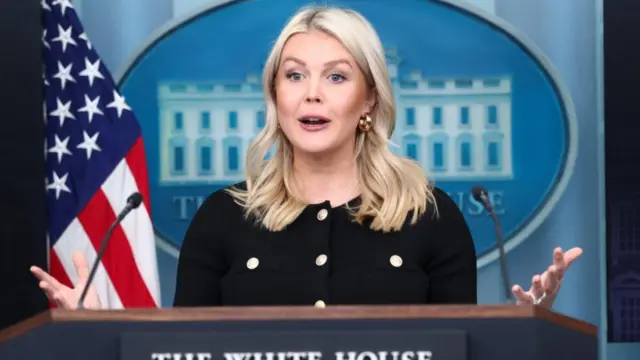
    White House Press Secretary Karoline Leavitt says "49 of the most senior Iranian regime leaders" have been killed in the strikes on Iran.

    In a social media post, she outlines the objectives for the US operation, which include "preventing this radical regime" from threatening the US.

    "Killing terrorists is good for America. 49 of the most senior Iranian regime leaders - including Supreme Leader Ayatollah Ali Khamenei - have already been wiped off the face of the Earth so far in the opening strikes of Operation Epic Fury," she says.

  9. 'All options on the table', IDF says when asked about potential ground mission in Lebanonpublished at 19:24 GMT

    An Israel Defense Forces (IDF) spokeperson says that "all options are on the table" when asked whether Israel is going to expand its operation in Lebanon to a ground operation.

    In a briefing, Effie Defrin says that Israel will finish the campaign with Hezbollah having sustained "very severe damage" - adding that operations won't conclude until "the threat from Lebanon is removed".

  10. Iran operations will last 'as long as it takes' to end threat, says Israel's UN ambassadorpublished at 19:13 GMT

    Danny Danon in black suit, white shirt and red tie stands in front of a wall covered in a blue paper with the UN Security Council logoImage source, Reuters

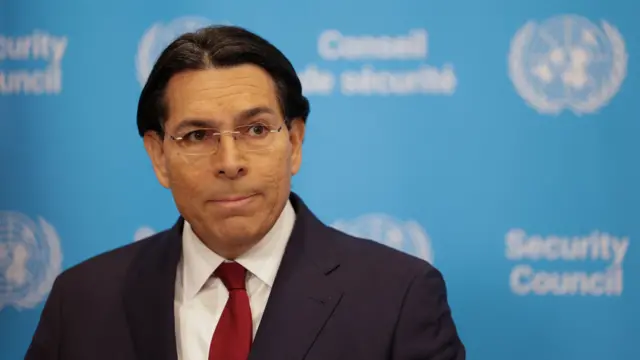
    Israel's Ambassador to the UN Danny Danon has spoken about the operation against Iran at the organisation's headquarters in New York.

    He says Israel will not stop its operation against Tehran until Israel achieves its objectives - which he lists as: "No nuclear weapons, no ballistic missile threat, destroy their navy and crash the regime's proxy network."

    Danon says the joint operation will last "as long as it takes" and Israel will do "whatever is necessary to protect our people and borders".

  11. The latest developments across the Middle Eastpublished at 19:00 GMT

    Large plumes of smoke rise from buildings, with the sea just behindImage source, EPA/Shutterstock
    Image caption,

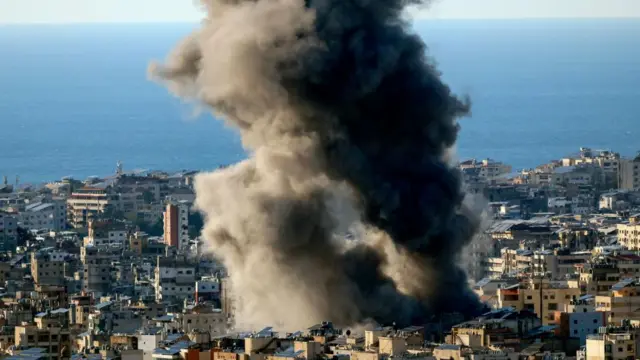
    The scene after an Israeli air strike in the southern suburbs of Beirut, Lebanon, on Monday

    Developments in the Middle East have been fast-moving today, with multiple countries in the region affected. Here's the latest.

    Lebanon:

    • There have been numerous Israeli strikes across Lebanon's capital, targeting what are believed to be Hezbollah positions
    • The country's death toll has risen to 52 people
    • The Lebanese government has banned the military activities of Hezbollah, after they undercut the government by firing rockets towards Israel without state consultation

    Qatar:

    • Qatar's Ministry of Defence says it shot down two aircraft coming from Iran, as well as seven missiles and five drones
    • The country's state-owned energy company, QatarEnergy, has halted the production of liquefied natural gas (LNG) earlier after strikes on some of its energy facilities

    Kuwait:

    Iran:

    • Iranian state media report that the wife of Iran’s late Supreme Leader Ali Khamenei, who was killed in Israeli strikes on Saturday, has also been killed

    Israel:

    • Prime Minister Netanyahu visited the site of a fatal Iranian ballistic missile strike that killed nine Israelis on Sunday - he told reporters Iran would threaten "all of humanity" if they acquired nuclear weapons
  12. Regime change difficult as Iranian forces still present - former CIA director tells BBCpublished at 18:51 GMT

    A former CIA director says forcing regime change in Iran will be difficult, but the US will still have achieved something significant.

    Donald Trump has said the war could give the Iranian people a chance to rise up against the current regime. But David Petraeus, the former director, told BBC Radio 4's PM programme: "The problem there is that it's pretty tough to take control of a country if there are still hundreds of thousands of armed and organised regime security force members."

    Petraeus also points out that Trump has already made it clear there will not be boots on the ground.

    He says, even without regime change in Iran, the US will have achieved valuable objectives in this operation.

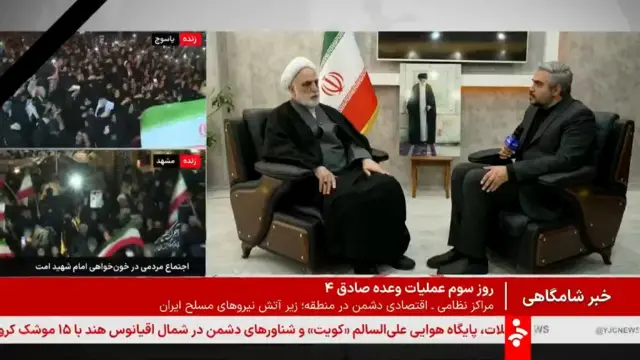
  13. State-organised rallies held in Tehran and other Iranian citiespublished at 18:42 GMT

    Ghoncheh Habibiazad and Sarah Jalali
    BBC Persian and BBC Monitoring

    Screengrab from Iranian TV showing ralliesImage source, IRINN

    Iran's state TV was showing rallies held in different Iranian cities today, including northeastern Mashhad, the birthplace of Iran’s late Supreme Leader Ali Khamenei.

    Iranian news agencies had published a list of 22 locations in the capital today where people should gather, following the evening prayers, to mourn the death of the Supreme Leader.

    The crowds could be heard chanting "death to Israel" and "death to America" in the videos.

    Khamenei was killed on Saturday by a US-Israeli strike, and the Iranian government has announced 40 days of public mourning.

    Meanwhile, BBC Persian has seen a text message from inside Iran that told the citizens rallies will be held in "squares in the cities and mosques all over the country” today and in the next few days.

    While these state-organised rallies are being held, the BBC had previously seen text messages warning Iranians not to go out onto the streets to protest.

    Since the death of Ayatollah Ali Khamenei, the BBC has verified videos from several cities showing gatherings of celebration in the streets.

  14. Iran confirms the death of seven commanderspublished at 18:35 GMT

    Sarah Jalali
    BBC News

    Iran's IRGC-affiliated Tasnim news agency has published a list, for the first time, confirming the death of seven commanders of the armed forces. The list is as follows:

    • Brigadier General Mohammad Shirazi, head of the Office of the Commander-in-Chief
    • Brigadier General Saleh Asadi, Deputy for Intelligence of the Armed Forces General Staff
    • Major General (Air Force) pilot Mohsen Darehbaghi, Deputy for Logistics and Support of the Armed Forces
    • Brigadier General Akbar Ebrahimzadeh, Deputy Head of the Office of the Commander-in-Chief
    • Brigadier General Gholamreza Rezaeian, Head of the Intelligence Organization of Faraja (Law Enforcement Command)
    • Brigadier General Bahram Hosseini Motlagh, Head of the Planning and Operations Department, Operations Deputy of the Armed Forces General Staff
    • Brigadier General Hassan-Ali Tajik, Head of the Logistics Department of the Armed Forces General Staff
  15. BBC Verify

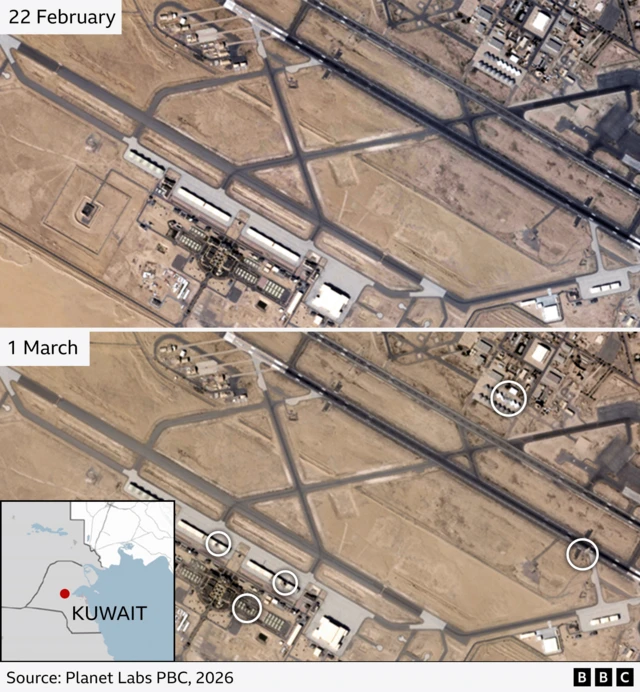
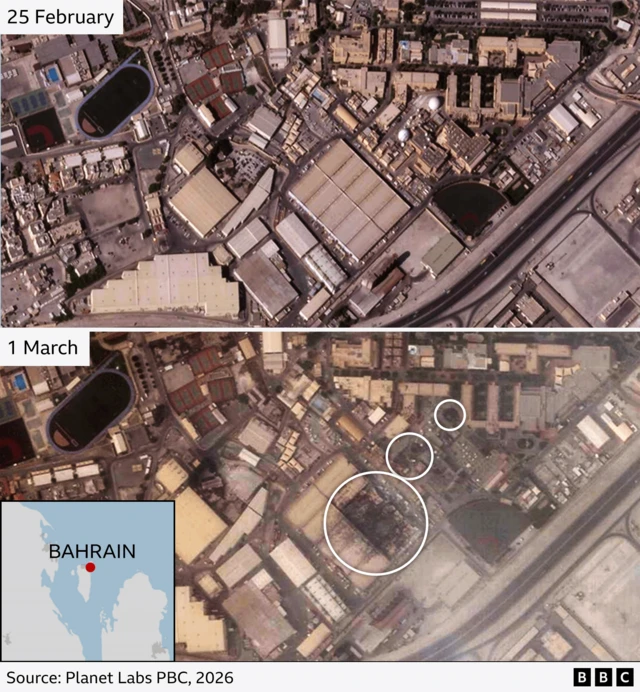
    Satellite images shows damage at two US Middle East basespublished at 18:30 GMT

    By Alex Murray

    Satellite imagery of a US naval base in Bahrain and an air base in Kuwait used by the US show both facilities have been struck several times in Iranian attacks.

    New images of Ali al-Salem air base in Kuwait show two aircraft shelters have been destroyed and two others were damaged in recent strikes.

    There is also a damaged area near the base’s southern runway which may be the result of an explosion. Other buildings in the south of the base also appear to have been hit.

    Satellite images shows damage at a US Middle East base
    Satellite images shows damage at a US Middle East base
  16. A wider regional conflict is one thing other political factions in Lebanon are desperate to avoidpublished at 18:24 GMT

    Samantha Granville
    Reporting from Beirut

    Sirens sounded near Beirut’s American Embassy in the early hours of Monday morning as Israel launched a barrage of attacks against Hezbollah positions in the Lebanese capital.

    Here in Beirut and in parts of southern Lebanon, which is also regarded as a Hezbollah stronghold, initial reports from the health ministry said at least 31 people were killed.

    Residents in Beirut’s southern suburbs said the Israeli airstrikes came without warning and they fled for their lives.

    Israel has continued to hit targets in Beirut and further afield throughout the day, hitting Hezbollah’s financial structures as well as senior figures in the pro-Iranian Shia militia, which had earlier fired missiles into Israel, risking a wider, regional conflict.

    That is the one thing other political factions in Lebanon are desperate to avoid after the damaging yearlong conflict with Israel.

    Other political factions here have condemned Hezbollah’s actions but that is unlikely to placate Israel which has vowed to continue the strikes, even naming senior Hezbollah figures which it now considers legitimate targets.

  17. Lebanon's death toll rises to 52 - authoritiespublished at 18:09 GMT
    Breaking

    Lebanon's Disaster Management Unit has just announced that, following the Israeli attack, 52 people have been killed and 154 wounded.

    Earlier, the Lebanese health ministry said 31 people had been killed and 149 injured.

  18. Many Israeli strikes targeting Hezbollahpublished at 18:03 GMT

    Wyre Davies
    Reporting from Lebanon

    Throughout the day in the Lebanese capital, there have been numerous Israeli airstrikes targeting what are believed to be Hezbollah positions. In the past hour, we’ve heard several more strikes, one of which may have been aimed at a senior figure in the Islamic Jihad movement, an ally of Hezbollah.

    After Hezbollah fired a small barrage of rockets into northern Israel, Israel responded with a significantly broader military operation. It has struck Hezbollah targets in southern Lebanon and in Beirut, particularly in the southern suburbs, long considered a Hezbollah stronghold.

    Given the intensity of the strikes over the past couple of hours, that figure has almost certainly risen.

    Israeli officials argue the response was necessary after Hezbollah expanded the conflict by firing rockets into northern Israel. We’ve heard repeated statements from the Israeli defence minister and the Israel Defense Forces justifying today’s operations, both in the Lebanese capital and in southern Lebanon.

    Smoke rises over buildings following intense Israeli airstrikes targeting the Burj al-Barajneh area in southern Beirut, LebanonImage source, Getty Images
    Image caption,

    Smoke rises over buildings following intense Israeli airstrikes targeting the Burj al-Barajneh area in southern Beirut, Lebanon

  19. Analysis

    Trump offers few clues on his long-term goals for Iranpublished at 17:51 GMT

    Daniel Bush
    Washington correspondent, reporting from the White House

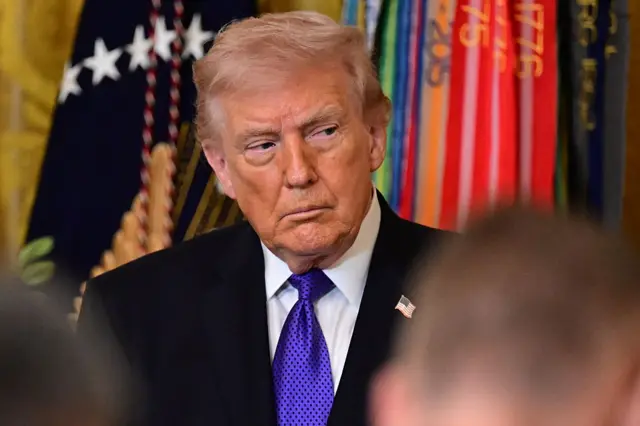
    Donald Trump in a dark suit and purple tieImage source, Getty Images

    US President Donald Trump's first live remarks in public about the US war in Iran offered few clues on his longer-term goals for Iran once the war ends.

    Trump outlined his military objectives, which include destroying Iran’s ballistic missile programme, navy and ability to develop nuclear weapons. He also gave an update on his thinking about how long the war might last, saying the administration had initially projected it could take "four to five weeks".

    But at the same time, Trump suggested a longer-term commitment if needed. "Whatever the time is, it's OK. Whatever it takes," Trump said.

    The president didn't address Iran’s political future, a major question now that the US has killed supreme leader Ayatollah Ali Khamenei and it's unclear who will replace him. Trump also didn’t offer an explanation of how the US plans to respond should the war widen into a broader regional conflict.

    Trump's communications strategy around the war represents a break from precedent. In the past, US presidents have made major addresses to the nation to explain their rationale for going to war. Trump hasn't done that yet – and gave no indication on Monday that such an address may be coming in the days ahead.

  20. Analysis

    Trump sticks to the scriptpublished at 17:37 GMT

    Sarah Smith
    North America editor, reporting from the White House

    It's unusual to see President Trump using a teleprompter. The fact that he was reading from one as he made his first live remarks since the attack on Iran began suggests he knew it was important to stick to the script.

    As he outlined the objectives of this war – wipe out Iran's ballistic missiles, annihilate Iran’s navy, prevent the regime ever getting a nuclear weapon and stop them from sponsoring terrorists – he did not repeat his call for the Iranian people to rise up and overthrow the government.

    There was no mention of regime change at all.

    The president said it was projected the war would last four to five weeks. But that it will take whatever time it takes.

    Referring to a suggestion he’d heard in the media that he might get bored – he said there is "nothing boring about this".

    There was then some nervous laughter in the room as he went off script and started praising the rooms curtains which he chose in his first term and describing the ballroom he is constructing at the White House.