Summary

  1. The Strait of Hormuz - why is it so vital?published at 01:30 GMT

    Media caption,

    Timelapse shows change in the flow of ships in the Strait of Hormuz

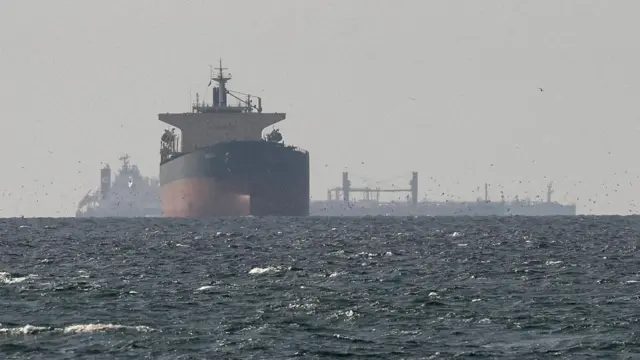
    The Strait of Hormuz - a critical waterway for global shipping - remains a focus of the conflict between the US, Israel and Iran.

    About 20% of the world's oil and liquefied natural gas (LNG) usually passes through the strait and the war has sent global fuel prices soaring.

    In a message posted by Iran's mission to the UN, Tehran says that "non-hostile vessels" will be allowed to pass through the Strait of Hormuz, provided they coordinate with the "competent Iranian authorities".

    As the BBC's diplomatic correspondent writes, the message essentially formalises a situation which has emerged in recent days, in which countries or companies have quietly negotiated safe passage for their vessels.
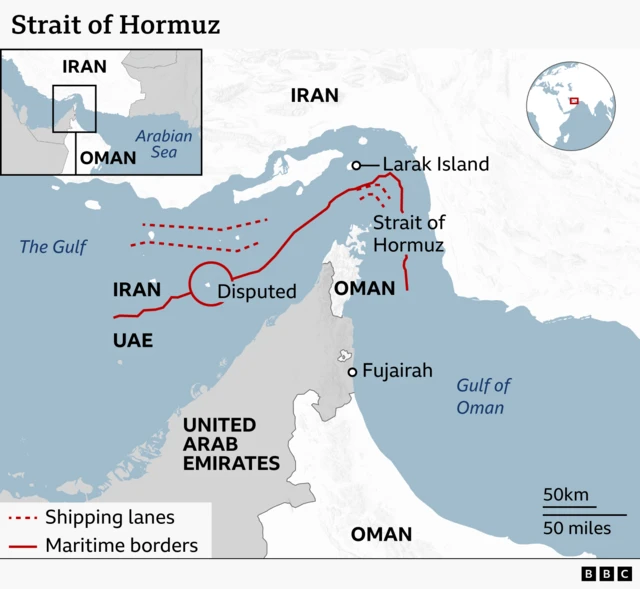
    The Strait of Hormuz, a narrow shipping route in the Gulf region, is one of the world's most important shipping routes. Bounded to the north by Iran and to the south by Oman and the United Arab Emirates (UAE), the Strait of Hormuz connects the Gulf with the Arabian Sea. The strait is deep enough for the world's biggest crude oil tankers, and is used by the major oil and gas producers in the Middle East - and their customers.

    Just under 100 ships have passed through the Strait of Hormuz since the start of March, according to data analysed by BBC Verify, with daily traffic down about 95% since the Iran war began on 28 February.

    Vessels that have successfully passed through the Strait of Hormuz since the start of the month include ships from China, India and Pakistan.

    However, President Donald Trump appears poised to deploy US ground troops to Iran, according to the BBC's US partner, CBS News.

    Military experts say a a possible deployment would likely be focused on increasing pressure on Iran to reopen the Strait of Hormuz, our Washington correspondent writes.
  2. Oil prices drop on Wednesday in Asiapublished at 01:06 GMT

    It's early trade in Asia on Wednesday and oil prices have fallen sharply following US President Donald Trump's comments that negotiations to end the Iran war are happening "now".

    Brent crude is down by 6.5% to $97.65 (£72.71) a barrel, a day after it had crossed $100.

    US-traded oil dipped by 6% to $86.77.

    Prices may have fallen but they are still well higher than before the Iran war started.

    Read more here.

    Close view of a red fuel pump used to top up a car a petrol station.Image source, Getty Images
  3. What's next in Trump's plan for Iran?published at 00:53 GMT

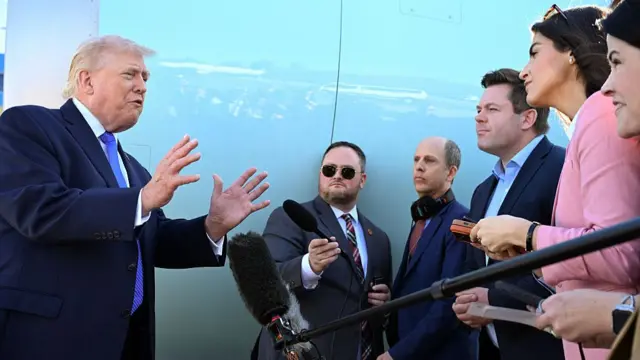
    Donald Trump speaks with reporters outside Air Force OneImage source, Getty Images

    What is next in US President Donald Trump's plan for the war in Iran - does he have an exit strategy?

    The BBC Global News podcast, external has spoken to North America correspondent Anthony Zurcher about what he learned about Trump's goals for the war as he travelled with the president to Tennessee this week - including to Elvis Presley's home Graceland.

    The president has said he is "winding down" the operation, yet he also threatened to "obliterate" Iran's power plants unless Tehran lifted its blockade in the Strait of Hormuz.

    He then postponed those strikes, saying there had been constructive talks with Iran. Iranian officials have denied that any contact with the US had taken place.

    A growing list of countries are said to be trying to mediate between Washington and Tehran, including Pakistan, Turkey and Egypt.

    And there are reports that Vice-President JD Vance, an outspoken opponent of long wars, could join the negotiations - which some analysts say is a possible change of strategy.

    Listen to the BBC Global News podcast to hear more.

    A man in a pale blue shirt and grey jacket looks directly at the camera.
  4. Photos show smoke rising over buildings in Tehran after Israel confirms strikespublished at 00:28 GMT

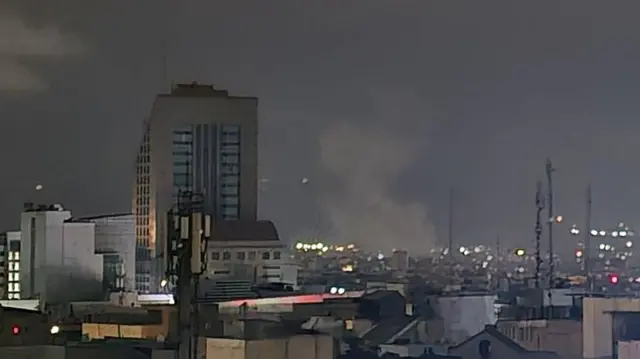
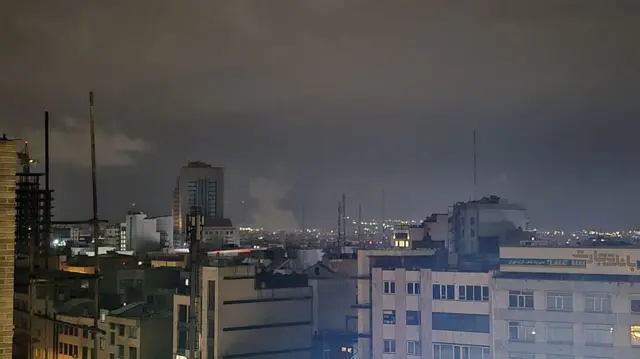
    Israel has confirmed strikes on the Iranian capital of Tehran, with sources on the ground telling the BBC they have been hearing explosions.

    Photos show plumes of smoke rising over buildings in the early morning hours of Wednesday.

    Smoke rises over buildings in an otherwise dark Tehran, IranImage source, Getty Images
    Smoke rises over buildings in an otherwise dark Tehran, IranImage source, Getty Images
  5. Philippines on edge after emergency powers announcementpublished at 00:14 GMT

    Suranjana Tewari
    Asia Business Correspondent in Manila

    A jeepney driver speaks with fellow drivers at a terminal in ManilaImage source, Getty Images

    The morning after President Ferdinand Marcos Jr declared a national energy emergency, the mood across Manila is uneasy.

    The government warns of an “imminent danger” to fuel supplies, after the conflict in the Middle East drove up global oil prices and disrupted shipments.

    The Philippines relies heavily on imported fuel from the region, leaving it exposed to sudden shocks.

    Officials say the country has around 45 days of fuel at current consumption, and they are now racing to secure additional supplies.

    The emergency, which could last up to a year, gives authorities more flexibility - from speeding up fuel imports to offering support for public transport and cracking down on hoarding of essential items like food.

    There are plans to rely more on coal to keep electricity prices from rising further. Ministers have also allowed limited use of a cheaper but dirtier type of fuel temporarily.

    On the streets, the strain is already visible. Jeepney drivers say their earnings have been cut as fuel prices climb, and commuters are bracing for higher fares.

    Labour group Kilusang Mayo Uno has criticised the move, calling it proof the government has failed to manage the crisis - and warning that limits on protests could silence workers.

    Thousands of transport workers, including ride-hailing drivers, are expected to strike later this week - and they say, for now, those plans remain unchanged.

  6. Nuclear watchdog calls for 'maximum restraint' after Iran's nuclear power plant hit againpublished at 23:53 GMT 24 March

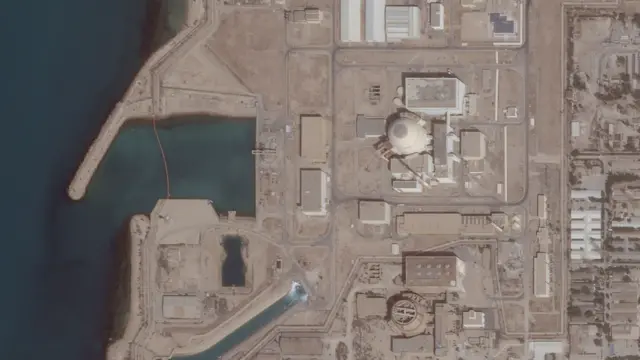
    Satellite image shows the Bushehr Nuclear Power Plant in IranImage source, Reuters

    The International Atomic Energy Agency (IAEA) says Iran informed the agency that another projectile has "hit the premises" of the Bushehr Nuclear Power Plant in Iran.

    "According to Iran, there was no damage to the NPP itself nor injuries to staff, and the condition of the plant is normal," it says.

    The head of the IAEA, Rafael Grossi, reiterated his call for "maximum restraint to avoid nuclear safety risks during conflict".

    Iran’s only operational nuclear power plant, in the southern city of Bushehr, was also hit last week but there were no reports of casualties or damage.

  7. No casualties after drone strike on Kuwait airport, officials saypublished at 23:38 GMT 24 March

    Drones have struck the Kuwait International Airport, leading to a fire but no casualties, the country’s civil aviation authority says.

    Firefighters are working to tame the blaze, and relevant authorities are involved, according to the statement.

  8. IDF confirms new strikes in Tehranpublished at 23:34 GMT 24 March

    The Israel Defense Forces (IDF) says they have begun a "new wave of strikes" in Tehran, targeting infrastructure from the "Iranian terror regime" across the nation's capital.

    The BBC has just heard from sources inside the city who were reporting explosions in the east, the north and the centre of Tehran.

  9. Analysis

    How could US troops potentially be deployed in Iran?published at 23:21 GMT 24 March

    Daniel Bush
    Washington correspondent

    The Trump administration appears poised to deploy US ground troops to Iran, according to reports published by US media today. But some of the information is conflicting, and it's unclear if President Trump has approved such a plan or whether the Pentagon has given the final order yet.

    The Pentagon is expected to send troops from the 82nd Airborne Division, including ground forces and a command element, according to CBS News, the BBC's US partner.

    Trump did not address a possible troop deployment in remarks on the war in the Oval Office earlier today, and the defence department has not announced any troop deployment.

    Military experts say a possible deployment would likely be focused on increasing pressure on Iran to reopen the Strait of Hormuz. Iran began targeting commercial oil tankers that use the strait after the US launched the war last month.

    US troops could be used to take over Kharg Island. The island houses oil storage and loading facilities and accounts for roughly 90% of Iran’s oil exports. Former US defence officials and military experts tell me that US troops could likely easily take control of the small island.

    But the island is roughly 500 miles from the Strait of Hormuz. A military operation there would not stop Iran from disrupting oil shipments in the strait, and it would expose US troops to attacks from Iranian forces.

    Trump has also discussed securing Iran's enriched uranium, sparking speculation that US troops could be sent to get the material - but military experts say that type of operation is riskier and less likely.

  10. Strikes heard in Tehranpublished at 22:53 GMT 24 March

    Ghoncheh Habibiazad
    Senior reporter, BBC Persian

    There have been strikes on Tehran, sources in the east and north of the Iranian capital tell me.

    Another in the centre of the city says the same.

  11. Iran makes clear it will continue to exert control over Hormuz - until a deal is struckpublished at 22:38 GMT 24 March

    Paul Adams
    Diplomatic correspondent

    Cargo ships in the Gulf near the Strait of HormuzImage source, Reuters

    In a message posted by its mission to the UN, Iran says that "non-hostile vessels" will be allowed to pass through the Strait of Hormuz, provided they coordinate with "the competent Iranian authorities".

    The message essentially formalises a situation which has emerged in recent days, in which countries or companies have quietly negotiated safe passage for their vessels as they pass through one of the world's most important shipping lanes.

    In a post on X, the Iranian UN mission says ships will benefit "provided that they neither participate in nor support acts of aggression against Iran and fully comply with the declared safety and security regulations".

    Vessels that have successfully passed through the Strait of Hormuz since the start of the month include ships from China, India and Pakistan.

    Rather than using the two narrow transit corridors closer to Oman, ships have been rerouting further north, through Iranian territorial waters north of Larak Island, allowing the Iranian authorities to monitor and control traffic.

    The issue of freedom of navigation through the Strait of Hormuz features prominently in a 15-point plan to end the war which the White House has sent to Iran via Pakistan, which has been reported by American and Israeli media.

    But until a deal is struck - something which still seems some way off - Iran is making it clear that it will continue to exert as much control as it can over this vital waterway.

  12. Iran firing missiles towards Israel, IDF sayspublished at 22:00 GMT 24 March

    The Israeli military says missiles have been fired towards the country by Iran.

    In a social media post, the Israel Defense Forces (IDF) says "defensive systems are operating to intercept the threat", and advises residents to follow alerts sent to mobile phones.

    We'll bring you more on this when we get it.

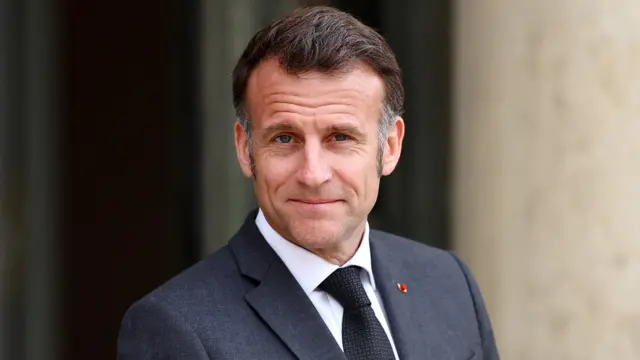
  13. Macron tells Iranian president: Engage in negotiations in 'good faith'published at 21:54 GMT 24 March

    Emmanuel MacronImage source, Reuters

    In Europe, French President Emmanuel Macron says he's spoken to President Masoud Pezeshkian and called on Iran to end its attacks on Gulf countries.

    Macron says he also emphasised the importance of "restoring freedom of navigation in the Strait of Hormuz", and "preserving energy and civilian infrastructure".

    The French leader says he urged Iran to engage in negotiations in "good faith" - adding this would "open a path towards de-escalation".

    Meanwhile, Israeli President Isaac Herzog says he's also spoken to Macron. In a social media post, Herzog’s office says the president reiterated the importance of continuing its operation "in order to prevent Iran from ever obtaining a nuclear weapon and dismantle its ballistic missile capabilities".

    The Israeli president is also said to have told Macron that "a vision of peace with Lebanon is the right objective", but this requires Israel to dismantle Hezbollah’s capabilities.

  14. Residents of southern Lebanon warned to evacuate by Israeli militarypublished at 21:40 GMT 24 March

    The Israeli military has issued a fresh warning to residents in the southern suburbs of Lebanon's capital Beirut to evacuate.

    In a social media post, spokesperson Avichay Adraee says the Israel Defense Forces (IDF) is continuing its operations and attacks on Hezbollah infrastructure in the region.

    Adraee lists neighborhoods including Haret Hreik, Laylaki, Haddad and Borj el-Branjeh, from which he warns residents must "evacuate immediately" to avoid harm.

    Earlier, Lebanon's health ministry said the number of people killed since the beginning of this conflict had risen to 1,072.

  15. US and Israeli media reporting US has handed over 15-point plan to Iranpublished at 21:22 GMT 24 March
    Breaking

    The New York Times, Reuters news agency and Israel's Channel 12 are reporting that the US has handed over a 15-point plan to Iran, via Pakistan, which earlier offered to host peace talks between the warring countries.

    The outlets are citing unnamed sources. The BBC has not seen the document and is working to verify the reports.

    Channel 12 lists some of the demands the US has reportedly made to Iran, including that the Strait of Hormuz is open and constitutes a free maritime zone. It also details what Iran would reportedly receive if it were to accept the plan, including the removal of sanctions.

    We've asked the White House for more information and will bring you more details when we get them.

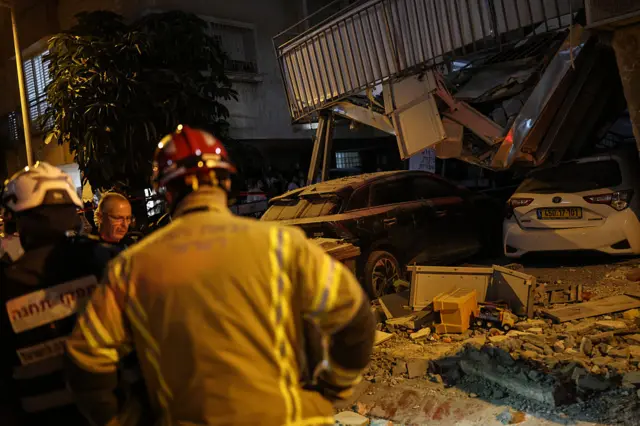
  16. Several injured, including children, in strike on Israel's Bnei Brakpublished at 20:25 GMT 24 March

    Emergency personnel work at the site where a building was struck by a projectile in Bnei Brak.Image source, AFP via Getty Images
    Image caption,

    Emergency service workers at the site of a projectile strike in Bnei Brak, Israel

    Israel's emergency responders say they are treating six children among nine people injured after a strike in the central city of Bnei Brak, on the outskirts of Tel Aviv.

    Magen David Adom says a 23-year-old man with shrapnel injuries is in a "moderate condition" while eight others, including six children, have suffered mild blast and shrapnel injuries following an explosion.

    In a post on X, the responders also say they have rescued a boy, 7, with glass shrapnel injuries, and are conducting searches across a number of sites that have been struck.

  17. Iran says Bushehr nuclear power plant site attacked againpublished at 19:59 GMT 24 March

    Ghoncheh Habibiazad
    Senior reporter, BBC Persian

    The Public Relations Office of Iran’s Atomic Energy Organisation (AEOI) says in a statement published by Iranian outlets that the site of the Bushehr nuclear power plant has been attacked again today.

    The statement alleges that the strike was "in continuation" of the attacks carried out by the US and Israel. It adds the incident caused "no financial or technical damage, and no casualties", and "no part of the facility" was affected.

    The AEOI says the same nuclear power plant was hit on 17 March, but that incident also resulted in no casualties or damage.

    It condemns the attacks on what it described as "peaceful nuclear facilities" and warns such actions could have "dangerous and irreparable consequences" for regional security and safety, "particularly for countries along" the Gulf.

    Iran’s only operational nuclear power plant, in the southern city of Bushehr, was completed with Russia's assistance.

    Iran’s nuclear programme has long been a point of contention, leading to extensive international sanctions. The US-Israeli war with Iran began on 28 February, two days after a third round of indirect US–Iran nuclear talks in Geneva.

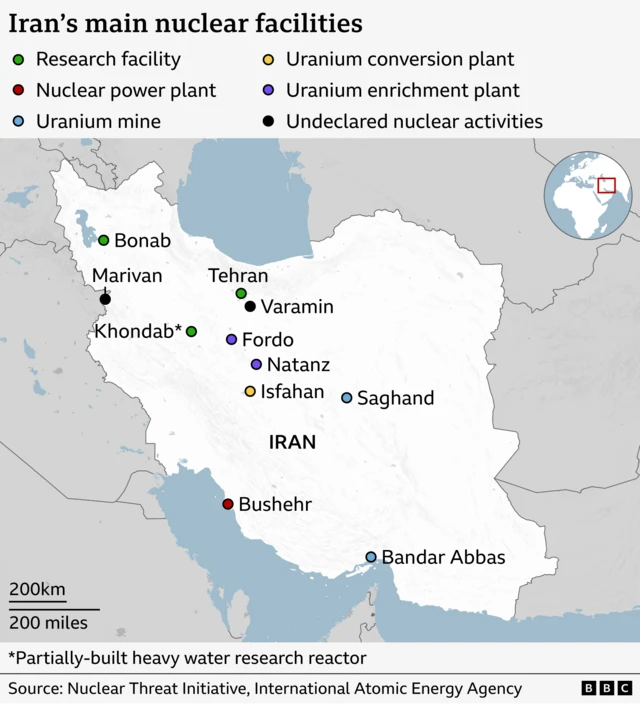
    Map of Iran showing the locations of its main nuclear facilities. Sites are marked with coloured dots representing different facility types: research facilities (green), nuclear power plant (red), uranium mines (blue), uranium conversion plant (yellow), uranium enrichment plants (purple), and sites of undeclared nuclear activities (black). Key locations include Natanz and Fordo (enrichment plants), Arak (research reactor), Bushehr (power plant), Isfahan (conversion plant), and others such as Tehran, Marivan, Varamin, and Saghand. A small inset map shows Iran’s location within the region. Source: Nuclear Threat Initiative and International Atomic Energy Agency.
    Image caption,

    Iran's only operational nuclear power plant, Bushehr, is located in the south west of the country

  18. Israeli military says Iranian missile fell in Lebanon's capitalpublished at 19:41 GMT 24 March

    A close-up of a hole in a wall in BeirutImage source, Reuters
    Image caption,

    Damage has been pictured in Beirut as the Israeli offensive against Hezbollah has continued

    We're now moving away from Donald Trump's latest comments and turning back to what's happening across the Middle East.

    Through the day, we've been seeing reports of Israeli strikes continuing to hit Lebanon.

    The Lebanese health ministry says a further 33 people have been killed in the past 24 hours, while vast piles of rubble have been pictured in the capital Beirut.

    Israel's military has now blamed Iran for a missile that fell in Beirut.

    In an update, the Israel Defense Forces (IDF) says: "a ballistic missile fired by the Iranian terror regime fell in Beirut". It explains that this has been established "following an assessment and based on the data available to the IDF, alongside the launches carried out toward the State of Israel earlier today".

    Iran has not commented.

  19. Analysis

    Trump strikes positive tone on Iran negotiations, but lacks clarity on specificspublished at 19:35 GMT 24 March

    Bernd Debusmann Jr
    Reporting from the White House

    Donald Trump struck an optimistic tone in the Oval Office just now, doubling down on negotiations and publicly suggesting that this conflict will end through negotiations.

    From a purely military standpoint, Trump clearly believes the US has already prevailed, saying the war "has been won" and blaming any ongoing questions about that on the media.

    For the first time, we heard Trump directly confirm that Vice President JD Vance, Secretary of State Marco Rubio, special envoy Steve Witkoff and Jared Kushner are taking part in negotiations.

    Who they are negotiating with, however, remains unclear, as does the substance of the negotiations or any clarity on how far along they are.

    Trump has also not, so far, publicly specified what exactly he wants from the Iranians as far as concessions, other than a firm commitment - which he says the US has - that Iran will abandon its nuclear weapons programme.

    Other US war aims - such as an end to Iran's support for proxy organisations in the Middle East or an end to its ballistic programme - garnered little mention.

    Importantly, Trump also made no mention of Israel, or how a negotiated settlement would support their own military and geopolitical objectives in the region.

  20. Key takeaways from Trump's update on Iran warpublished at 19:24 GMT 24 March

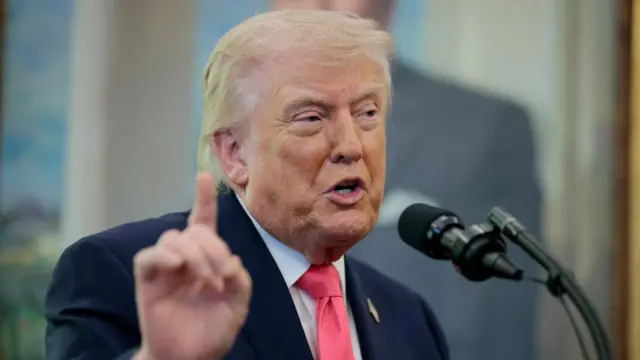
    Donald Trump raises a finger while speaking into a microphone in the Oval OfficeImage source, Reuters
    • Trump said his administration was "talking to the right people" in Iran, and "they want to make a deal so badly". He also said Vice President JD Vance and Secretary of State Marco Rubio are involved in the discussions
    • The president said the Iranian regime have agreed they will never have a nuclear weapon - a claim he has made before. He also said strikes on Tehran have led to "regime change"
    • He hinted at a "very significant prize" gifted to the US by Iranian negotiators, adding it was related to oil and gas, and the Strait of Hormuz. No further detail was given
    • Asked how hopeful he was that a peace deal with Iran would work, Trump responded: "This war has been won". Though as our White House reporter noted, there was little mention of how the war could actually end