Summary

  1. Key takeaways from Trump's update on Iran warpublished at 19:24 GMT
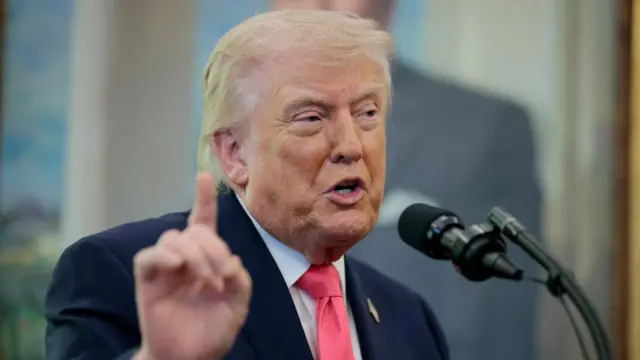
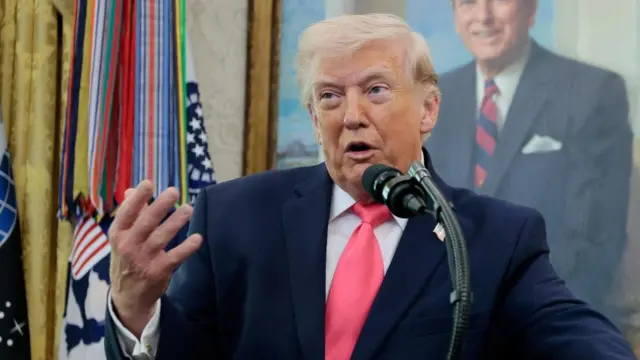
    Donald Trump raises a finger while speaking into a microphone in the Oval OfficeImage source, Reuters
    • Trump said his administration was "talking to the right people" in Iran, and "they want to make a deal so badly". He also said Vice President JD Vance and Secretary of State Marco Rubio are involved in the discussions
    • The president said the Iranian regime have agreed they will never have a nuclear weapon - a claim he has made before. He also said strikes on Tehran have led to "regime change"
    • He hinted at a "very significant prize" gifted to the US by Iranian negotiators, adding it was related to oil and gas, and the Strait of Hormuz. No further detail was given
    • Asked how hopeful he was that a peace deal with Iran would work, Trump responded: "This war has been won". Though as our White House reporter noted, there was little mention of how the war could actually end
  2. White House says any update on US troop deployment will come from defence officialspublished at 19:24 GMT

    Bernd Debusmann Jr
    Reporting from the White House

    As we said in our last post, the issue of a potential deployment of US ground troops to Iran, or to secure the Strait of Hormuz, did not come up during Trump's Oval Office comments.

    I've been pressing the White House for several hours on the topic, and just moments after Trump's event ended, I received a response.

    "All announcements regarding troop deployments will come from the Department of War," White House spokesperson Anna Kelly said in a statement. "As we have said, President Trump always has all military options at his disposal."

    Earlier today, the BBC asked the Pentagon for comment on the potential troop deployments, but was referred to the White House.

  3. Wide-ranging remarks from Trump - but no mention of whether US will deploy troopspublished at 19:13 GMT

    Daniel Bush
    Washington correspondent

    Donald Trump gave wide-ranging remarks about the war in Iran on Monday in a lengthy exchange with reporters in the Oval Office.

    The one issue that didn’t come up? A possible US troop deployment to Iran.

    In the hour before Trump’s appearance, several news outlets reported that the Pentagon was close to finalising an order to send thousands of US troops to Iran.

    But Trump wasn’t asked about the potential troop deployment by the press during the event. He didn’t bring it up on his own, either.

    Trump said the US was negotiating a potential end to the war with Iran and that, as part of those talks, Iran has agreed to abandon its nuclear programme. Iran is yet to respond.

  4. US defence secretary asked to give brief operational update on warpublished at 18:58 GMT

    The last bit of this White House event we're going to bring you comes from US Defence Secretary Pete Hegseth, who Donald Trump asks to come to the microphone.

    "We negotiate with bombs," Hegseth says, after Trump took questions on potential negotiations between the US and Iran.

    He adds that "never in history" has a modern military force such as Iran's been so quickly "obliterated".

    That's it for our live updates of this event - we'll bring you a round-up of the key points shortly.

  5. War has been won, Trump sayspublished at 18:54 GMT

    Donald Trump - speaking to reporters at the White House - is asked for further comment on the Gulf states during the Iran war.

    He says the UAE has been "excellent", and describes Qatar as "great".

    Asked again how hopeful he is that a peace deal with Iran will work, Trump responds: "This war has been won".

  6. Iran has given US 'significant prize' related to Strait of Hormuz - Trumppublished at 18:51 GMT

    Trump says Iranian negotiators have given the US a "very significant prize" related to oil and gas.

    The gift, the US president says, is related to the Strait of Hormuz - but he doesn't give any further detail.

    He says this showed him that "we're dealing with the right people".

  7. Trump: US-Israeli strikes on Iran led to regime change, but I don't trust anybodypublished at 18:49 GMT

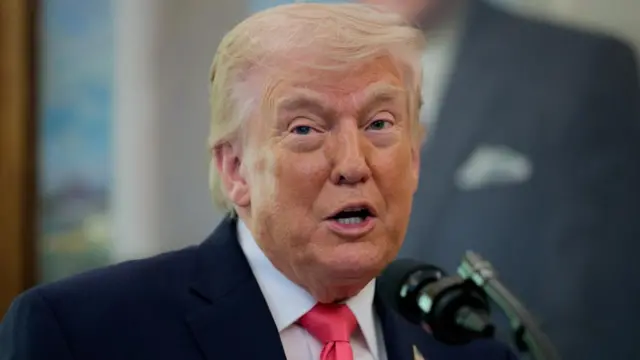
    Trump in a pink tie.Image source, Reuters

    The Iranian regime has agreed the country will never have a nuclear weapon, Trump says - a claim he has made before during this conflict.

    He is also asked to give a sense of who his teams have been negotiating with in Iran.

    "We killed all their leadership, and then they met to choose new leaders and we killed all of them," Trump responds.

    "Now we have a new group... let's see how they turn out."

    Trump says that the US-Israeli strikes have led to "regime change" - but warns: "I don't trust anybody".

  8. Analysis

    There's little to no mention of how war in Iran could endpublished at 18:43 GMT

    Bernd Debusmann Jr
    Reporting from the White House

    Trump has so far shed very little light on his thinking regarding a ceasefire, or the negotiated end to the war in Iran.

    As recently as last week, Trump said that he was not interested in a ceasefire, and remained bullish on the conflict until yesterday's announcement that US forces would hold off on attacking Iranian energy facilities if the Strait of Hormuz remains closed.

    Asked what prompted him to change his mind, Trump said that the Iranians are now "talking to us" and "talking sense".

    This claim, however, stands in contrast to public remarks from Iranian officials, although it may well be that initial overtures are taking place behind the scenes.

    Trump's red line for negotiations continues to be that Iran cannot be allowed to have a nuclear weapon.

    So far on Monday he has not made any mention of Iran's ballistic missile programme or its support for proxy groups in other parts of the Middle East - both of which were stated war aims of the Trump administration early on in the conflict.

  9. Trump says Vance and Rubio involved in Iran negotiationspublished at 18:38 GMT

    Trump is asked about sending his senior adviser Jared Kushner and Middle East envoy Steve Witkoff for direct negotiations with Iran.

    The president says they are in negotiations "right now", alongside Vice President JD Vance and Secretary of State Marco Rubio.

    He claims Iran "would like to make a deal...and who wouldn't if you were there?"

    Trump says Iran's navy, air force, and communications are "gone", and the fact that they can't communicate poses "the biggest problem".

  10. Analysis

    US president seems optimistic about Iran's willingness to negotiatepublished at 18:30 GMT

    Bernd Debusmann Jr
    Reporting from the White House

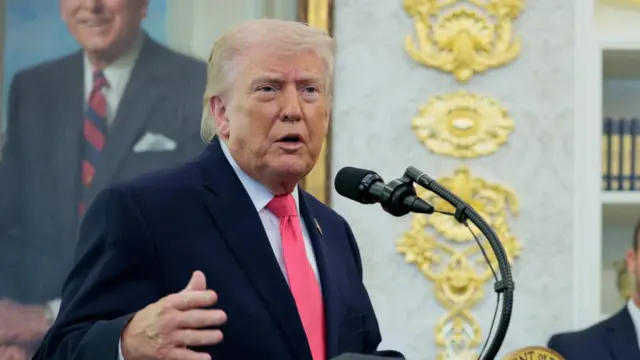
    Trump speaking in Oval office in a pink tie.Image source, Reuters

    While Donald Trump's initial remarks focused on the topic at hand - the swearing-in ceremony for Markwayne Mullin - the US president quickly praised the military success of Operation Epic Fury.

    As we reported in our last post, Trump also said the US is "talking to the right people" and Iran wants "to make a deal so badly".

    The Trump administration has so far publicly not specified who they would negotiate with in Iran, and various figures within the Middle Eastern country have denied such talks are taking place.

    It is also not clear what form Trump believes the Iranian government will take once the conflict ends, or whether he stands by his previous remarks that the US should have a hand in choosing Iran's future leader.

    On multiple occasions, Trump has suggested that he hopes for an Iranian equivalent of Delcy Rodriguez, Venezuela's acting president who took over governance of the country after Nicolas Maduro was captured by the US in January.

    Trump's now answering questions from reporters, so we'll see if we get any further detail.

  11. Trump says US 'talking to right people' in Iran and officials there 'want a deal so badly'published at 18:25 GMT

    TrumpImage source, Reuters

    Back in the White House, Donald Trump addresses the conflict in the Middle East while swearing-in his new secretary of Homeland Security.

    He repeats claims made before, that Iran has no remaining navy, leaders or radar - and calls the US operation a "tremendous success".

    On peace talks, he adds: "We're talking to the right people and they want to make a deal so badly."

  12. 'I don't think they will negotiate': Iranians respond to reports of US-Iran talks to end warpublished at 18:17 GMT

    BBC Persian

    We're continuing to listen into a White House event where Donald Trump is speaking (see our last post) and will bring you any updates on the war, but in the meantime BBC Persian has been speaking to Iranians about the conflicting reports surrounding talks between Iran and the US.

    Most have been expressing their disbelief at the reports.

    "I don't think that they will negotiate," says one man in Karaj, a city near Tehran.

    "Even if the war stops, it will start again at some point," he says, adding that the Islamic Republic is "very much in place right now".

    A woman in Tehran shares a similar view: "Trump is buying time for himself to take the war to another phase... I don't think that he's going to make a deal with them".

    "I don't think that any negotiations are happening," says another Tehran resident. "[Trump] sometimes says various things. I think his games are complex."

    • For context: On Monday, Iranian officials denied any contact with the US had taken place after Trump said there had been "productive" talks between Iran and the US. Iran's parliament speaker branded the comments "fake news".
  13. We're due to hear from Trump shortly - watch and follow livepublished at 18:03 GMT

    Donald Trump is expected to appear at a White House event soon, where he'll be swearing-in his new Secretary of Homeland Security Markwayne Mullin.

    We've heard very little from the US president, so far, today. Earlier, on his Truth Social platform, he shared without comment an X post from Pakistani Prime Minister Shebhaz Sharif, who has offered to host US-Iran peace talks.

    We'll keep an eye and ear across the event, and bring you any key lines should Trump give an update on the war in the Middle East. You can also watch the event liveat the top of the page.

  14. Iran's ambassador to Lebanon expelled by country's foreign ministrypublished at 17:58 GMT

    Also in Lebanon, the Iranian ambassador has been expelled from the country and declared "persona non grata", according to Lebanon's ministry of foreign affairs.

    In a statement, the ministry says Mohammad Reza Shibani had been asked to leave Lebanese territory by 29 March, later adding that the decision did not constitute a "severing of diplomatic relations" with Iran.

    The department also says it has summoned its ambassador to Iran, Ahmad Sweidan, back to Lebanon due to "Tehran's violations of the norms".

    Hezbollah, based in Lebanon, is calling for the country to "immediately reverse" its decision against Shibani and calling it a "national and strategic sin", according to a statement carried by Lebanese state media.

    Hezbollah - considered a terrorist organist by the UK, US and some other nations - is a Shia Muslim political and military group. It has strong backing from Iran and opposes Israel's right to exist.

  15. Lebanese health ministry: 1,072 killed since start of warpublished at 17:42 GMT

    The number of people killed in Lebanon since Israel began its latest operations against Hezbollah has risen to 1,072, according to the country's health ministry.

    That's up from 1,039 on Monday, meaning 33 more deaths have been recorded in the past 24 hours.

    The ministry says the number of people wounded has also increased, to 2,966 - up by 90 on Monday's figure.

  16. Destruction after missiles hit Tel Aviv and Beirut, as Tehran prepares for future attackspublished at 17:30 GMT

    Photographs from Tuesday show the damage caused to cities being hit by strikes.

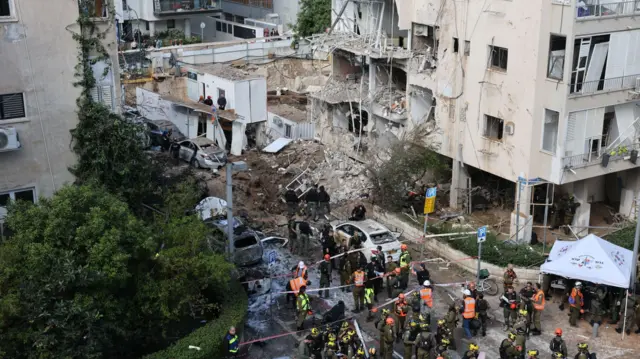
    In Tel Aviv, Israel, balconies were sheared off residential buildings and walls were seen shedding masonry into a crater, following what officials are saying was a direct hit from an Iranian missile.

    Israeli emergency workers at the site of a missile attackImage source, EPA/Shutterstock

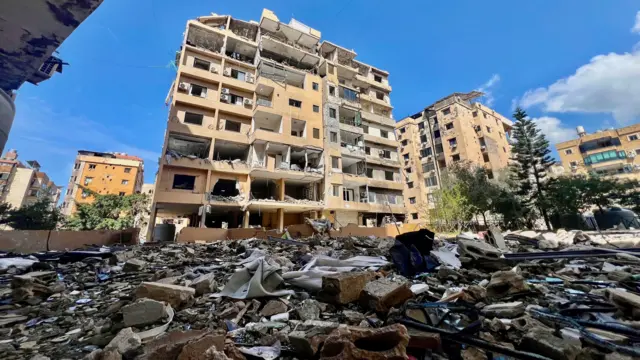
    In Beirut, Lebanon, vast piles of rubble have been pictured in the southern suburbs following overnight strikes from Israel.

    Rubble in BeirutImage source, Reuters

    Across Iran, some 82,417 "civilian units" (hospitals, clinics, pharmacies) have been damaged by air strikes since the start of the war, according to the president of the Iranian Red Crescent.

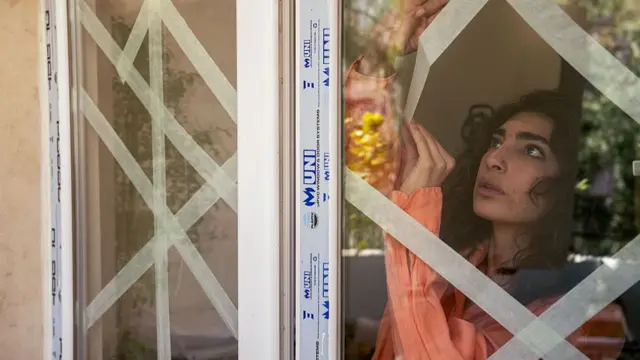
    Images coming out of Tehran show some residents making preparations for future strikes.

    A resident tapes a window to prevent it from shattering, amid ongoing US-Israeli strikesImage source, Getty Images
  17. Strike hits north Lebanon, local media reportspublished at 16:44 GMT

    A village in the north of Lebanon has been targeted by an air strike, according to unverified reports from Lebanese media.

    The country's National News Agency says one of its correspondents reported the strike, while the LBCI claims a missile exploded mid-air, sending fragments across the area.

    Reuters news agency says there were no immediate reports of casualties in the town of Sahel Alma.

    The BBC has not been able to independently verify the claims.

    Sahel Alma is a town in the Keserwan district of Lebanon, north of the capital Beirut.

  18. Bahrain suffers one of its worst attacks, as Gulf official calls it 'dangerous escalation'published at 16:01 GMT

    Frank Gardner
    Security correspondent, reporting from Doha

    Bahrain has suffered one of its worst attacks of the war so far, after an Iranian missile hit a military base in the west of the island.

    Bahrain said the attack on Hamala base killed a UAE military contractor (a Moroccan national) and injured over a dozen others, with four in critical condition.

    All the injured are Bahraini or UAE military personnel.

    A senior Gulf official said the attack marked "a dangerous escalation".

    "We will not be intimidated; our partnership with the Gulf, the United Kingdom and the United States is further strengthened," the official adds.

    Bahrain is home to the US Navy’s 5th Fleet but that base was evacuated days before the war began, with ships leaving port to spread out at sea.

    The island nation, which has often been "claimed" by Iran as a lost province, has debatably the worst relations with Tehran of all the six Gulf Arab states.

    It continues to suffer nightly drone and missile attacks from Iran, the vast majority of which are intercepted. Other attacks have hit oil storage tanks, the airport and a residential apartment block.

    Bahrain has a large and sometimes restive Shia population, some of which are known to have sympathies with the Islamic Republic of Iran. Bahrain is the only Gulf Arab state to deny entry to the international media.

  19. 'I want to blink and have it all be over': Iranians speak to BBC as strikes continuepublished at 15:30 GMT

    Ghoncheh Habibiazad
    Senior reporter, BBC Persian

    People in Iran have been speaking to BBC Persian about the Middle East conflict, one woman in her 20s says she "just wants to blink and have it all done and over".

    "I don't know how to feel," she says, adding: "I don't even want to think about the next steps."

    If the war ends and explosions stop, she tells the BBC, Iran will be left with a "regime that is very weak", but one that "still has power over their own people". She thinks the regime could "become even more violent".

    Meanwhile, a man in his 20s from Tehran finds Iran's denial of negotiations with the US "interesting", adding: "Literally anything that happens they deny it."

    "I don't care when it [the war] ends. I do care about how it ends," he adds.

    • BBC Persian is the Persian language service of BBC News, used by 24 million people around the world - the majority in Iran - despite being blocked and routinely jammed by Iranian authorities.
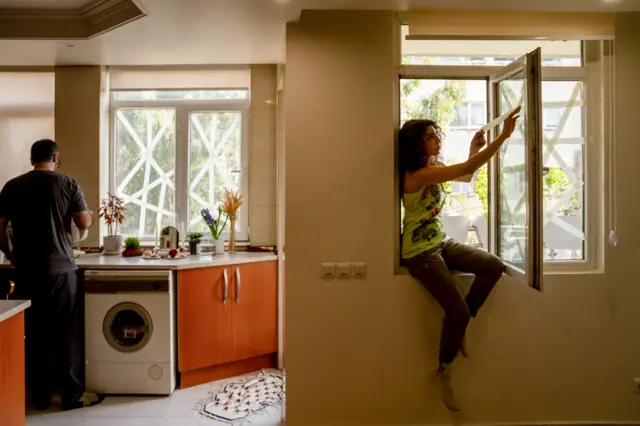
    A person tapes a window as another works in the kitchen in a home in Tehran on TuesdayImage source, Getty Images
    Image caption,

    A photo from Tehran today shows residents (not those quoted) taping windows to help prevent shattering amid strike attacks

  20. Iranian Red Crescent says 82,000 sites, including hospitals, damaged by strikes since war beganpublished at 15:10 GMT

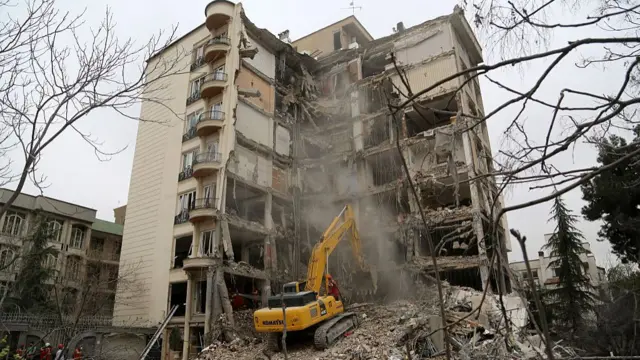
    A digger combs through a building which has been torn in half by an airstrikeImage source, Getty Images
    Image caption,

    Buildings in the Iranian capital Tehran have borne the brunt of US-Israeli strikes

    In our previous post we brought you images of daily life continuing in Tehran, but it comes amid the backdrop of ongoing conflict in the Middle East.

    Since the start of the war in Iran, 82,417 "civilian units" across the country have been damaged by airstrikes, according to the president of the Iranian Red Crescent.

    The humanitarian organisation's president says that "a total of 281 hospitals, clinics, and pharmacies have also been targeted".