Summary

  • Nasa's Artemis II astronauts set a new record for the furthest distance humans have travelled from Earth - watch live coverage above

  • They have broken the previous record of 248,655 miles (400,171km) set by the Apollo 13 crew in 1970

  • In an emotional moment, the crew tell mission control they'd like to name a Moon crater after commander Reid Wiseman's late wife, Carroll

  • The four astronauts will soon fly around the Moon - why are they going?

  • The 10-day voyage is the first time in more than half a century that humans have left Earth orbit

  • The astronauts won't land on the Moon's surface, but the Orion spacecraft will loop around its far side and back again - what will they do as they fly by?

  1. 'The Earth is a small crescent' - Wisemanpublished at 19:38 BST

    Commander Reid Wiseman of NASA speaks with family members during the walkout from the Neil A. Armstrong Operations and Checkout Building toward Launch Pad 39B as part of Artemis II's launch preparations in Titusville, Florida, USA, 01 April 2026.Image source, EP
    Image caption,

    Commander Reid Wiseman pictured during launch preparations in Florida earlier this month

    Commander Reid Wiseman, leading the Artemis mission, has been giving an update of the view that his crew is seeing from the spacecraft's window.

    "The earth is a small crescent out there. It's magnificent, I got a picture of it...such a majestic view out here," he says.

  2. Lunar observations starting soonpublished at 19:35 BST

    We've just been hearing from the Artemis crew, who say they are ready to begin the lunar observation period in around 13 minutes.

    Stick with us as we bring you the latest from onboard the Orion spacecraft.

  3. Crew is more than 240,000 miles from Earthpublished at 19:20 BST

    Kelsey Young from mission control says the crew is 248,655 miles (400,171 km) from Earth. They will reach their furthest distance around 18:07 central time (22:07 GMT).

    "At that time they will be in an LOS or a loss of signal with us on Earth as they'll be flying behind the Moon," she adds.

  4. Crew names Moon crater after Artemis II commander's late wifepublished at 19:17 BST

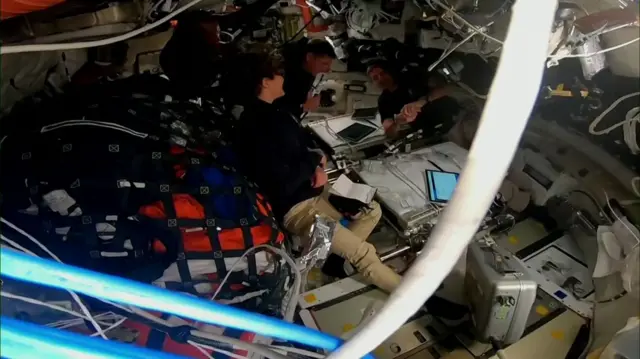
    Two astronauts can be seen hugging each other inside the spacecraft with two more behind themImage source, NASA
    Image caption,

    The crew hugged after commander Reid Wiseman emotionally described which crater he wanted to name after his late wife

    Astronaut Jeremy Hansen tells Nasa's Kelsey Young that the crew would like to name some craters on the Moon that they can currently see "both with our naked eye and with our long lens".

    He asks Nasa to name one after Artemis II commander Reid Wiseman's late wife, Carroll, who died in 2020 of cancer.

    They name another crater Integrity - after the Orion spacecraft which has carried them to the far side of the Moon.

    "A number of years ago we started this journey.. and we lost a loved one and there's a feature on a really neat place on the moon... at certain times of the Moon's transit around Earth we will be able to see this from Earth," he says.

    Jim Lovell, an astronaut in the Apollo 8 and 13 missions who had prerecorded a message for the Artemis crew before he died last year, also named a crater after his late wife, Marilyn, in 1968.

    Correction: An earlier version of this post incorrectly attributed the quotes above to Reid Wiseman.

  5. A major milestone, but the focus is now on what lies aheadpublished at 19:13 BST

    Rebecca Morelle
    Science editor, Houston

    We were in mission control just a few hours ago - on a big screen at the front of the room, they were keeping track of the Apollo distance record, counting down the miles until they surpassed the distance set so long ago.

    This is a major milestone for the team there, but there focus will be very much on the hours ahead as the crew travel even further into space.

  6. Artemis II crew challenges next generation 'to make sure this record is not long-lived'published at 19:05 BST

    On breaking the Apollo 13 record, one of the Artemis astronauts says: "We surpass the furthest distance humans have ever travelled from planet earth. We do so in honouring the extraordinary efforts and feats of our predecessors in human space exploration.

    "We will continue our journey even further into space before Mother Earth succeeds in pulling us back to everything we hold dear."

    He challenges this generation and the next "to make sure this record is not long-lived".

  7. This is a huge moment for the crewpublished at 19:03 BST

    Rebecca Morelle
    Science editor, reporting from Mission Control in Floria

    Astronauts inside the Orion spacecraftImage source, NASA

    They are now further than any human has ever been from Earth - a very long way away from home.

  8. Artemis II crew breaks record for the furthest humans have ever travelled from Earthpublished at 18:59 BST
    Breaking

    Media caption,

    Watch: Moment Artemis II sets distance record

    The Artemis II crew has broken the record for the furthest distance humans have travelled from Earth.

    The record was previously set by the Apollo 13 crew in 1970 - the crew travelled 248,655 miles from Earth.

    Artemis II will beat this record by about 4,102 miles, reaching a maximum distance of 252,757 miles.

    We're expecting to hear from the crew on their reaction shortly.

  9. Two-minute delay to Artemis crew breaking recordpublished at 18:57 BST

    We've just heard that there's been around a two-minute delay to when the Artemis crew will break the record of the furthest distance humans have travelled from the Earth.

    We'll keep you up-to-date with the latest updates when we get them.

  10. Say cheese! Asia, Africa and Oceania to be pictured, Nasa sayspublished at 18:48 BST

    Nasa science officer Kelsey Young continues speaking to the crew.

    She tells them that "around earthset and earthrise", when the crew is "viewing us back here at home", they'll be looking directly at Asia, Africa and Oceania.

    "So I'm sure people watching from those places here on Earth will wanna give you a wave as you take their picture," she adds.

    Earlier we heard from Artemis curation lead Juliane Gross, who explained that the crew will be able to see craters on the Moon such as Aristarchus Plateau and Grimaldi, and lunar plain Oceanus Procellarum.

  11. The major milestones of the mission so farpublished at 18:45 BST

    Tara Mewawalla
    Live reporter

    We are moments away from one of the most important milestones of the of the Artemis II mission - the crew will break the record for the furthest distance humans have travelled from Earth.

    Here is a look back at the other key moments of this mission:

    • April 1: The Artemis II rocket blasted into the sky at 18:35 EDT (22:35 GMT) at the Kennedy Space Center in Cape Canaveral, Florida. The BBC's Science Editor, who was standing three miles away, explained how she could feel its force
    • April 2: While speaking to Earth via video link, astronaut Christina Koch mentioned there had been a slight "priming" issue with the toilet and Nasa announced on Saturday that a wastewater vent line had clogged. Nasa Administrator Jared Isaacman told CNN nailing this capacity is one "we need to certainly work on"
    • April 3: Nasa shared the first high-resolution images of the Earth taken by the Artemis II crew as they passed the halfway point between Earth and the Moon
    • April 6: Nasa said Artemis entered the lunar sphere of influence at 00:38 EDT - the point where the pull of the Moon's gravity becomes stronger than the pull of the Earth's
    • April 6: Very soon, we are expecting Artemis II to break the record for the farthest distance travelled by humans from Earth - they will reach a maximum distance of 252,757 miles
    • And later tonight, the four astronauts will be alone for around 40 minutes as the Moon will block the back-and-forth communication between the spacecraft and Earth
  12. 'We hear you loud and clear': Mission control speaks with Artemis II crewpublished at 18:42 BST
    Breaking

    Nasa Science Officer Kelsey Young has just checked in with the Artemis II crew.

    "How do you hear me?" she asks.

    One of the astronauts replies: "We hear you loud and clear. Kelsey, you've just got to know you're pulling us away from the Moon just now so let's go."

  13. Crew speak to Nasa mission control ahead of lunar flybypublished at 18:32 BST
    Breaking

    We're now hearing from the Artemis II crew, who are speaking to the science officer in Nasa's Mission Control Centre in Houston from onboard the Orion capsule.

    This will be the crew's last chance to review the details of the mission before the flyby begins.

  14. Thirty minutes until Artemis crew travel further from Earth than any humans beforepublished at 18:31 BST

    We're less than 30 minutes away from Nasa's Artemis II astronauts breaking a record that has stood since 1970.

    They're set to go beyond 248,655 miles (400,171km) from Earth - the distance that was travelled by the Apollo 13 crew.

  15. 'I'm proud to pass the torch to you,' late Apollo 13 commander tells Artemis crewpublished at 18:29 BST

    In a short while, the Artemis II astronauts are expected to surpass a record for travelling the furthest away from Earth than any humans before - set on Apollo 13 in 1970.

    Today, the four-strong crew woke up to hear a special message recorded by astronaut Jim Lovell, who took part in the Apollo 8 and 13 missions. Lovell made the recording shortly before his death last year.

    "Welcome to my old neighbourhood... I'm proud to pass that torch on to you as you swing around the Moon", he tells the astronauts.

    "It's a historic day, and I know how busy you'll be, but don't forget to enjoy the view", he adds.

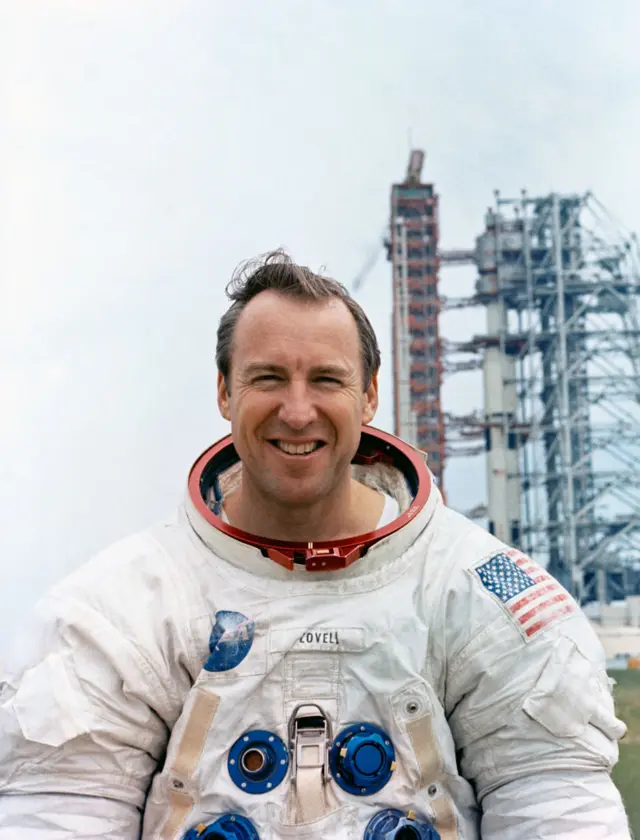
    Astronaut James A. Lovell in his space suit poses in front of Nasa equipment while training for the Apollo 13 missionImage source, Universal Images via Getty
    Image caption,

    Astronaut James Lovell, who was commander on the Apollo 13 mission in 1970, died last year

  16. The mission so far: Flawless and beautifulpublished at 18:18 BST

    Pallab Ghosh
    Science correspondent

    Artemis II roared off the launch pad and into history on Thursday - and so far, the mission is doing exactly what Nasa hoped for.

    “Flawless” was the word that the head of the Artemis programme, Dr Lori Glaze, used.

    And the sights have not failed to astonish us all, from the moment the SLS rocket turned the Florida evening into a wall of white flame and thunder.

    After a day in Earth orbit, Orion’s training wheels came off and the spacecraft with its four astronauts were blasted into an elliptical orbit around the Moon and back - seeing and sharing with us sights that had not been seen for more than fifty years.

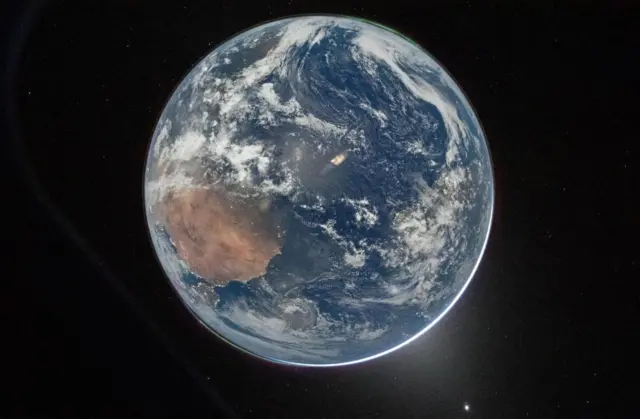
    Notably the view of the whole Earth from space: a stunning view of our planet hanging in the blackness of space.

    The entire Earth hangs luminous in the blackness of space: deep blue oceans and swirling white clouds and bright atmosphere give it the appearance of a shimmering jewelled marble. An echo of the first colour image of Earth taken by the astronauts of Apollo 8 in 1968.

    Back then the image that provided a moment of hope and optimism to a divided and war-torn world, and perhaps the new picture and the mission so far might have the same effect, especially as the best is yet to come with more spectacular images as the Orion space hurtles towards to its destination.

    the entirrety of Earth is seen from the orion spacecraft. part of south america and the sahara desert are visible. clouds swirl over top and the vast, blue oceans can be seen. it is illuminated towards the southern axis by the sun, creating a sliver of light on the edge.Image source, NASA
  17. The 40 minutes of silence during the flybypublished at 18:12 BST

    Alison Francis
    Senior science journalist

    As the astronauts pass behind our celestial neighbour, the radio and laser signals that allow communication between the spacecraft and Earth, will be blocked by the Moon itself.

    For about 40 minutes, the four astronauts will be totally alone.

    They’ll spend the blackout dedicated to lunar observation – taking images, studying the Moon’s geology and simply gazing at its bleak beauty.

    When they emerge and the signal is re-established, the world is expected to breathe a collective sigh of relief.

    And the history-making astronauts will be able to share their incredible views with everyone back home.

  18. What is the mission all about?published at 18:04 BST

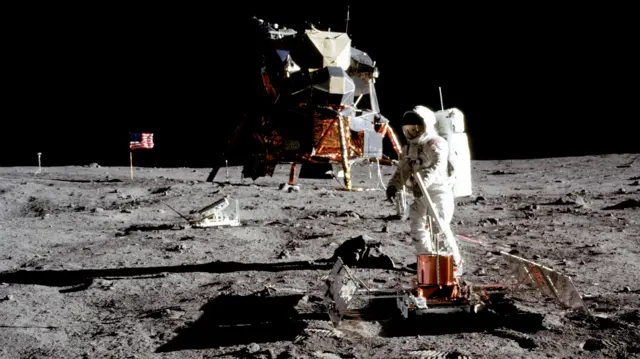
    A photo showing Buzz Aldrin in his spacesuit on the moonImage source, European Photopress Agency
    Image caption,

    The first moon landing took place in July 1969

    Almost 60 years have passed since America's Apollo missions landed humans on the Moon for the first time in July 1969.

    And, while Nasa's Artemis II crew won't make a lunar landing themselves, their mission over the next few days will to pave the way for the next human footsteps on the Moon.

    During their trip the four astronauts will fly 6,400 miles (10,299km) beyond the far side of the Moon, which always faces away from the Earth - marking the first time this has taken place.

    Nasa says that during this three-hour period, the crew will "analyse and photograph geologic features, such as impact craters and ancient lava flow", which will help future missions to explore the Moon's South Pole region.

    Studies on the astronauts' health will also help Nasa to better understand how deep space travel influences the human mind and body, protecting astronauts on future lunar missions as well as travel to Mars.

    If the crew pass safely around the Moon on this trip, Nasa's goal is for Artemis IV and V to become lunar landing missions - and is aiming for both to happen in 2028.

  19. Rewatch the moment Artemis II blasts into spacepublished at 17:48 BST

    3...2...1...

    Watch the all-important moment when the countdown concluded and Artemis II shot towards space, leaving spectators feeling its power through their entire body.

    One BBC reporter described it as "spectacular" and difficult to fully take in.

    Media caption,

    Moment Artemis II mission blasts into space

  20. Inside mission’s tiny Orion crew modulepublished at 17:37 BST

    BBC Visual Journalism Team

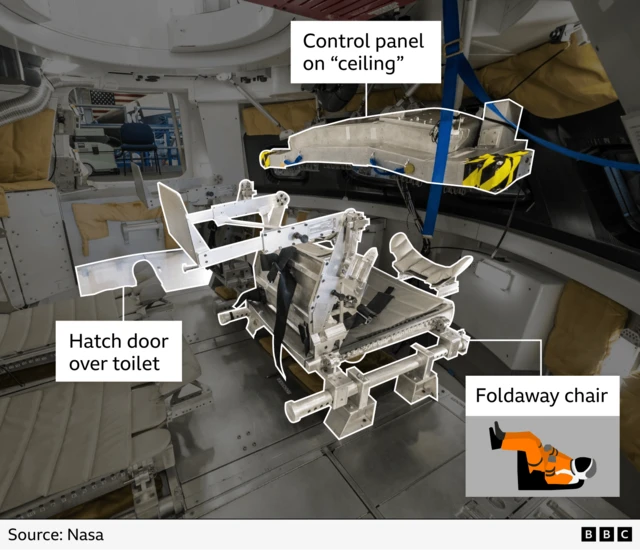
    Interior view of the Orion crew module highlighting a metal structure in the centre, labelled as a foldaway chair, another highlight shows the control panel mounted on the “ceiling”, while a third shows a panel labelled as a hatch door positioned over the toilet. The cabin includes padded wall sections, metal flooring, and equipment mounts. A small illustration in the corner shows an astronaut demonstrating how the foldaway chair is used.

    The four Artemis astronauts are spending 10 days cramped together in a space about the size of a minibus.

    The Orion crew module has similarities to the ones used for the Apollo missions 50 years ago, but the interior is very different.

    The weightless environment means they can make use of space that would otherwise be unusable - so the control panel can be on the “ceiling”.

    The four seats the astronauts used during the launch are now packed away to give them more room.

    Perhaps most important, there is a toilet tucked away under the floor. It’s not very private but has been designed to overcome the challenges of going to the bathroom in space.

    And just above the toilet hatch is a step that doubles as a flywheel exercise machine - the astronauts will each pull on the cable for 30 minutes of resistance and cardiovascular training every day to help counter the physical effects of being in space.

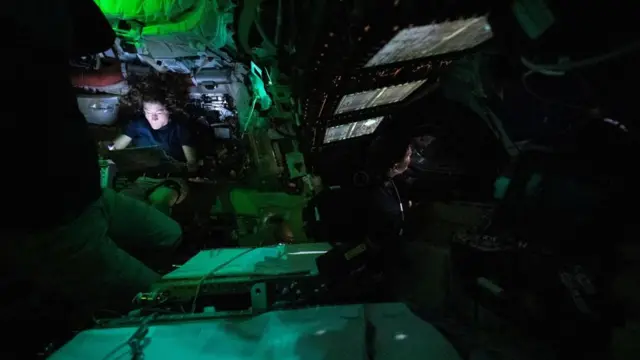
    Nasa astronaut Christina Koch is illuminated by a screen she is looking at inside the darkened Orion spacecraft, with some green lights illuminating the wallsImage source, Reuters
    Image caption,

    Nasa astronaut Christina Koch in the darkened Orion spacecraft on the third day of the agency's mission

    Nasa astronaut Christina Koch in a side-profile picture with an American flag blurry in the background and her curly brown hair floating due to lack of gravityImage source, Reuters
    Image caption,

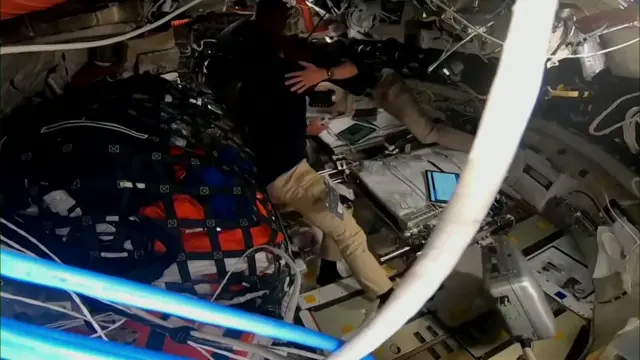
    Koch preparing for the lunar flyby inside the Orion spacecraft