Summary

  • Nasa's Artemis II astronauts will soon fly around the Moon, travelling further from Earth than any humans before - why are they going?

  • Watch live coverage above - here are the key timings

  • The 10-day voyage has sent commander Reid Wiseman, mission specialists Christina Koch and Jeremy Hansen, and pilot Victor Glover to our closest neighbour - it's the first time in more than half a century that humans have left Earth orbit

  • The astronauts won't land on the Moon's surface, but the Orion spacecraft will loop around its far side and back again - what will they do as they fly by?

  • The Moon's gravitational pull on the spacecraft is now stronger than Earth's

  1. The mission so far: Flawless and beautifulpublished at 18:18 BST

    Pallab Ghosh
    Science correspondent

    Artemis II roared off the launch pad and into history on Thursday - and so far, the mission is doing exactly what Nasa hoped for.

    “Flawless” was the word that the head of the Artemis programme, Dr Lori Glaze, used.

    And the sights have not failed to astonish us all, from the moment the SLS rocket turned the Florida evening into a wall of white flame and thunder.

    After a day in Earth orbit, Orion’s training wheels came off and the spacecraft with its four astronauts were blasted into an elliptical orbit around the Moon and back - seeing and sharing with us sights that had not been seen for more than fifty years.

    Notably the view of the whole Earth from space: a stunning view of our planet hanging in the blackness of space.

    The entire Earth hangs luminous in the blackness of space: deep blue oceans and swirling white clouds and bright atmosphere give it the appearance of a shimmering jewelled marble. An echo of the first colour image of Earth taken by the astronauts of Apollo 8 in 1968.

    Back then the image that provided a moment of hope and optimism to a divided and war-torn world, and perhaps the new picture and the mission so far might have the same effect, especially as the best is yet to come with more spectacular images as the Orion space hurtles towards to its destination.

    the entirrety of Earth is seen from the orion spacecraft. part of south america and the sahara desert are visible. clouds swirl over top and the vast, blue oceans can be seen. it is illuminated towards the southern axis by the sun, creating a sliver of light on the edge.Image source, NASA
  2. The 40 minutes of silence during the flybypublished at 18:12 BST

    Alison Francis
    Senior science journalist

    As the astronauts pass behind our celestial neighbour, the radio and laser signals that allow communication between the spacecraft and Earth, will be blocked by the Moon itself.

    For about 40 minutes, the four astronauts will be totally alone.

    They’ll spend the blackout dedicated to lunar observation – taking images, studying the Moon’s geology and simply gazing at its bleak beauty.

    When they emerge and the signal is re-established, the world is expected to breathe a collective sigh of relief.

    And the history-making astronauts will be able to share their incredible views with everyone back home.

  3. What is the mission all about?published at 18:04 BST

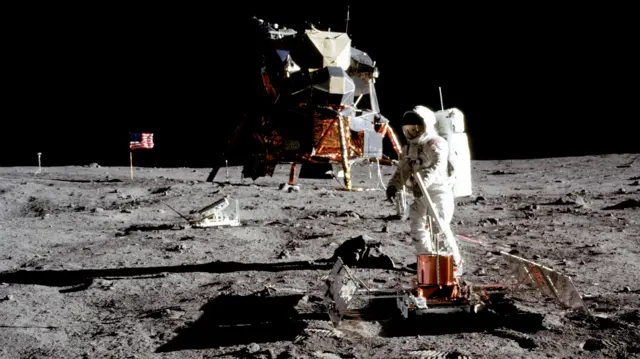
    A photo showing Buzz Aldrin in his spacesuit on the moonImage source, European Photopress Agency
    Image caption,

    The first moon landing took place in July 1969

    Almost 60 years have passed since America's Apollo missions landed humans on the Moon for the first time in July 1969.

    And, while Nasa's Artemis II crew won't make a lunar landing themselves, their mission over the next few days will to pave the way for the next human footsteps on the Moon.

    During their trip the four astronauts will fly 6,400 miles (10,299km) beyond the far side of the Moon, which always faces away from the Earth - marking the first time this has taken place.

    Nasa says that during this three-hour period, the crew will "analyse and photograph geologic features, such as impact craters and ancient lava flow", which will help future missions to explore the Moon's South Pole region.

    Studies on the astronauts' health will also help Nasa to better understand how deep space travel influences the human mind and body, protecting astronauts on future lunar missions as well as travel to Mars.

    If the crew pass safely around the Moon on this trip, Nasa's goal is for Artemis IV and V to become lunar landing missions - and is aiming for both to happen in 2028.

  4. Rewatch the moment Artemis II blasts into spacepublished at 17:48 BST

    3...2...1...

    Watch the all-important moment when the countdown concluded and Artemis II shot towards space, leaving spectators feeling its power through their entire body.

    One BBC reporter described it as "spectacular" and difficult to fully take in.

    Media caption,

    Moment Artemis II mission blasts into space

  5. Inside mission’s tiny Orion crew modulepublished at 17:37 BST

    BBC Visual Journalism Team

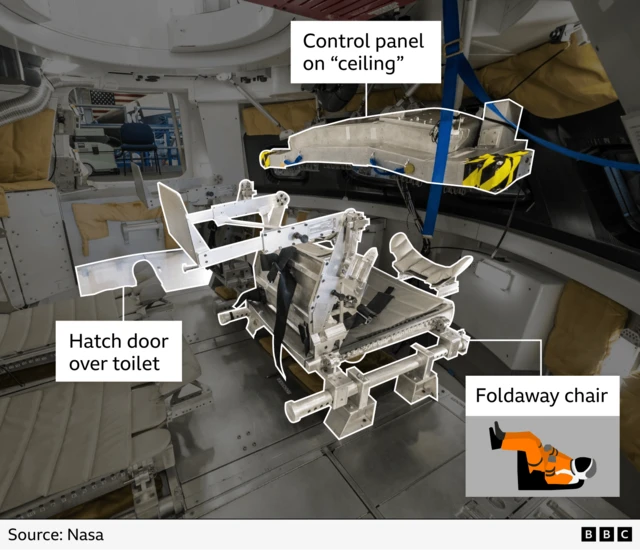
    Interior view of the Orion crew module highlighting a metal structure in the centre, labelled as a foldaway chair, another highlight shows the control panel mounted on the “ceiling”, while a third shows a panel labelled as a hatch door positioned over the toilet. The cabin includes padded wall sections, metal flooring, and equipment mounts. A small illustration in the corner shows an astronaut demonstrating how the foldaway chair is used.

    The four Artemis astronauts are spending 10 days cramped together in a space about the size of a minibus.

    The Orion crew module has similarities to the ones used for the Apollo missions 50 years ago, but the interior is very different.

    The weightless environment means they can make use of space that would otherwise be unusable - so the control panel can be on the “ceiling”.

    The four seats the astronauts used during the launch are now packed away to give them more room.

    Perhaps most important, there is a toilet tucked away under the floor. It’s not very private but has been designed to overcome the challenges of going to the bathroom in space.

    And just above the toilet hatch is a step that doubles as a flywheel exercise machine - the astronauts will each pull on the cable for 30 minutes of resistance and cardiovascular training every day to help counter the physical effects of being in space.

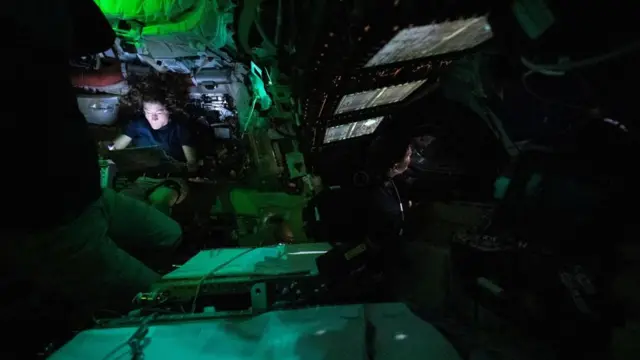
    Nasa astronaut Christina Koch is illuminated by a screen she is looking at inside the darkened Orion spacecraft, with some green lights illuminating the wallsImage source, Reuters
    Image caption,

    Nasa astronaut Christina Koch in the darkened Orion spacecraft on the third day of the agency's mission

    Nasa astronaut Christina Koch in a side-profile picture with an American flag blurry in the background and her curly brown hair floating due to lack of gravityImage source, Reuters
    Image caption,

    Koch preparing for the lunar flyby inside the Orion spacecraft

  6. Why it’s the far side, not the 'dark side'published at 17:32 BST

    Rebecca Morelle
    Science editor, reporting from Mission Control

    We always see the same side of the Moon from the Earth.

    It’s tidally locked, which means that it takes the same amount of time for the Moon to spin on its axis as it does for the Moon to orbit once around the Earth.

    The result is that one side perpetually faces us.

    But don’t make the mistake of calling the side we don’t see the dark side. That comes from the name of a 1973 Pink Floyd Album - Dark Side of the Moon.

    Because this side of the Moon isn’t dark - it gets illuminated by the Sun just like the near side is.

    And you’ll see that when the Artemis astronauts return their images.

  7. The best Earth pictures captured so far in this missionpublished at 17:27 BST

    Nasa has shared photos taken from space as the Orion capsule makes its way towards the Moon.

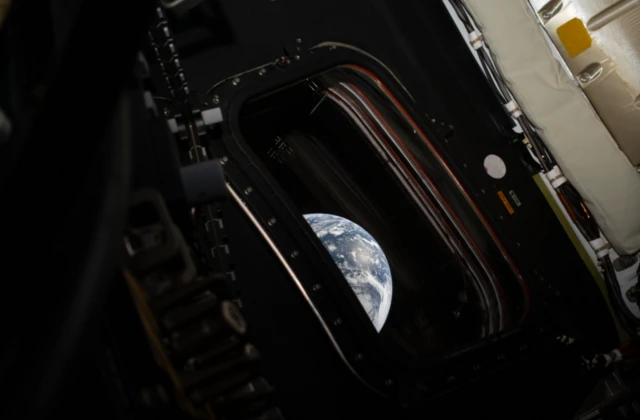
    The space agency shared a high resolution photo of the Earth peaking through the window of the capsule on Friday.

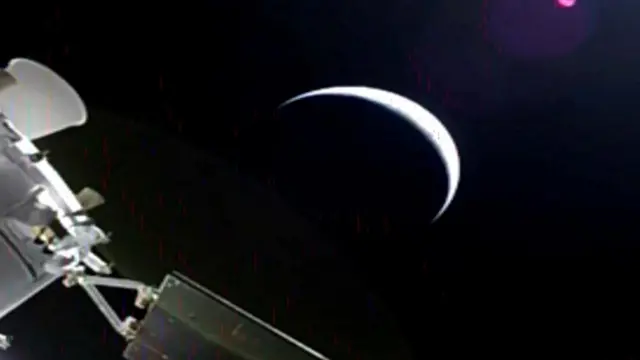
    Footage taken from the spacecraft shows the Earth in a shape of a crescent, back lit by the Sun.

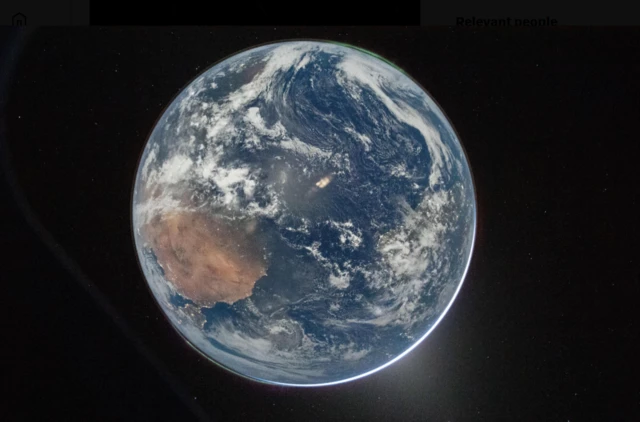
    At another stage, a full disk image of the Earth was seen from the Orion capsule.

    A picture shows Earth poking through the window of the spaceship. Large swirls of cloud can be seen as well as seas of blueImage source, NASA
    Image caption,

    A high resolution picture of Earth taken through the window on the Orion capsule

    The Orion capsule leaves Earth, backlit by the sun as a crescent, on its way to fly by the moonImage source, Reuters
    Image caption,

    The Orion capsule leaves Earth, backlit by the sun as a crescent, on its way to fly by the moon

    A full disk image of Earth, as seen from the Orion capsule. The planet is a pale blue, swirling with white clouds and glowing slightly lighter blue in place from reflected light. A large brown landmass can be seen on the left hand sideImage source, NASA
  8. What will the astronauts do as they fly by the Moon?published at 17:22 BST

    Rebecca Morelle
    Science editor

    As soon as the rocket blasted off and its trajectory was set, lunar scientists have been working out the parts of the Moon that will be illuminated during the flyby.

    They’ve given the astronauts a wish-list of features they’d like them to study, and the crew have been busy prepping for this while they’ve been making their lunar approach.

    The crew will be taking photos with different digital cameras, making sketches, which they’ll also annotate, and recording audio descriptions.

  9. Fifty-four years since the last person set foot on the Moonpublished at 17:13 BST

    Alison Francis
    Senior science journalist, reporting from Mission Control

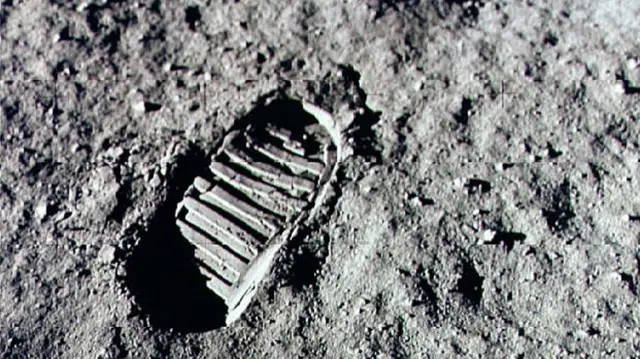
    An Apollo 11 astronaut's footprint in the lunar soil. Neil Armstrong made history on 20 July 1969 by leaving the first human footprint on the surface of the Moon. Several Apollo missions went to the Moon after that, but the last was in 1972Image source, Getty Images

    “As we leave the Moon… we leave as we came and, God willing, as we shall return, with peace and hope for all mankind. Godspeed the crew of Apollo 17.”

    These were the words spoken in December 1972 by Commander Eugene “Gene” Cernan, the last astronaut to walk on the Moon, as he prepared to climb the ladder into the lunar module for the flight home.

    Cernan, and his pilot Harrison Schmitt, set several records during their three days in the Taurus-Littrow valley: the longest stay on the Moon - 75 hours - the unofficial lunar rover speed record - 11.2 mph - and the largest amount of rock and dust sample collected - 110kg (243lb).

    That sample included some orange soil - small spheres of volcanic glass later found to contain tiny traces of water.

    Before leaving the Moon’s surface, Cernan wrote his daughter Teresa Dawn Cernan’s initials in the lunar dust. They’re still there, undisturbed amongst the footprints and tyre tracks.

    Gene Cernan didn't know it would be more than 50 years before humans would make the journey back to the Moon. The next mission to land, scheduled by 2028, will be at a different location - the lunar south pole.

  10. Meet the four astronauts on Artemis IIpublished at 17:04 BST

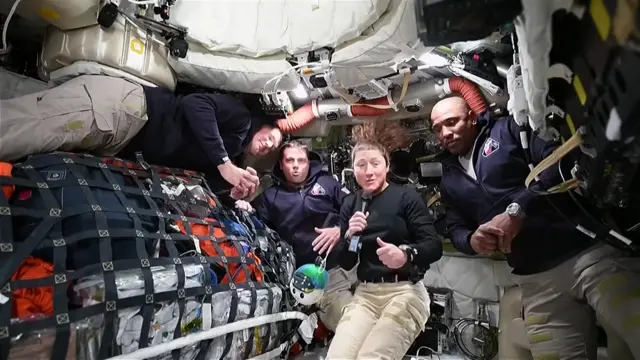
    Four astronauts on board the Orion spacecraft in orbitImage source, NASA

    The astronauts aboard Artemis II have been speaking about the "spectacular" view of Earth from their spacecraft as they hurtle towards the Moon - here's more about who's on board.

    Reid Wiseman,the mission commander, is a former US Navy pilot and test pilot. He became a Nasa astronaut in 2009 and spent 165 days on the International Space Station (ISS) in 2014.

    The ship's pilot is Victor Glover, who lived on the ISS from November 2020 to May 2021 and was also the pilot of SpaceX Crew-1. He will be the first Black astronaut to fly on a Moon mission and holds three master's degrees.

    Mission specialist Christina Koch holds the record for the longest single spaceflight by a woman (328 days) after becoming an astronaut in 2013. She will also be the first woman to travel around the Moon.

    The other mission specialist on the team is Jeremy Hansen,who will become the first Canadian to go to the Moon. He previously lived underwater for seven days as part of his aquanaut work with Nasa.

  11. The 40 minutes of silence during the flybypublished at 16:53 BST

    Alison Francis
    Senior science journalist

    As the astronauts pass behind our celestial neighbour, the radio and laser signals that allow communication between the spacecraft and Earth will be blocked by the Moon itself.

    For about 40 minutes, the four astronauts will be totally alone.

    They’ll spend the blackout dedicated to lunar observation - taking images, studying the Moon’s geology and simply gazing at its bleak beauty.

    When they emerge and the signal is re-established, the world is expected to breathe a collective sigh of relief.

    And the history-making astronauts will be able to share their incredible views with everyone back home.

  12. The 'successful failure': How the previous distance record was set by accidentpublished at 16:44 BST

    Esme Stallard
    Science reporter

    Black and white photo showing a group of flight controllers gather round the console of Shift 4 flight director Glynn Lunney (seated, nearest camera) in the Missions Operations Control Room (MOCR) of the Mission Control Center at the Manned Spacecraft Center in Houston, Texas/Image source, Space Frontiers/Getty Images

    This Artemis II mission is hoping to break the record for the furthest humans have travelled from Earth - by flying potentially more than 270,000 miles.

    This would break the previous record (248,655 miles) set nearly 56 years ago by the Apollo 13 team.

    The difference this time around is this record attempt is deliberate.

    The Apollo 13 mission is known by Nasa as the "successful failure". On April 11, 1970 when the Saturn V rocket launched from the Kennedy Space Centre the plan was to achieve humanity's third lunar landing.

    After some initial early issues during launch, the mission was proceeding well. Joe Kerwin, the capsule communicator who was part of Mission Control back in Houston, declared he was "bored to tears".

    Just minutes later, one of the oxygen tanks exploded and the astronauts could see the valuable gas needed for their survival leaking out into space.

    The explosion also damaged other equipment and affected the use of the fuel cells - potentially affecting their power and water supply.

    They could no longer land on the Moon, so instead they did a free-return-to-Earth trajectory. Just as Artemis II will now do, slingshotting themselves round the far side of the Moon and back to Earth.

    All astronauts intact and a record set.

  13. Seatbelts fastened? Here are the key timingspublished at 16:38 BST

    Pallab Ghosh
    Science correspondent

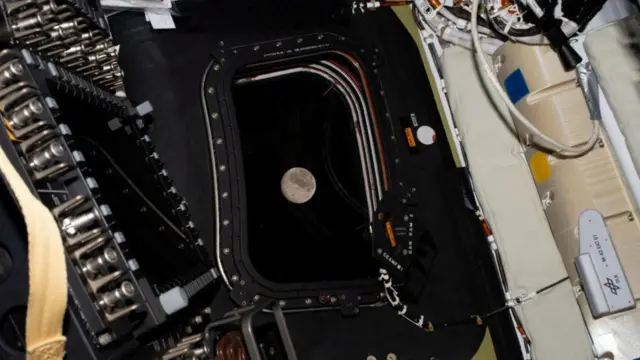
    the moon through the orion windowImage source, NASA

    If you’re following along today, this is what to look out for as you follow the Artemis II crew’s trip around the Moon.

    Through this afternoon, Orion will slip fully into the Moon’s gravitational pull and the crew will wake to begin setting up the cabin for the flyby, running through camera check outs and rehearsal calls with the flight controllers in Houston, where my colleagues Rebecca Morelle, Alison Francis and Kevin Church are reporting from.

    From 18:00 BST (17:00 GMT; 13:00 EDT), there will be the build to beating Apollo 13’s distance record as they sail past 248,655 miles (400,171km) from Earth.

    Look out for sharper, more dramatic views of the lunar surface filling the spacecraft windows.

    Artemis II will pass behind the Moon at 23:44 BST (22:44 GMT; 18:44 EDT) and reappear from the other side at 00:25 BST (23:25 GMT 19:25 EDT). As it swings behind the Moon there will be an eerie, planned silence of around 40 minutes when radio contact will drop.

    Despite the flawless performance of the mission so far, it will still be an anxious wait for mission managers, the astronauts’ families , and indeed all of us – as we wait for a cheery call sign from Reid Wiseman when contact is restored.

    Not long after it re-emerges, there’s a chance of a one-hour solar eclipse from the crew’s point of view – the Moon sliding in front of the Sun.

    For those who want to stay up late, a live downlink with the crew will begin at 02:50 GMT, where we hear from them what it was like to go to the Moon’s far side and see spectacular views that even the Apollo astronauts have not seen before.

  14. A trip to the far side of the Moonpublished at 16:34 BST

    Jenna Moon
    Live editor, Moon enthusiast

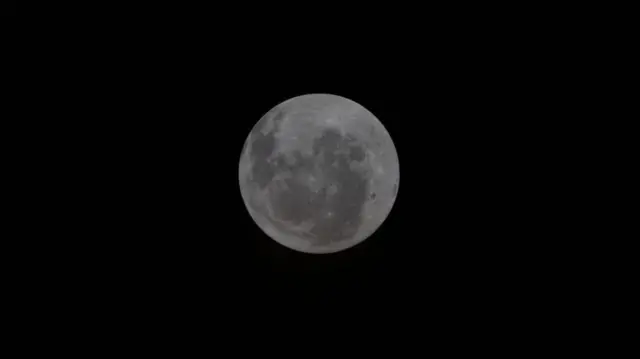
    The moon, shown as a grey scale image. photo taken from the orion spacecraft.Image source, NASA

    Today, humans are preparing to travel further into space than ever before.

    The Artemis II mission is on course to break the record previously set more than half a century ago during Monday's spectacular lunar flyby.

    The crew - astronauts Christina Koch, Jeremy Hansen, Reid Wiseman and Victor Glover - are the first people since 1972 to travel outside of Earth orbit, as they slingshot around the Moon.

    The Orion capsule they're in won't land on the lunar surface, but the flyby promises views of the far side never seen before by human eyes.

    This trip is setting the stage for Nasa's next Moonshot with Artemis III. The astronauts will photograph the Moon, sketch it, and record audio about their observations.

    All of this will hopefully set humans up to return to Earth's closest neighbour in the years to come.

    As Orion passes behind the Moon, communication between the spacecraft and mission control in Houston will be blocked - they'll be totally alone for 40 minutes.

    We'll be following all the moments leading up to the crew's flyby right here - you'll be able to watch live later at the top of the page to keep up with all the action.