Summary

  1. Analysis

    To the Moon and likely farther than any human has gone beforepublished at 09:42 BST 3 April

    Pallab Ghosh
    Science correspondent, reporting from Cape Canaveral

    Orion is on its way, bringing four humans towards the Moon for the first time in more than 50 years.

    From this point, Artemis II is on a long, looping path that has been estimated to carry the crew farther from Earth than anyone has ever travelled, swinging around the far side of the Moon before gravity guides them home.

    Over the next few days, the views outside their windows will become steadily more inspirational and beautiful: Earth shrinking to a small blue white marble behind them and the Moon growing from a bright disc into a heavily cratered world filling the frame.

    On about the sixth day of the mission, as Orion cruises beyond the Moon, the astronauts are expected to witness a total solar eclipse from deep space - the Moon sliding directly in front of the Sun so its bright face is completely covered and the delicate halo of the solar corona flares into view, with Earth hanging off to one side.

    The crew are set to capture this unique sight in images and video beamed back to us at home.

  2. Artemis II crew dial in at zero gravity as they hurtle to far side of the Moonpublished at 09:33 BST 3 April

    Adam Goldsmith
    Live reporter

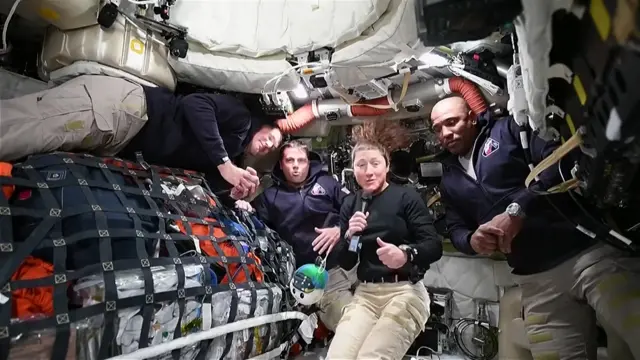
    Artemis II crew floatingImage source, NASA

    We’re closing our live coverage as the four astronauts on board the Orion spacecraft get ever closer to the Moon.

    In the latest of nervy moments for the crew and ground team supporting them, the Artemis II mission was able to successfully execute a trans-lunar injection.

    “I am so excited to be able to tell you that for the first time since 1972 during Apollo 17, human beings have left Earth orbit,” relieved Nasa scientist Dr Lori Graze told reporters, after the critical engine burn boosted the astronauts towards the far side of the Moon.

    Bobbing about at zero gravity, the crew were inspired by their journey so far as commander Reid Wiseman described the "spectacular moment" of seeing "the entire globe from pole to pole" - we've got a full roundup on the team's other comments on toilet troubles, sleeping, and uniting behind the mission.

    Two days into its mission, the Orion spacecraft carrying the crew is being put to the test, and passing, our science correspondent writes.

    The Artemis II mission is expected to fly around the Moon on 6 April and we'll be back with live coverage, but until then:

    We've got one more post to come from our science correspondent in Cape Canaveral, thanks for joining us.

  3. Lift-off and trans-lunar injections completed, but what's next for Artemis II?published at 09:28 BST 3 April

    Esme Stallard
    Science reporter

    It has been quite an exciting 36 hours, take off, burns, backflips, trans-lunar injections and in and among all that, the astronauts had time to try out the exercise machine.

    But we are only just at the beginning of the ten day mission, and Glover, Koch, Hansen and Wiseman will be kept busy on the next part of their journey to the Moon.

    Over the next day the astronauts will be working with the lunar science team on the Lunar Targeting Plan.

    This outlines what observations they will make when they reach the far side of the Moon.

    During this period communications via the Deep Space Network will be lost for 41 minutes so Mission Control cannot ask any follow up questions. They are relying on the astronauts to take note.

    The spacecraft team will be looking for key features on the surface which can help scientists understand how our solar system formed.

    Nasa have said that a recent addition to the Lunar Targeting Plan has been a solar eclipse observation.

  4. Broken toilets and email problems - the everyday issues experienced in spacepublished at 09:06 BST 3 April

    Esme Stallard
    Science reporter

    As far as what could have gone wrong they are relatively minor, but this mission has not been without its difficulties.

    Even before the launch there was a problem with a battery overheating and the termination system. Without fixing this the Artemis II mission would have had to be abandoned - in the event the rocket went off course this system is needed to detonate it and prevent people on Earth being harmed.

    Luckily a spare part from the Space Shuttle programme more than 15 years ago was retrieved to patch it up.

    Once the astronauts were in Earth's orbit it seems to have been pretty plain sailing.

    A little chilly at times and a broken toilet have been the main problems - which when you are stuck in a space not much bigger than a caravan for ten days does become quite pressing.

    Luckily, the resident astronaut turned plumber Christina Koch has got it fixed.

    And in an almost comical moment of parallels to life back home for us earthlings, Commander Reid Wiseman reportedly told Nasa Mission Control he was having issue with the email system.

    Media caption,

    How will the Artemis astronauts go to the toilet in space?

  5. The 'successful failure': How the previous distance record was set by accidentpublished at 08:51 BST 3 April

    Esme Stallard
    Science reporter

    Black and white photo showing a group of flight controllers gather round the console of Shift 4 flight director Glynn Lunney (seated, nearest camera) in the Missions Operations Control Room (MOCR) of the Mission Control Center at the Manned Spacecraft Center in Houston, Texas/Image source, Space Frontiers/Getty Images
    Image caption,

    Nasa flight controllers in the Missions Operations control room in April 1970 trying to get the Apollo 13 crew back to Earth after the aborted landing

    This Artemis II mission is hoping to break the record for the furthest humans have travelled from Earth - by flying potentially more than 270,000 miles.

    This would break the previous record (248,655 miles) set nearly 56 years ago by the Apollo 13 team.

    The difference this time around is this record attempt is deliberate.

    The Apollo 13 mission is known by Nasa as the "successful failure". On April 11, 1970 when the Saturn V rocket launched from the Kennedy Space Centre the plan was to achieve humanity's third lunar landing.

    After some initial early issues during launch, the mission was proceeding well. Joe Kerwin, the capsule communicator who was part of Mission Control back in Houston, declared he was "bored to tears".

    Just minutes later, one of the oxygen tanks exploded and the astronauts could see the valuable gas needed for their survival leaking out into space.

    The explosion also damaged other equipment and affected the use of the fuel cells - potentially affecting their power and water supply.

    They could no longer land on the Moon instead they did a free-return-to-Earth trajectory. Just as Artemis II will now do, slingshotting themselves round the far side of the Moon and back to Earth.

    All astronauts intact and a record set.

  6. 'A wonderful dance of orbital dynamics' as astronauts flung towards Moonpublished at 08:32 BST 3 April

    You might be wondering exactly how the Artemis II mission is propelling itself to the Moon.

    Well, it's down to "a wonderful dance of orbital dynamics", according to space scientist Dr Maggie Aderin.

    Earlier, the crew completed a critical engine burn to boost the spacecraft out of the Earth's orbit and towards the far side of the moon.

    "Because of orbital dynamics, they're going to head towards the Moon, then the gravity of the Moon will swing them round and then they will actually... be pulled back to Earth by the gravity," Aderin tells BBC Radio 4's Today programme.

  7. Remind me, what is this mission all about?published at 08:15 BST 3 April

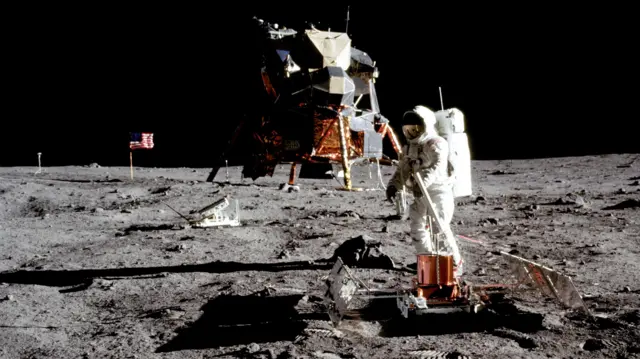
    A photo showing Buzz Aldrin in his spacesuit on the moonImage source, European Photopress Agency
    Image caption,

    The first moon landing took place in July 1969

    More than 50 years have passed since America's Apollo missions landed humans on the Moon for the first time in July 1969.

    And, while Nasa's Artemis II crew won't make a lunar landing themselves, their mission over the next few days will to pave the way for the next human footsteps on the Moon.

    During their trip the four astronauts will fly 6,400 miles (10,299km) beyond the far side of the Moon, which always faces away from the Earth - marking the first time this has taken place.

    Nasa says that during this three-hour period, the crew will "analyse and photograph geologic features, such as impact craters and ancient lava flow", which will help future missions to explore the Moon's South Pole region.

    Studies on the astronauts' health will also help Nasa to better understand how deep space travel influences the human mind and body, protecting astronauts on future lunar missions as well as travel to Mars.

    If the crew pass safely around the Moon on this trip, Nasa's goal is for Artemis IV and V to become lunar landing missions - and is aiming for both to happen in 2028.

  8. Mission shows international co-operation of space agencies, says former astronautpublished at 08:02 BST 3 April

    Naoko Yamazaki in her orange space suitImage source, Getty Images
    Image caption,

    Naoko Yamazaki, the second Japanese woman in space, spent time on the International Space Station

    Nasa hopes the Artemis II mission will mark a step towards a lunar landing for astronauts as soon as 2028 - and to even establishing a base on the Moon in years to come.

    And, speaking to the BBC, former Japanese astronaut Naoko Yamazaki says the mission shows national space agencies are now "building together with international co-operation" towards the same goals.

    When Nasa's Apollo 11 mission became the first to land on the Moon in 1969, it marked the end of a competitive space race between the US and USSR to put the first human footprints on the Moon's surface.

    Now that race is over, Yamazaki says modern collaboration has encouraged a focus on the development of "sustainable infrastructure on the Moon".

    She says that's why Canadian astronaut Jeremy Hansen is among the three Americans on board Artemis II, adding this is a "great symbol for international co-operation".

  9. The mission to the Moon - step-by-steppublished at 07:42 BST 3 April

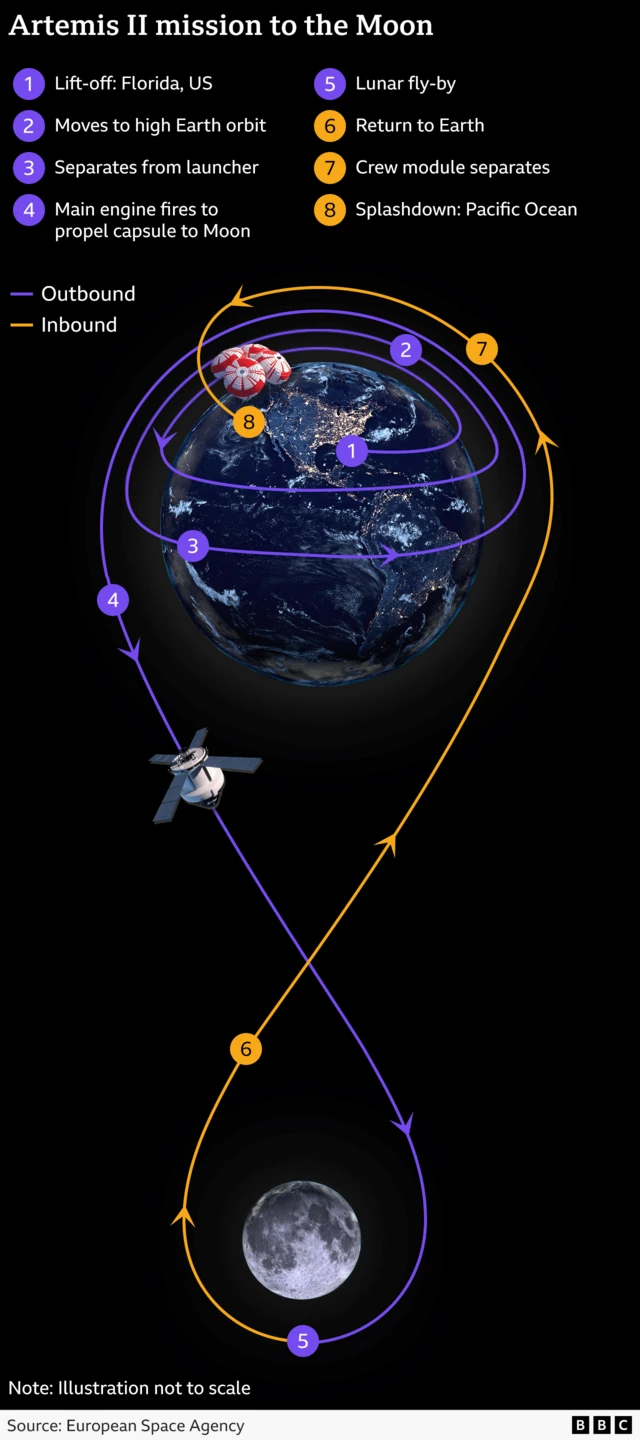
    A ten-day journey is expected to take the Artemis II crew further than any human has been before, as they attempt to gather more information about the Moon - paving the way for a future lunar landing.

    As the graphic below shows, the crew aboard the Orion spacecraft have now completed step four, and are hurtling towards the far side of the Moon.

    We're expecting the astronauts to fly around the Moon on 6 April.

    Graphic showing the Earth and the Moon, with the spacecraft’s figure of eight orbital trajectory highlighted. Specific points are labelled. These are: 1. Lift-off at the Kennedy Space Centre, 2. Orbit around the Earth, 3. Rocket separation, 4. Main engine fires to take spacecraft to the Moon, 5. Lunar fly-by, 6. Return to Earth, 7. Crew module separates, 8. Splashdown in Pacific Ocean
  10. Watch: Moment Artemis II successfully begins push towards Moonpublished at 07:20 BST 3 April

    The Artemis II mission to the Moon hit a significant milestone in the last few hours, when the crew successfully performed a trans-lunar injection burn.

    The key moment essentially pried the spacecraft out of the grip of the Earth and sent it onto a path for the Moon by adding a huge boost of extra speed.

    In doing so, the four astronauts on board became the first humans since 1972 to leave Earth's orbit - watch how it happened below:

    Media caption,

    Moment Artemis II successfully begins push towards Moon

    As a reminder, you can watch all the key moments from the mission in our video rail at the top of the page.

  11. 'The most spectacular moment': Artemis II crew speak as they head to the Moonpublished at 06:54 BST 3 April

    Media caption,

    'Trust us, you look amazing': Artemis II astronauts speak from space

    As the Artemis II spacecraft makes its way to the far side of the Moon after leaving Earth's orbit, we've heard from the four astronauts on board - as well as the team supporting them on the ground - about the mission so far.

    First, we heard from officials at Nasa:

    • "Our crew is healthy and our spacecraft is performing really well," says Dr Lori Glaze, who is leading Artemis development and operations
    • Glaze stresses that Artemis II is a test flight and the team intends to "learn as much as we can" about the spacecraft - our science correspondent says it's so far, so good
    • The astronauts are yet to speak to their families directly from space, but Nasa will "make time" for this soon
    • Spacecraft manager Howard Hu admits he has not slept much over the past day, but says the crew had the "perfect ride uphill" and adds that their life-support system is performing "exactly as predicted"

    Next up, the crew of four astronauts dialled in at zero gravity:

  12. Orion is being put to the test - and passingpublished at 06:27 BST 3 April

    Pallab Ghosh
    Science correspondent, reporting from Cape Canaveral

    Away from the headline‑grabbing engine burns, today has been all about quietly finding out what Orion can really do.

    One of the most revealing moments came when Victor Glover took manual control and flew the spacecraft around the spent upper stage it had just separated from – first sweeping side‑to‑side and up‑and‑down at a distance of about 120 metres, then edging in to roughly 10 metres and making tiny, precise nudges while lining up on a new docking target and camera.

    Engineers say the capsule behaved just as it did in the simulator, which is exactly what they were hoping for, because future missions will need this kind of hand‑flown approach for docking with a lander or space station near the Moon.

    Inside, life‑support systems have also been put through its paces: all three carbon‑dioxide scrubbers - which allows for breathable air aboard the spacecraft - have been checked and are working normally, including during a deliberate bout of heavy exercise to see how the system copes when the crew are really puffing.

    And every engine firing so far – from the early orbit‑raising burns to tonight’s big push for the Moon – has run on time and to plan, giving NASA growing confidence in the spacecraft’s European‑built propulsion system.

  13. Artemis II crew to witness solar eclipse from spacepublished at 05:56 BST 3 April

    As the crew continues its mission, it will observe an hour-long solar eclipse on Monday when they fly by the Moon.

    We had a full moon early Thursday morning (GMT) and typically it is this condition that can give us a lunar eclipse - when Earth is exactly between the Moon and Sun, and its shadow is cast on the surface of the Moon, dimming it.

    But from the perspective of the Orion spacecraft, the Sun will be hidden from view as it moves behind the Moon, Artemis II said in a mission status update today.

    "The crew will see a mostly dark Moon at this time – an opportunity for them to look for flashes of light from meteoroids striking the Moon’s surface, dust lofting above the edge of the Moon, and deep space targets, including planets," they wrote in the update.

    The crew will also observe the Sun's outermost atmosphere, known as the solar corona, while it is visible.

    Only a handful of people have witnessed a solar eclipse from space since the first crewed space missions in the 1960s.

  14. What's next for the Artemis II mission?published at 05:31 BST 3 April

    This Flourish post cannot be displayed in your browser. Please enable Javascript or try a different browser.

  15. Some of the views from Orionpublished at 05:00 BST 3 April

    We're keeping an keen eye across Nasa's live feed - which is showing live the views from the Orion spacecraft. Sometimes the shot dips out and goes bright blue, other times it is very blurry.

    Now and then, however, we get a glimpse of something more recognisable.

    A pretty blurry photo showing a very bright light on the right, and a small section of Orion on the leftImage source, NASA
    Image caption,

    In this screenshot you can see part of Orion on the left hand side.

    You can see part of the Earth on the left, and the legs of Orion on the very far left.Image source, NASA
    Image caption,

    And this shot shows Earth, with Orion on the far left

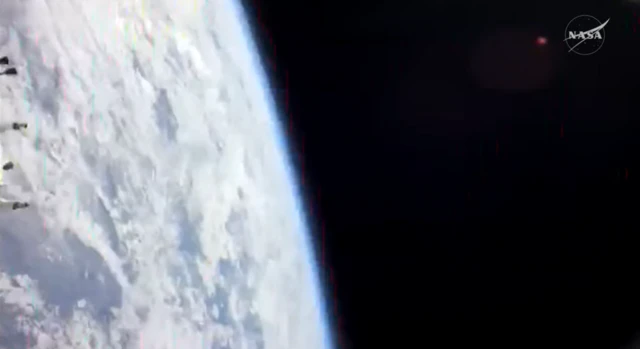
    This shot of the small dot on the far right side of the screen shows Earth fading into the distance as the spacecraft is propelled into space towards the MoonImage source, NASA
    Image caption,

    The small dot on the far right side of the screen shows Earth fading into the distance as the spacecraft is propelled into space towards the Moon

  16. Commander Wiseman recalls 'spectacular moment' of seeing Earth 'from pole to pole'published at 04:45 BST 3 April

    The crew has wrapped up their press conference, in which they spoke about the significance of the mission, adapting to life in space, and the "spectacular" view of Earth.

    "You can see the entire globe from pole to pole, you can see Africa, Europe, and if you looked closely, the northern lights," Artemis II commander Reid Wiseman said at the start of the press conference, describing the moment the crew saw Earth as a whole.

    "It was the most spectacular moment and it paused all four of us in our tracks."

    The four astronauts on the mission include commander Wiseman, Artemis II pilot Victor Glover, and mission specialists Christina Koch and Jeremy Hansen.

  17. Pilot urges America to unite as 'one people'published at 04:28 BST 3 April

    Asked about existing divisions within the US, pilot Victor Glover urged Americans to unite behind the mission.

    "No matter where you're from or what you look like, we are one people," he says.

    It is unclear if the reporter's question referred specifically to divisions around Nasa's Artemis programme. Some take pride in it as an "America First project", while others have shown scepticism over its high cost and technical setbacks.

    The ongoing mission to the Moon is also happening against the backdrop of deepening political divisions in the US.

    "We call amazing things that people do 'moonshots' for a reason. This mission has shown us what we can do when we, not just put our differences aside, but when we bring our differences together to accomplish something great," Glover said.

    "It has given us [something] we all can hold on to for the rest of our days. And I hope people will tune in and give us a chance."

  18. 'A Herculean effort'published at 04:19 BST 3 April

    Crew commander Reid Wiseman says the team realises the "gravity" of the historic mission, which will take the four astronauts further from Earth than any other human has ever gone.

    "There is nothing normal about this... [it's a] Herculean effort," he says.

    "We just feel like we are lifted by the team that's supported us," Jeremy Hansen adds.

  19. Sleeping in space 'comical but comfortable' - crew commanderpublished at 04:09 BST 3 April

    In response to a question on how they manage naps in the tight space of the Orion, the team's commander Reid Wiseman said Christina Koch has been sleeping upside down, "suspended like a bat", and Jeremy Hansen has been "sleeping under monitor displays" just in case things go awry.

    Pilot Victor Glover fits himself into a narrow nook between space equipment and the ceiling of the spacecraft, Wiseman adds.

    "It's comical... [but] more comfortable than you would think," he said. "It's nice to sleep with weightlessness again."

  20. Plunger the 'most important piece' of equipment in space - mission specialistpublished at 04:01 BST 3 April

    Christina Koch, the crew's self-appointed "space plumber", said she's resolved the teething issues with the Orion spacecraft's toilet.

    "I like to say that [the plunger] is the most important piece of equipment in space," Koch said with a laugh.

    "We were all breathing a sigh of relief... It was a priming issue. Luckily we're [now] all systems go," she said, adding that the team was overall surprised by how "smooth" the flight was.

    The astronauts are gathered together in a cosy space, accompanied by a plushie of their mascot, which was designed by eight-year-old Lucas Yee from San Francisco.

    Koch's teammate Jeremy Hansen, who is the first Canadian to fly around the moon, described his debut flight as an "extraordinary" experience.

    "[It's a] tremendous amount of disbelief for me. It's just so extraordinary. I wish I could have gotten here sooner," he said.

    Eight-year-old space enthusiast Lucas Yee designed Artemis II's moon mascotImage source, EPA
    Image caption,

    Eight-year-old space enthusiast Lucas Yee designed Artemis II's moon mascot