Summary

  1. 'NHS is in recovery but not out of the woods'published at 10:25 GMT

    Matt Cole
    Senior political reporter

    Giving a condition check on the NHS under Labour, Streeting told BBC Radio Cornwall's Julie Skentelbery that the NHS is in recovery but not out of the woods.

    The question for patients though is: is he right when he says there has been "real progress in 18 months" of Labour Government?

    Waiting lists are down - but still nowhere near hitting the target for 18-week maximum waits that patients are told they should expect.

    Wes Streeting is wearing a blue blazer and a blue tie. He has short brown hair and is smiling.Image source, PA
  2. Health secretary about to face local radio interviewspublished at 10:02 GMT

    Health Secretary Wes Streeting is preparing to be grilled by a round of BBC local radio presenters as we find out how he thinks the NHS is performing.

    You can watch the interviews live at the top of this page.

    Wes Streeting is pictured with his hands up wearing a blue suit and maroon tie in front of a camerman right behind himImage source, PA Media
  3. The faster alternative to A&Epublished at 09:59 GMT

    Staff working at the Urgent Treatment Centre (UTC) at Woking Community Hospital say they are there to take pressures off A&E.

    The "vast majority" of patients who walk through their doors are treated there and then sent home, bosses say.

    Chief Executive Officer Renée Padfield describes community providers as "one of the bedrocks" of the health service.

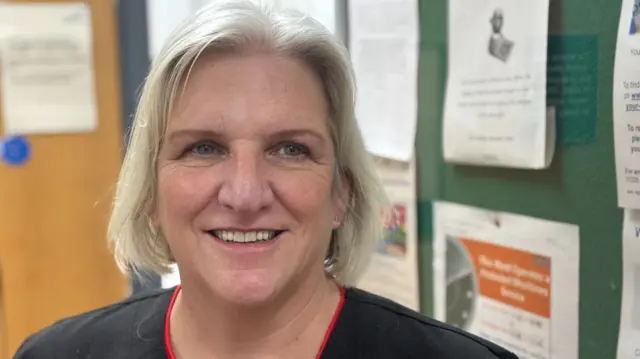
    Chief executive officer Renée Padfield wearing black suit

    While it may feel natural to go to the nearest hospital when feeling unwell, she said A&E departments across Surrey were facing "real pressures".

    "So people might go there, but they'll have quite long waits," she added.

    "If you come here to us at Woking Community Hospital, your wait is likely to be shorter."

  4. 'Working in A&E is tough, it's really difficult'published at 09:53 GMT

    Mark Norman
    Health Correspondent, BBC South East

    Workers at a hospital are wearing uniforms and face masks while standing in a circle talking to one another.

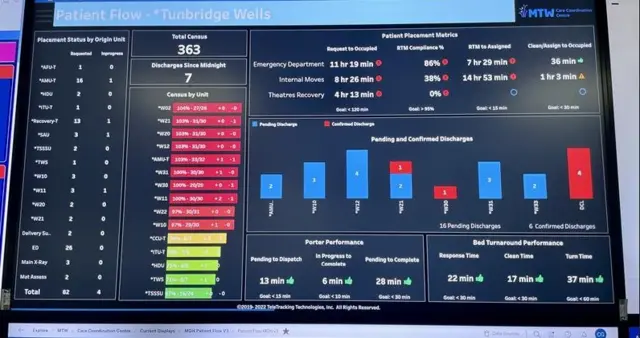
    The hospital in Maidstone, Kent, is full of patients, the A&E is also full, and other people are waiting to be admitted.

    It’s very busy, and some patients are frustrated with the waits they are experiencing.

    But I am being told this is a normal day in the emergency department.

    Maidstone and Tunbridge Wells NHS Trust has two of the best-performing A&E departments in the country, but they are not immune to the pressures and the toll it takes on staff and patients.

    Dr Sahaj Sethi, one of the A&E consultants, said: “It’s tough. I think it's really difficult.

    “It's tough not just on the medical staff but the nursing staff as well, and you're providing care for patients in perhaps areas you're not used to, not areas you would ideally like to be providing that treatment, and that takes its toll mentally and physically on all members of staff.”

  5. GPs perform 'daily miracles'published at 09:48 GMT

    Plymouth doctor Richard Ayres stood in front of white door. He is wearing glasses and a navy topImage source, Handout

    Plymouth doctor Richard Ayres has been working in general practice for 40 years and says it's still the "best job in the world".

    Speaking to BBC Radio Devon, Ayres says general practice provides 1.5 million appointments daily and handles 90% of contact with the NHS.

    "It's daily miracles," he says. “It’s still the best job in the world; I love it and I’m very privileged to have had so many years of it.”

    Ayres said although things have changed over the years, such as technology, medication, and tests, a lot of things are the same.

    He said: "It’s still the doctor and a patient sorting things out the best we can."

  6. Patients face long A&E waits - but small signs of improvementpublished at 09:44 GMT

    Hospitals across the UK have been struggling to meet the government's target of seeing and treating 95% of patients who attend A&E within four hours.

    The latest data show that in 2025, 75% of patients in England waited under four hours - a slight improvement from 73% in 2024, but still below the expected level.

    The NHS region with the highest percentage of patients waiting over four hours was the North West, at 28% in 2025.

    Figures also show that one in 10 people in 2025 waited over 12 hours in major A&E units.

    A graph showing months along the bottom with different years and up the left hand side there are percentages.
  7. 'We are very busy, particularly weekends'published at 09:37 GMT

    Jack Fiehn
    Surrey political reporter

    At Surrey's Haslemere Urgent Treatment Centre, which is based in a community hospital, demand has been so high that they have increased from opening five days a week to every day.

    NHS bosses are keen for patients to use centres like this to take the pressure of A&E departments.

    Charlotte Morley, lead practitioner, said: “We are very busy, particularly weekends and Mondays, but that's the same as the main site in the emergency department.

    “We see about 1,900 patients a month here.”

    Charlotte Morley, lead practitioner wearing blue nursing uniform while stood on ward
  8. How workers are easing pressures on A&Espublished at 09:26 GMT

    In Cornwall, teams at Kernow Health CIC monitor pressure across minor injury units and intervene early to prevent patients attending hospital when it is not needed.

    The group said more than 21,000 NHS 111 calls were downgraded last year, diverting patients from lower-priority ambulance call-outs to services such as urgent treatment centres.

    Staff at Bodmin Community Hospital say 60% of patients seen in its Community Assessment and Treatment Unit are able to return home, helping to ease pressure on A&E.

    A paramedic is providing medical care to an elderly person in their own home.
  9. How life-like mannequins are helping hospitalspublished at 09:15 GMT

    BBC Midlands

    Mannequins on the simulation ward at Aston University. There is a woman and a man in hospital beds.

    Student doctors in Birmingham are preparing to treat real patients by practising on mannequins.

    The dolls blink, move, bleed and even speak.

    Speaking to BBC Radio WM, second-year student Andrea Susane Paul says they check their medical records and manage the "patient" accordingly, as if it's a real-life scenario.

    Luke, also a student, says he was "really surprised" when he first saw the mannequin blink.

    "They say things as well, for example if they are in pain," he said.

    "It's as if it’s a real person.”

    Professor John Cookson, dean of medical education, said there were, of course, limitations but it did offer students "real bedside skills".

    He said other simulations offered a chatbot, so students were able to carry out consultations.

    Media caption,

    Medical students at Aston University discuss their training on simulation wards.

  10. 'We can understand that frustration'published at 08:57 GMT

    Josh McLaughlin
    Radio Sussex & Surrey reporter, in Eastbourne

    Ahead of the phone lines opening, I joined staff at Princes Park Health Centre in Eastbourne, East Sussex, on Monday morning.

    It was a busy day: 30 patient calls came in at 08:30 GMT on the dot, and medical forms and the queue outside started filtering in soon after.

    By midday, the team had received 150 requests for in-person care.

    GP receptionist Ruby told me she had just started working this winter after graduating from university.

    She said: "Typically, people are understanding because of the winter pressure, and it can be busy after Christmas.

    “Some people don’t understand, and it’s frustrating because we’re patients ourselves, so we can understand that frustration.”

    A woman with long dark blonde hair is sitting in front of a computer screen with a blue NHS lanyard round her neck
  11. 'Enormous strain on our service'published at 08:40 GMT

    In Nottingham, if you call 111 you're likely to get put through to NEMS - Nottingham Emergency Medical Services - which runs urgent treatment centres based at the city's QMC hospital and King's Mill Hospital in Sutton-in-Ashfield.

    The centre at the QMC has seen an "unprecedented level of patients" walk through its doors, according to Dr Shane Green, its medical lead.

    "This year in particular, we have seen twice as many patients as we did compared with this time last year," he says.

    "That's an enormous strain on our service and the wider system, and it's our job to mitigate those pressures with our partners."

    The main goal of the urgent treatment centre is to take patients off the emergency department who are not critical but still need same-day care.

    A man wearing glasses, a light pink shirt, a blue lanyard and a stethoscope around his neck looks at the camera
  12. Robot helpers and prescription vending machinespublished at 08:24 GMT

    Technology is playing a big part in helping to reduce pressures on the NHS.

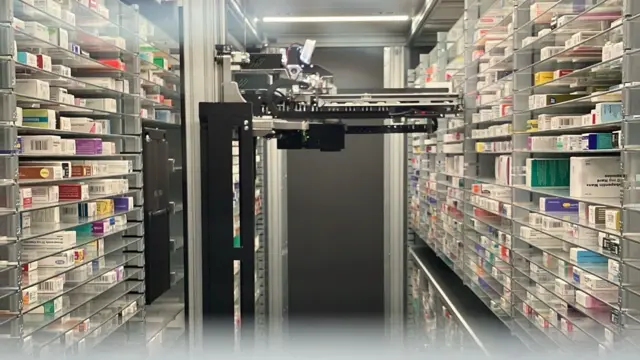
    And at Riverside Surgery in Lincolnshire, Vincent, a dispensing robot, helps deliver medication.

    The machine is a bit like a vending machine, selecting tablets from shelves by barcode, before sending them down a series of chutes to the pharmacy.

    Outside, a 24-hour prescription dispenser, called PharmaSelf24, allows patients to pick up medication using a secure code.

    Michelle Slimm, the surgery's business manager, says: "It frees up staff and avoids queues."

    Two women using PharmaSelf24
  13. GPs working at ‘relentless pace’published at 08:07 GMT

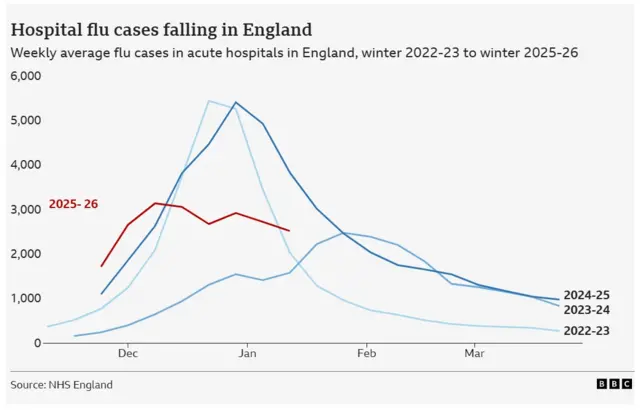
    GP surgeries across England have been facing huge pressures amid a sharp rise in the number of flu patients.

    We visited one surgery in Kent to see how staff were coping.

    Within 10 minutes of opening, there were 150 patients waiting for an appointment at Whitstable Medical Practice.

    The centre is one of the NHS's trailblazer sites, designed to take pressure off hospitals by offering a much wider range of services in the community.

    On site, patients can have X-rays, minor surgery and specialist clinics that would otherwise require a hospital visit.

    GP Alister Headon regularly works more than 12 hours a day in the clinic, completely aware that it will not be enough to see every patient who would like to see him.

    “Even if we could offer appointments 24 hours a day, seven days a week, I know there would still be unmet demand,” Headon said.

    He added GPs were working at a "relentless pace".

    GP Alister Headon looking to the left and smiling. There are two computer screens on his desk.
  14. Sweaty palms at triage phone linepublished at 07:54 GMT

    Angie Costello is part of a small team running a triage phone line that health and social care professionals in Staffordshire and Stoke-on-Trent can call for help.

    The aim is to come up with alternative ways of caring for patients in the community that don't involve sending them to hospital in an ambulance.

    Integrated Care Coordination is designed to be a single point of access for urgent care in the county - and on Monday they had 190 referrals.

    Costello says they prepare for winter pressures - but it's a challenge.

    "Do we dread it? No," she says.

    Is it tricky? "Yes," she answers.

    Does everybody work harder than they ever have? "Yes."

    Do people have sweaty palms? "Sometimes."

    A woman with short blue hair is standing half-smiling in front of a noticeboard
  15. Mixed progress made on hospital waitspublished at 07:35 GMT

    Nick Triggle
    Health correspondent

    While winter brings much focus on emergency services, the government’s number one priority for the NHS in England is to reduce waiting times for planned hospital treatments.

    This includes things such as hip and knee replacements.

    The government is aiming to get hospitals back to hitting the 18-week target by the end of the parliament.

    A year ago, it set out a plan to get the NHS on track.

    Nationally progress is being made, but locally the picture is mixed.

    Nearly a quarter of hospital trusts have actually gone backwards in the past year.

    East Cheshire has had the biggest drop, going from 61.2% of patients waiting less than 18 weeks to 51.2%.

    Barnsley saw a drop of nine percentage points, while both Whittington Health and Epsom and St Helier NHS trusts experienced falls of around five percentage points.

  16. A difficult winter – but signs of improvementpublished at 07:16 GMT

    Nick Triggle
    Health correspondent

    It has been a very difficult winter for the NHS – and it’s not over yet.

    Huge pressures on A&E, an early flu season and disruption from resident doctor strikes in November and December have combined to cause problems across all services in each part of the country.

    But there are also signs that the NHS has coped a little better than in the last few winters.

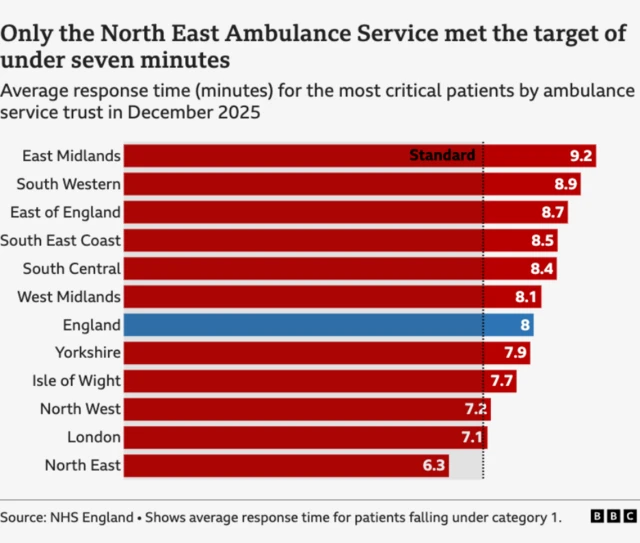
    Ambulance response times and waits in A&E have improved, although these services are still some way from hitting all their key targets.

    And, as one NHS leader said to me this week, “we’re still failing too many patients, it’s just that we’ve become so used to the problems we’re not shocked anymore – we’ve become desensitised”.

  17. 'The NHS is broken, but it's not beaten'published at 07:07 GMT

    Improving the NHS was among the five big “missions” that Labour put at the heart of its manifesto prior to returning to government in July 2024.

    Delivering on that promise is the task of Health Secretary Wes Streeting, who has previously said: “The NHS is broken, but it's not beaten, and together we will turn it around.”

    We’ll be hearing how he thinks that is going later as he takes part in a series of quick-fire interviews on BBC local radio stations from 10:00 GMT.

    And we’ll be digging into what the latest NHS performance stats tell us on a range of measures from ambulance response times to hospital waiting times.

    Wes Streeting smiles while looking slightly to the right of the camera. He has short brown hair and blue eyes, and is clean shaven. He is wearing a navy blue suit and tie.Image source, Reuters
    Image caption,

    Health Secretary Wes Streeting

  18. The NHS in focuspublished at 07:01 GMT

    When it comes to public services that people most rely on, the NHS is often named as a top priority for greater investment.

    Staffing shortages, problems with IT systems and crumbling buildings are among the worries facing some health trusts in England.

    But amid those pressures, there are teams finding creative ways to tackle the challenges and using new technology to transform their services.

    Join us today as we take a look at the picture across England, from the role of GPs and ambulance services to what’s happening in our hospitals.

    A busy hospital corridor. A young female doctor wearing blue scrubs and a face make walks towards the camera. A male orderly pushes an elderly woman in a wheelchair away from the camera. In the background is various medical paraphrenaliaImage source, PA Media
    Image caption,

    As it comes under increasing pressure the NHS is finding new ways to cope