Summary

  • The government sets out major changes to the system for children with special eductional needs and disabilities (SEND) in England - here's an overview

  • By 2035 education, health and care plans (EHCPs) - legal documents which set out the help children are entitled to - will be reserved for only the most complex cases

  • From 2029, children will be reassessed for ECHPs as they move up to to their next stage of education. The number of people with these plans has more than doubled in a decade in England - how are EHCPs changing?

  • As part of the plans, the government says it will spend £4bn in mainstream schools over three years - BBC Verify has looked at the figures

  • One parent tells us the current system is an "uphill struggle". Tell us your experiences here

  1. Analysis

    Do Scottish pupils have the highest level of additional needs in the UK?published at 16:13 GMT

    Susie Forrest, Health assistant editor BBC Scotland

    A record number of pupils in Scottish schools - nearly 300,000 in total - are now classed as having an additional support need (ASN) - 43% of all students.

    That’s much higher than in England, where 19.6% of pupils are recognised as having special educational needs (SEN), and Wales, where just 9.5% of pupils have what’s called an additional learning plan (ALN) or SEN.

    Teachers' leaders in Scotland have warned that schools are being overwhelmed by an "explosion" in children with additional support needs, including dyslexia and ADHD.

    Since 2004, there’s been an eight-fold increase in pupils requiring extra support, but in that time the definition of additional support needs has also become much broader to include emotional or behavioural issues, autism, disabilities, dyslexia and speaking English as a second language.

    And in recent years, the Scottish government expanded it further to include, for example, looked after children and young carers, which it says in part explains the huge increase in numbers.

    Unlike in other nations, children in Scotland are not legally entitled to individualised funding.

  2. 'SEND reforms risk adding pressure to already anxious parents'published at 15:56 GMT

    NJ Convery
    BBC News

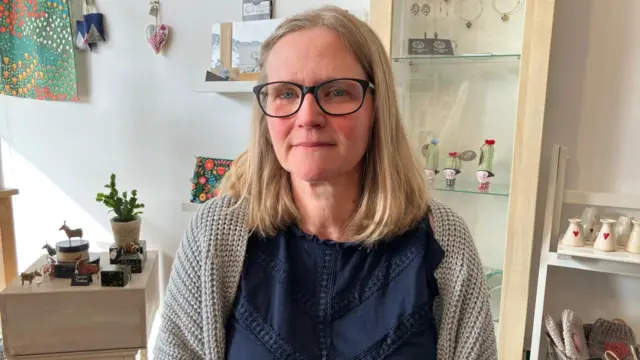
    Lucie Glover pictured. She has blond hair and is wearing a grey cardigan with a navy blue top.

    Lucie Glover’s daughter Emily is in year six. She has Down’s syndrome, and has had an education health and care plan (EHCP) since 2019.

    She has just had Emily's place at a specialist school for secondary school next year confirmed. But Lucie has concerns about today's announcements.

    "My concerns with the changes are the fact that by the time it affects her directly, she’ll be going from high school to post-16," Lucie tells me.

    "So, what’s going to happen? When they say complex needs - what do they mean by complex needs? That’s one of my biggest worries."

    Lucie says the changes will add extra pressure to parents, who are "anxious already".

  3. A positive but cautious welcome from some disability-focused charitiespublished at 15:44 GMT

    Beth Rose
    Disability affairs reporter

    Reaction to the government’s plans for specialist education has been positive but cautious from some of England’s disability-focused charities.

    Jon Sparkes, CEO of Mencap - which supports people with learning disabilities - says the move to make the system more mainstream is a "welcome" one.

    "Right now, too many families are left waiting, fighting and worn down. No child’s future should depend on parents battling for support."

    The Council for Disabled Children - which represents 300 voluntary and community organisations - says it is pleased EHCPs will be retained for those "whose needs cannot be met through this new model".

    Its director Amanda Allard - who we heard from a little earlier - says there remains some questions around the detail and accountability of the new system.

    "The consultation launched today is an opportunity to clarify those details ensuring families have clear routes to action where these ambitions are not being delivered."

  4. Government proposals outline change to maternity pay for teacherspublished at 15:27 GMT

    Marthe de Ferrer
    BBC News

    We're continuing to comb through the details in the Schools White Paper which has been primarily, but not exclusively, focused on SEND.

    Away from SEND, one detail in the Schools White Paper that has proved interesting to teachers is changes to maternity pay.

    Currently, teachers get four weeks at full pay, followed by two weeks at 90% of pay, followed by 12 weeks of half pay topped up with the statutory maternity pay.

    A report from 2024 found that women in their 30s are the biggest single group leaving the profession.

    Today’s announcement doubles the length of time new mothers will receive at full pay to eight weeks.

    The white paper also includes details of increased flexible working arrangements for parents returning to work.

    Parent-teacher charity the MaternityTeacher PaternityTeacher (MTPT) Project welcomed the additional support for mothers, but said that the new pay increase "only translates into an additional week of fully paid leave" and referring to maternity pay as being doubled could "easily be misleading".

    Emma Sheppard, founder of MTPT, said the government had been "shortsighted" in not mentioning improvements to paternity or adoption leave and highlighted the difference between parental leave and pay for teachers versus other public sector workers.

    She pointed to the Department for Education's offer of 28 weeks at full pay for all parents.

    "There needs to be openness to benchmarking teacher and support staff parental leave and pay against other graduate industries".

  5. 'What will the impact be on preschool and early years provision?'published at 15:10 GMT

    A BBC graphic which says "your voice"

    Adam, who works in a preschool, wants to know how these changes could impact early years provision.

    Our senior education reporter Vanessa Clarke says the early years are mentioned in the white paper, and says it sounds like there will be more support for children under five.

    Nurseries and early years centres will be able to use the bank of specialist provision that councils are setting up, she says.

    But nursery charities say they will be looking at the detail to see how the sector's funding will be impacted, Clarke says.

    They will be hoping some of the additional money will come their way, she adds.

    This is the last question answered by our experts - stay with us for more developments on this story.

  6. 'How will children with special transport needs get to school?'published at 15:07 GMT

    Your voice written in white over a red background

    Next is a question from a bus driver in Exeter, who is concerned about how changes announced today will impact children who have special transport requirements.

    Bill Revans, from the County Council Network, says individual entitlement to school transport would remain and children will continue to be transported to their educational setting (schools and colleges).

    He notes that if the education setting is closer to where a child lives - something the government is pushing for by having more SEND students in mainstream schooling - then those transport costs could be lower.

    Revans says transport costs have gone "through the roof" recently because some children have needed to take taxis to go to school.

    He says that one case saw about £55,000 in taxi costs to take that child to their school placement, which he called a "huge expenditure" for one child.

    Quote Message

    If we can reduce that expenditure on transport, we can spend it on education instead."

    Bill Revans, County Council Network

  7. 'What support will be available for over-16s?'published at 15:02 GMT

    A red banner which says YOUR VOICE in white

    Gemma, whose surname is not read out, from Sutton asks what support will be available for those who are aged over 16, without an EHCP.

    Political correspondent Alex Forsyth says "a lot of the devil will be in the detail".

    But the government is stressing that as young people go through the education system, including when they're over 16, they'll have regular reviews to make sure they're still being supported correctly.

    The package of support is for people up to the age of 25, she explains.

    The ambition the government is setting out, Forsyth continues, is that transitions between education, such as from primary to secondary school, will be managed.

    But there are still questions over what resources will be available, and the systems parents will have to follow, she adds.

    The BBC News Channel's question and answer on the SEND changes has just finished. We'll bring you the final few questions, and the response from our panel of experts, shortly.

  8. 'Will my son still be allowed movement breaks if he loses his EHCP?'published at 15:00 GMT

    A BBC graphic which says "your voice"

    Mark, whose surname was not shared, says his 15-year-old son has an EHCP and the prospect it could be removed is concerning.

    The EHCP allows his son to take movement breaks - Mark asks if this wasn't written in to his son's EHCP would he still be allowed them?

    Chair of the Disabled Children's Partnership Anna Bird says it is her understanding that even if a child doesn't have an EHCP, they should have a plan written by the school if they have special educational needs.

    What she cannot see from the detail published today is what the eligibility criteria for an EHCP will be, but adds the government seems to be saying every child with SEND needs will get a plan with support. "That's really positive," she says.

    SEND and inclusion specialist Margaret Mulholland says it is her understanding that those with an EHCP will retain them if needed. But she says "what we are hearing" is that younger children will be reviewed before starting secondary school.

    She says she has questions over the timing and process, and says "we're really concerned about how that will spike the anxiety of families", but adds they do currently annually review whether a child's plan is right for them.

  9. 'How many children have an EHCP, and is the number rising?'published at 14:50 GMT

    A RED banner which says YOUR VOICE in white

    Andrew in Guildford next asks what proportion of children in the UK have an EHCP - education, health and care plan - and how has this number changed.

    SEND and inclusion specialist Margaret Mulholland says the number of children with an EHCP has increased rapidly since 2015.

    The increase is due to multiple reasons, Mulholland says, including "getting better at identifying need".

    Though, the number of children identified with SEND "has stayed pretty much the same", she adds.

    She adds: "If we do get money through these reforms... and get in early to support need, then we may not see as many young people needing an EHCP."

    This Flourish post cannot be displayed in your browser. Please enable Javascript or try a different browser.

  10. 'Where is the money for these SEND changes coming from?'published at 14:45 GMT

    A banner that says Your Voice in white text on a red background.

    The first question up is from Andy in Stoke-on-Trent, he asks where the money to fund these changes is coming from.

    Political correspondent Alex Forsyth explains that the government is putting £4bn as upfront investment (that money is spread over three years - Ben Chu from BBC Verify looked at the figures earlier).

    Some of those funds will go directly to schools, other bits will go to local authorities so that they can hire specialist staff.

    Forsyth says she has asked the government where the money is coming from, to which they said it's money that was allocated in the spending review.

    This is new money for the SEND system, the government told the BBC.

    Forsyth explains that this is the government trying to say they are putting the resources in to ensure children have access to support.

  11. Your questions answered on SEND changespublished at 14:30 GMT

    A red banner which says 'YOUR VOICE' in white

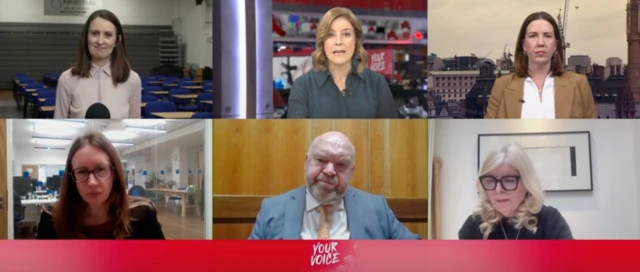
    A panel of experts will shortly be answering your questions on today's announcement on changes to the SEND system. You will be able to watch live above from 14:30 GMT.

    On the panel we'll have:

    • Senior education reporter Vanessa Clarke
    • Political correspondent Alex Forsyth
    • SEND spokesperson for the County Council Network Bill Revans
    • Chair of the Disabled Children's Partnership Anna Bird
    • SEND and inclusion specialist Margaret Mulholland
    A screenshot from BBC News Channel with five women and one man in split image.
  12. Unclear where extra SEND money will come frompublished at 14:21 GMT

    Ben Chu
    BBC Verify policy and analysis correspondent

    The government has said it plans to invest an extra £4bn in children with special educational needs and disabilities (SEND) in England over the next three years, including funding for schools and more specialist teachers.

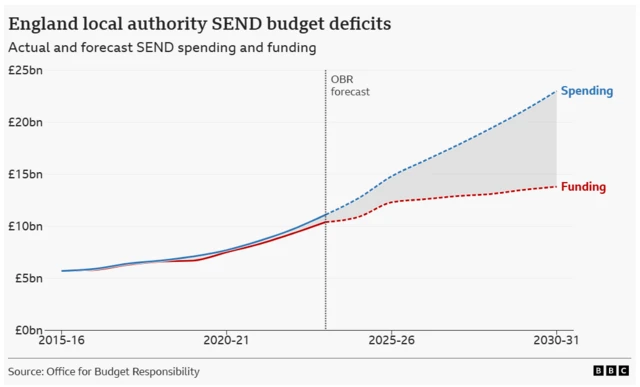
    In the Budget last November, the Office for Budget Responsibility (OBR) forecast the gap between government funding given to councils in England to spend on SEND and their actual spending on SEND would reach £6bn by 2028-2029, external.

    This calculation was based on the expectation there would be a rise in the number of new education, health and care (EHC) plans needed in England. These plans provide extra support for these children and young people up to the age of 25.

    Education Secretary Bridget Phillipson has suggested the extra investment and reforms to the assessment system could help bring down future spending pressure on the SEND system, but it’s not clear whether it will be enough to eradicate the expected £6bn deficit the OBR has projected for 2028-2029.

    It’s also unclear where the additional £4bn of spending over the next three years will come from.

    The education department's SEND reform consultation document released today, external states its budgets will rise as a result of today’s new investments relative to what was previously planned. But the department’s annual budgets were fixed in cash terms up to 2028-29 in the June 2025 Spending Review.

    The Treasury has clarified to BBC Verify that while it doesn’t expect a wholesale re-opening of the 2025 Spending Review, it does now expect the cash budget of the Department for Education to increase in 2028-29 by around £4bn pay for these new investments. It says that this additional sum will be found from within overall government resources and will not require cuts to other department budgets or tax increases.

    Update: The last paragraph of this post was amended after the Treasury clarified its position on the cash budget.

    Graph showing actual SEND spending and funding, compared to the OBR forecast
  13. Lib Dems say government must be 'more ambitious'published at 14:12 GMT

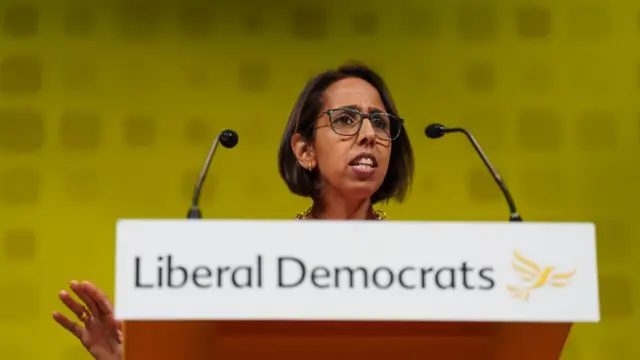
    Munira Wilson speaking in front of a Liberal Democrats podiumImage source, PA Media

    Let's bring you some more political reaction to the government's SEND reforms.

    Liberal Democrats education spokeswoman, Munira Wilson, says the government is taking "solid steps" to address the system, but that "the devil will be in the detail".

    "I am pleased ministers have finally listened to Liberal Democrat calls for tighter rules on private SEND providers. They must go further with an 8% cap on profits and for SEND schools to be given Critical National Infrastructure status - to block any dodgy backroom deals," Wilson says in a statement.

    Currently the status of critical national infrastructure is reserved for essential services like energy, transport and water.

    “But we also need to ensure we identify children who need help much sooner. Too many are falling through the cracks. The government needs to be more ambitious and look at universal screening," she adds.

  14. Badenoch questions where money is coming from for SEND changespublished at 14:07 GMT

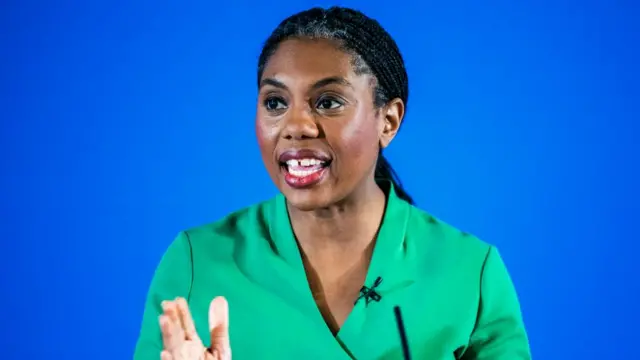
    Conservative leader Kemi Badenoch wearing a green dress and standing in front of a blue backgroundImage source, PA

    Conservative leader Kemi Badenoch says her biggest concern regarding the government's changes to the SEND system in England is financial.

    Speaking during a meeting with apprentices in London, Badenoch questions where the money is coming from.

    She says the government took out £6bn to pay for SEND provision during the Budget, and "what these proposals are covering is just about £4bn".

    "We know that there is an issue with special educational needs but right now I think many parents are worried about these changes", she adds.

    For context: The government has announced it will pay SEND costs currently covered by councils from 2028, a move that is forecast to create a £6bn pressure.

  15. Education, health and care plans - what's changing?published at 13:45 GMT

    By 2035, education, health and care plans (EHCPs) will be reserved for children with the most complex cases.

    EHCPs are legal documents that identify a pupil's needs and set out what support they should receive.

    Local authorities are responsible for ensuring EHCPs are followed.

    Until 2015, the proportion of pupils with EHCPs in schools was relatively stable at 2.8%. Since then it has nearly doubled to 5.3%.

    The government is worried that without changes, demand will only grow and it won't be possible to meet it.

    This Flourish post cannot be displayed in your browser. Please enable Javascript or try a different browser.

  16. Our panel of experts set to answer your questions on SEND changespublished at 13:31 GMT

    A banner that reads Your Voice in white text with a red background.

    At 14:30 GMT our experts will be answering your questions following the announcement of major changes to the system for children with special educational needs and disabilities (SEND) in England.

    On our panel of experts will be:

    • Vanessa Clarke, our senior education reporter, who's at Ninestiles, An Academy - a secondary school in Birmingham
    • BBC political correspondent, Alex Forsyth who joins us from Westminster
    • Bill Revans – SEND spokesperson for the County Council Network, he's also a Liberal Democrats councillor for Somerset and Taunton
    • Anna Bird is chair of of Disabled Children’s Partnership – a coalition of over 130 organisations who campaign for better education, health and social care for SEND children
    • Margaret Mulholland, SEND and Inclusion Specialist for the Association of School and College Leaders

    You can send us your questions via email or WhatsApp, external.

  17. 'Clear pathways will be crucial': How some charities are reactingpublished at 13:19 GMT

    We've been hearing reaction from some charities and organisations following the government's announcement of major changes to the SEND system in England:

    The Institute For Public Policy Research says the SEND system is "broken", with thousands of young people "waiting more than a year" for an initial assessment. Investing more in early support "will ensure more children get help sooner", says the organisation's executive director Harry Quilter-Pinner.

    The Autism Service, a provider of ADHD and autism assessments,says "providing earlier, school-based support through Individual Support Plans may help some children access help more quickly". Its founder, Dr Lisa Williams, says "moving through tiers can be frustrating for families", which means "clear pathways and timely reviews will be crucial".

    Amanda Allard, Director of the Council for Disabled Children, says the charity welcomes the scale of the Schools White Paper and its "vision for an inclusive education system". The proposals "set out the basis of a system that fully values children and young people with additional needs and their families, and commits the resources to make it happen", Allard adds.

  18. 'I'm confident parents will see change, but we want to do it carefully,' Phillipson tells BBCpublished at 13:09 GMT

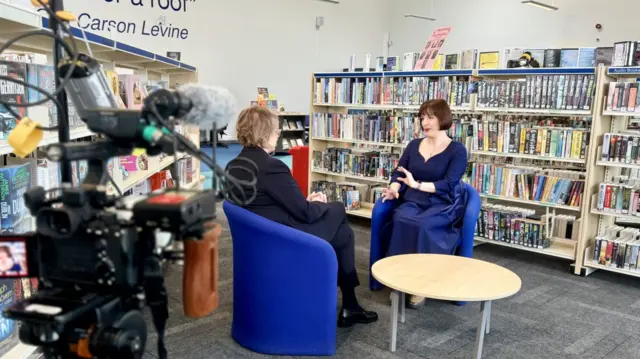
    Education Secretary Bridget Phillipson sitting opposite BBC's Branwen Jeffreys on blue chairs in a school library.

    The BBC's Education Editor Branwen Jeffreys has spoken with Education Secretary Bridget Phillipson following her speech at a school in Peterborough.

    She puts it to the education secretary that Labour may not still be in power when the main changes to SEND come into effect in 2029. "So how do you know they will be seen through?" she asks.

    In response, Phillipson says "the money starts going in from this year," pointing also to the extra expert support she says will be commissioned for schools to draw down on from later this year.

    "I'm confident parents will see that change, but we want to do it carefully," she adds.

    Quote Message

    Children have been let down by the system and we want to deliver that reform."

    Education Secretary Bridget Phillipson

  19. Government sets out major changes to SEND - what you need to knowpublished at 12:56 GMT

    The government has outlined planned changes to the SEND system in England. If you're just joining us, here's an overview:

    What is SEND?

    SEND stands for special educational needs and disabilities. It applies to children and young people who need extra support to meet their physical, communication, social, emotional or mental health needs.

    In England, if they need more support than is typically provided in mainstream schools, their parent or carer can apply for an education, health and care plan (EHCP) which sets out the extra support they are entitled to.

    Rising costs, extra funding

    Overall spending on SEND has risen by two-thirds in the past decade, according to the Institute for Fiscal Studies (IFS). Despite this, in 2024 the National Audit Office described the system as "broken".

    Today,the government has announced around £4 billion of extra funding, and set out plans for a wider overhaul of the system in its Schools White Paper.

    What's been announced?

    • By 2035, EHCPs will be reserved for only the most complex special educational needs
    • Children who currently have an EHCP will keep them until they reach the next stage of their education
    • Children will be reassessed for EHCPs as they move up to their next stage from 2029
    • Under the changes, the government projects that the proportion of children with SEND on the current highest level of support in school will start falling each year from the end of the decade
  20. 'You have to fight every step of the way,' says EastEnders actor Kellie Brightpublished at 12:39 GMT

    Emma Jacobs
    BBC Panorama

    Actress Kellie Bright in a bright red shirt standing behind a floral patterned chair against a pink background.Image source, Kellie Bright

    EastEnders actor Kellie Bright's son is autistic, has ADHD and is dyslexic.

    Kellie, for BBC Panorama, speaks to parents who say they’re exhausted by the fight to get the right education for their children.

    "To try and get the support that you need, you have to fight every step of the way," she says.

    She follows three families who are applying to their councils for an Education, Health and Care Plan (EHCP), a crucial document which can say where a child goes to school and what extra support they should get.