Summary

  1. Two injured in Iranian strike on Bahrain, government sayspublished at 08:17 BST

    Two people in Bahrain have "minor injuries" after an Iranian drone attack, says its interior ministry.

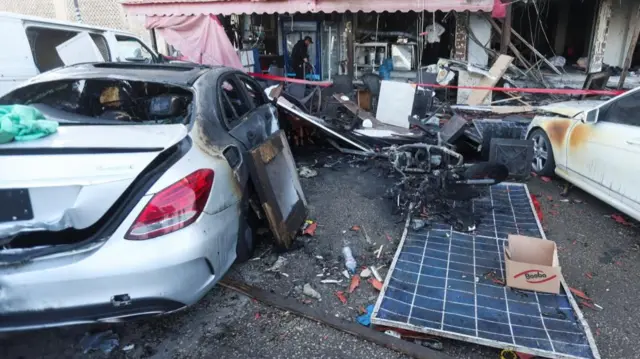
    It adds that "a number of houses" were damaged in the Sitra area due to falling shrapnel from the drone.

    The government has not confirmed whether the drone was fired before the US-Iran two-week ceasefire was announced.

  2. UAE says it 'triumphed' in warpublished at 08:03 BST
    Breaking

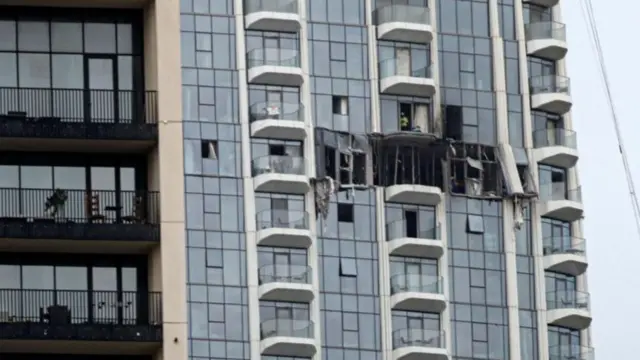
    This picture from 12 March shows a damaged apartment block in Dubai after an Iranian attackImage source, EPA
    Image caption,

    This picture from 12 March shows a damaged apartment block in Dubai after an Iranian attack

    An adviser to the president of the United Arab Emirates says the country has "triumphed", after suffering regular Iranian attacks since the war began.

    "We prevailed through an epic national defence that safeguarded sovereignty and dignity and protected our achievements in the face of treacherous aggression," Anwar Gargash says.

    "Today, we move forward to manage a complex regional landscape with greater leverage, sharper insight, and a more solid capacity to influence and shape the future."

    The country's ministry of defence has posted regular updates on intercepted Iranian attacks since the start of the war. An update posted on Tuesday gave the following figures: 2221 drones, 26 cruise missiles and 520 ballistic missiles.

    Oman's foreign minister has also welcomed the ceasefire.

    Its foreign ministry credited the work of Pakistan - but underlined the importance of "intensifying efforts" moving forwards towards a permanent ceasefire.

  3. Analysis

    Relief in the markets - but energy prices will remain elevated for some timepublished at 07:38 BST

    Dharshini David
    Deputy economics editor

    Relief around the world at news of a ceasefire agreement - and in the markets too.

    Shares are up - or are expected to open up - and the oil price fell by around 15%, buoyed by the envisioned re-opening of the Strait of Hormuz.

    But the price of oil remains considerably higher than before the conflict - for two reasons.

    The range we’ve seen for Brent Crude, of $100-110 per barrel in recent days, is midway between the kind of level you’d expect if investors were betting on an all-out prolonged escalation, and the kind that implies they’re expecting a swift resolution.

    Traders effectively had a foot in each camp, paralysed due to the sheer unpredictability of those calling the geopolitical shots.

    And that unpredictability remains while we wait to see how discussions and actions pan out.

    Even with a swift end to hostilities, energy prices may remain elevated to some degree for some time, as it will take months or even years to repair the damage done to supply capacity in the region.

    But the latest decline of prices, if sustained, means the impact on inflation and interest rates might be less severe and prolonged than previously feared.

    However, there remains a lot of ifs, buts, and unknowns.

  4. Israel tells people in Lebanese city to evacuate 'immediately'published at 07:29 BST
    Breaking

    The Israeli military has issued a new evacuation order for people living in the Lebanese city of Tyre, in the country's south.

    It says to "evacuate your homes immediately" and move north of the Zahrani River "to ensure your safety".

    As a reminder, Israel earlier said it supported the ceasefire, but it "does not include Lebanon". However, Iran and Pakistan’s Prime Minister Shehbaz Sharif, who helped negotiate the ceasefire, both have said the deal covers Lebanon, where Israel has been fighting the Iranian proxy Hezbollah.

  5. Starmer's Gulf trip was planned before ceasefire announcementpublished at 07:28 BST

    We can bring you more from Downing Street's statement now on Keir Starmer's trip to the Gulf.

    It says the PM will "thank UK personnel for their brave service" during his visit and see in person "the defensive support the UK has provided in the collective self-defence of our allies in the region".

    The statement continues by saying: "The Ministry of Defence has confirmed that UK personnel have intercepted more than 110 drone attacks in the region, and the RAF have conducted more than 1,600 hours of defensive operations."

    Downing Street adds the PM's travel was planned before the ceasefire was announced overnight.

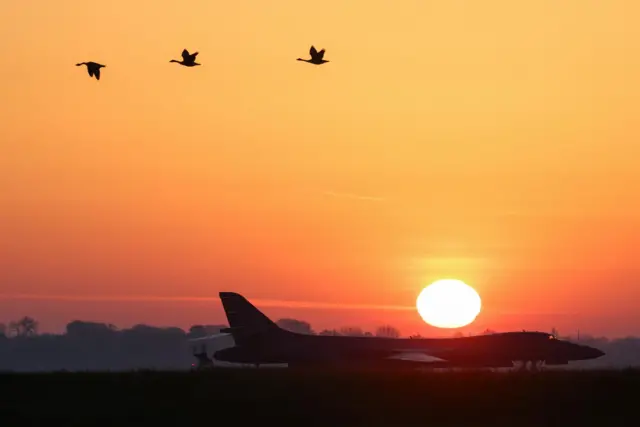
    A US B-1B Lancer seen parked at RAF Fairford in Gloucestershire on Wednesday morning. The US Air Force has used the base for operations in Iran - the UK says they were for "defensive" strikes on Iranian missile sitesImage source, Reuters
    Image caption,

    A US B-1B Lancer seen parked at RAF Fairford in Gloucestershire on Wednesday morning. The US Air Force has used the British base for operations in Iran - the UK says they were for "defensive" strikes on Iranian missile sites

  6. Starmer says UK will 'do all we can to support and sustain this ceasefire'published at 07:14 BST
    Breaking

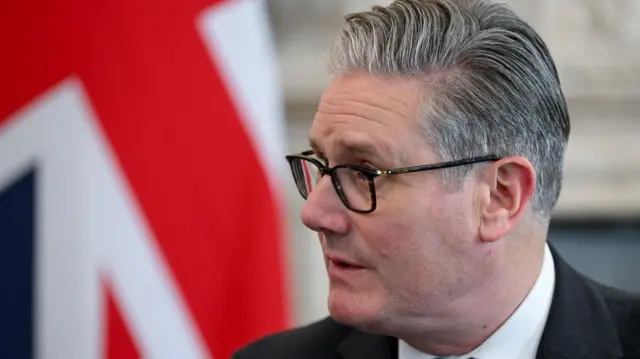
    Keir StarmerImage source, Reuters

    Keir Starmer says the UK will "do all we can to support and sustain this ceasefire".

    "I welcome the ceasefire agreement reached overnight, which will bring a moment of relief to the region and the world," he says.

    "Together with our partners we must do all we can to support and sustain this ceasefire, turn it into a lasting agreement and re-open the Strait of Hormuz."

    The announcement from Downing Street says:

    • The prime minister will travel to the Gulf to meet leaders of countries who have been on the front line, and will set out his full support for the newly agreed ceasefire
    • In meetings with regional leaders, he will reiterate unwavering UK support and need for a long-term diplomatic resolution to make sure the ceasefire leads to a lasting agreement
    • He will hold talks on ensuring the reopening of the Strait of Hormuz remains permanent, with the UK continuing to lead international efforts
  7. Keir Starmer heading to Gulfpublished at 07:09 BST
    Breaking

    UK Prime Minister Keir Starmer is travelling to the Gulf today to meet leaders in the region to "discuss diplomatic efforts to support and uphold the ceasefire", Downing Street says.

    We'll have more on this shortly.

  8. Analysis

    Disaster averted, or kicking the problem down the road? It's bothpublished at 07:02 BST

    Frank Gardner
    Security correspondent

    This ceasefire is a case of both "disaster averted" - and kicking the problem further down the road.

    There will be huge relief, both in Iran and in the neighbouring Gulf states, that President Trump has not felt the need to follow through on his recent threat to destroy what he called the "civilisation" in Iran.

    There’s relief too that the Strait of Hormuz will once more be open for business, a sentiment reflected in falling oil prices.

    And yet the war is, at best, on pause.

    Residents in Bahrain awoke this morning to the whine of incoming Iranian drones and the thump of explosions. Israel says it will continue to fight Hezbollah.

    And the US and Iranian negotiating positions remain far apart on everything - from who will control the Strait of Hormuz, to reparations, to nuclear enrichment.

  9. Analysis

    Lebanon, devastated by war, faces more uncertaintypublished at 06:44 BST

    Hugo Bachega
    Middle East correspondent in Beirut

    The aftermath of an Israeli strike in Sidon, Lebanon, seen on Wednesday morningImage source, Reuters
    Image caption,

    The aftermath of an Israeli strike in Sidon, Lebanon, seen on Wednesday morning

    The announcement of a ceasefire between the US and Iran happened in the early hours of the morning here, and - as we have reported - it is still not clear if it does or does not include Lebanon.

    There has been no immediate reaction from either the Lebanese government or Hezbollah.

    For Lebanon, the war has been devastating. Over 1.2 million people have been displaced, about a fifth of the population, and more than 1,500 people have been killed.

    Villages near the border have been destroyed as invading Israeli troops aim to create what the Israeli authorities call a security buffer zone to push Hezbollah away. This has raised fears that some areas may be occupied even after the war, and that families may never be able to return.

    Israeli officials had indicated their intention to continue with their campaign in Lebanon even if there was a deal with Iran.

    Observers and some in Israel have expressed surprise with Hezbollah’s capabilities. It was widely believed to have been weakened severely in the last war that ended in November 2024.

    Hezbollah has frequently launched rockets and drones into northern Israel and confronted Israeli troops in southern Lebanon.

    It has faced strong criticism inside Lebanon, where many blame it for dragging the country into an unwanted war.

  10. Netanyahu has failed, says Israeli opposition leaderpublished at 06:40 BST

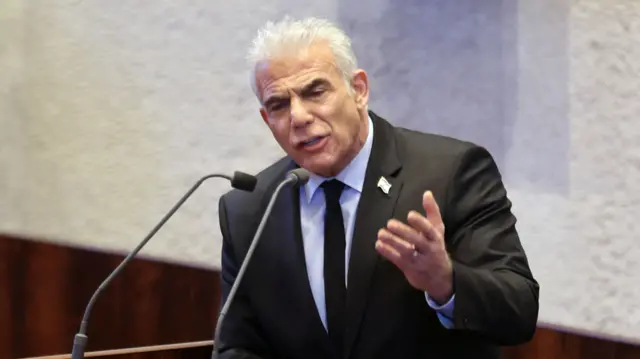
    Yair Lapid stands at a podium speakingImage source, EPA/Shutterstock

    Israel's leader of opposition, Yair Lapid, has criticised Benjamin Netanyahu's handling of the war - after the Israeli prime minister issued a statement overnight in support of President Trump's ceasefire.

    Netanyahu's office says the two-week ceasefire will not include Lebanon - although Iran and Pakistan both say it will.

    Lapid calls the situation a "political disaster" for Israel.

    "Israel was not even at the table when decisions were made concerning the core of our national security," the opposition leader says.

    "The army did everything they asked of it, the public displayed incredible resilience, but Netanyahu failed politically, failed strategically, and did not meet any of the goals he himself set."

  11. Fire put out in Bahrain after Iranian attack - interior ministrypublished at 06:38 BST

    A fire at a facility in Bahrain has been extinguished following an Iranian strike, says Bahrain's Interior Ministry.

    It's not known exactly when Iran launched its strike - as we said earlier, attacks were being reported across the region as news of the ceasefire broke.

  12. Iranians gather in Tehran after ceasefire announcedpublished at 06:05 BST

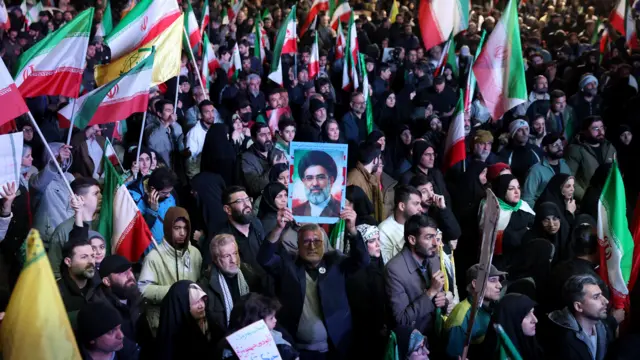
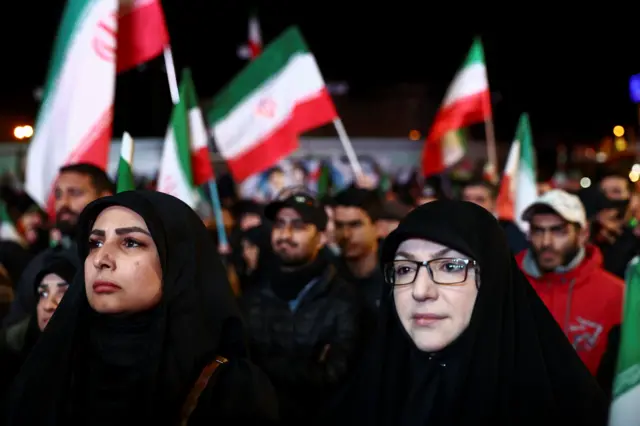
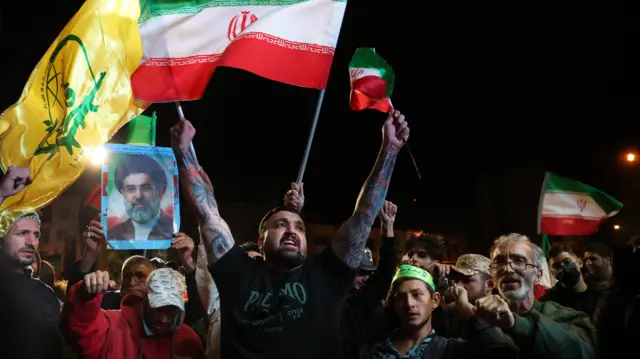
    Iranians gathered in Iran's capital city carrying flags and portraits of Iran's Supreme Leader Mojtaba Khamenei following the announcement of the ceasefire.

    Reaction to the ceasefire has been mixed in Iran, BBC Persian Washington correspondent Khashayar Joneidi says.

    There is a sense of relief now that power plants won't be attacked. But for those opposed to the regime, they must face it again, and now it is more angry.

    Iranians wave green and red flags during a demonstration following the announcement of a two-week ceasefire at Enghelab Square in Tehran.Image source, EPA
    Two women stand in a crowd waving Iranian flags. They both wear black hijabs and one has rectangular glasses on.Image source, Reuters
    Iranians wave the country's flag and hold a portrait of Supreme Leader Mojtaba Khamenei during a demonstration following the announcement of a two-week ceasefire at Enghelab Square in Tehran.Image source, EPA
  13. Iran ceasefire deal a partial win for Trump - but at a high costpublished at 05:53 BST

    Anthony Zurcher
    North America correspondent

    In the end, cooler heads prevailed – at least for now.

    The US and Iranians now will engage in negotiations over the next two weeks, buying some time to try to reach a permanent settlement.

    It is likely to be a bumpy ride, but in after-hours trading, the price of a barrel of oil dropped below the $100 mark for the first time in days and US stock futures soared.

    There appears to be a sense of optimism that the worst is over.

    Even this kind of progress was far from certain as recently as Tuesday morning, when Donald Trump threatened the death of Iranian civilisation, "never to be brought back again".

    Whether such a jaw-dropping threat from an American president pressured Iran to agree to the kind of ceasefire they had previously rejected is uncertain.

    What is clear is that Trump's astounding, inflammatory declaration – just two days after a similar obscenity-laced Truth Social demand – is unlike anything a modern US president has ever levelled or hinted at.

    And even if the two-week ceasefire does result in a permanent peace, the Iran war – and Trump's recent words – may have fundamentally altered the way the rest of the world views the US.

    Read more here.

  14. 'A big day for World Peace!' says Trumppublished at 05:43 BST

    Trump has posted on Truth Social to say it is a "big day for World Peace!"

    "Iran wants it to happen, they’ve had enough! Likewise, so has everyone else!"

    He notes that the US will be "helping with the traffic buildup in the Strait of Hormuz", continuing:

    "There will be lots of positive action! Big money will be made. Iran can start the reconstruction process. We’ll be loading up with supplies of all kinds, and just “hangin’ around” in order to make sure that everything goes well. I feel confident that it will. Just like we are experiencing in the U.S., this could be the Golden Age of the Middle East!"

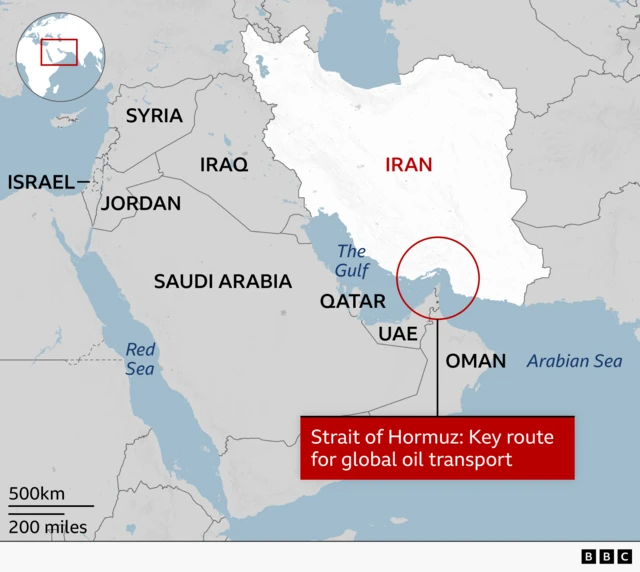
    Map of Strait of Hormuz
  15. Is Lebanon included in the ceasefire deal?published at 05:37 BST

    Daniel De Simone
    Reporting from Jerusalem

    A clear conflict over whether the ceasefire deal includes Lebanon has emerged.

    Iran and Pakistan’s Prime Minister Shehbaz Sharif, who helped negotiate the ceasefire, both have said the deal covers Lebanon, where Israel has been fighting the Iranian proxy Hezbollah.

    But a statement from the office of Israeli Prime Minister Benjamin Netanyahu has said the ceasefire "does not include Lebanon".

    This key issue will need to be clarified.

    In recent weeks, Israel has sent ground forces into southern Lebanon and has said it will keep control over the area south of the Litani River until any threat from Hezbollah has been removed.

    Israel has been destroying homes and villages in the area, where it says Hezbollah were active, and hundreds of thousands of people have been displaced. Israel has said they will not be allowed to return until Hezbollah has been removed.

    Shortly before the ceasefire was announced, the Lebanese Ministry of Health said eight people were killed and 22 injured in an Israeli attack on the city of Sidon in southern Lebanon.

    Over the past few weeks, Hezbollah has continued to fire rockets into Israel.

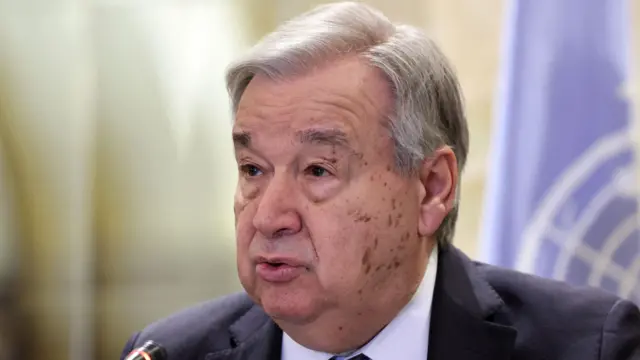
  16. UN secretary general welcomes ceasefire in Middle Eastpublished at 05:19 BST

    Secretary-General of the United Nations Antonio Guterres speaks during a press conference in Beirut, Lebanon, 14 March 2026.Image source, EPA
    Image caption,

    António Guterres pictured in Beirut last month

    UN Secretary General António Guterres "welcomes the announcement of a two-week ceasefire by the United States and Iran", his spokesperson has said.

    "He calls on all the parties to the current conflict in the Middle East to comply with their obligations under international law and to abide by the terms of the ceasefire in order to pave the way toward a lasting and comprehensive peace in the region," the statement read.

    Guterres expressed "sincere appreciation for the efforts of Pakistan and other countries in facilitating the ceasefire".

  17. Analysis

    The war of narrativespublished at 04:58 BST

    Behrang Tajdin
    Economics correspondent, BBC Persian

    Regardless of what happened on the ground in the past 39 days, the most important thing for Iran is how this ceasefire and any possible future deal is framed.

    As soon as the ceasefire was announced, the Iranian side tried to paint it as a victory, as they say the United States and Israel failed to defeat them completely.

    For the Islamic Republic, the state media and their allies in the "axis of resistance" that’s a win.

    So while Donald Trump has accepted Iran’s 10-point plan as the basis for further negotiations, the Supreme National Security Council says the Americans have agreed to all of their demands, without divulging what Iran has proposed to do in return, apart from the two-week reopening of the Strait of Hormuz.

    In other words, for the two sides to reach an agreement, both Trump and Iran need to reach a point where they can claim this whole process as a victory.

    That is probably more important than any details of a possible peace agreement.

  18. Death toll in Lebanon surpasses 1,500published at 04:31 BST

    The death toll in Lebanon during more than a month of war between Israel and the Iran-backed militant group Hezbollah reached 1,530 people on Tuesday, Agence-France Presse reported.

    The figure, which the outlet said was issued by Lebanon's health ministry, included 102 women and 130 children.

    It added that a further 4,812 people have been wounded in the conflict.

    In reference to the recently announced ceasefire, Israel said: "The two-weeks ceasefire does not include Lebanon."

    Pakistan and Iran said the ceasefire did include Lebanon.

  19. 'Total and complete victory,' says Trumppublished at 04:10 BST

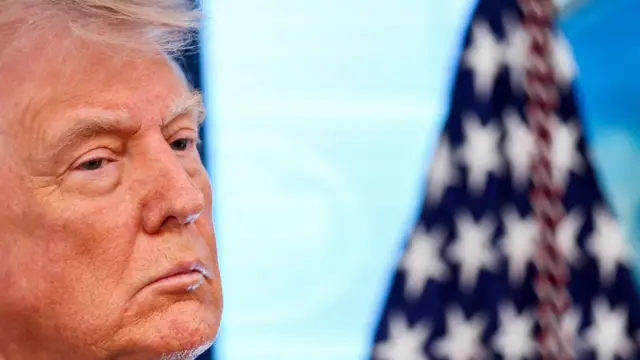
    U.S. President Donald Trump attends a press conference in the James S. Brady Press Briefing Room at the White House in Washington, D.C., U.S., April 6, 2026Image source, Reuters

    Donald Trump says there is no question the US had won a "total and complete victory" after agreeing a two-week ceasefire deal with Iran.

    In an interview with Agence France Presse after his announcement, he said that Iran's enriched uranium would be "perfectly taken care of" under the deal.

    "Or I wouldn't have settled," Trump said, without giving any specifics about what would happen to the uranium.

    When asked if he would go back to his original threats to destroy to Iran's civilian power plants and bridges if the deal fell apart all he would say was: "You're going to have to see."

    Trump, who is due to travel to China next month to meet his Chinese counterpart Xi Jinping, said: "I hear yes" when asked if Beijing was involved in getting its key ally Tehran to negotiate on a truce.

  20. Israel supports ceasefire, but it 'does not include Lebanon'published at 03:53 BST
    Breaking

    Daniel De Simone
    Reporting from Jerusalem

    Israel has just issued an official statement on the ceasefire with Iran. Here it is in full:

    Israel supports President Trump's decision to suspend strikes against Iran for two weeks subject to Iran immediately opening the straits and stopping all attacks on the US, Israel and countries in the region.

    Israel also supports the US effort to ensure that Iran no longer poses a nuclear, missile and terror threat to America, Israel, Iran's Arab neighbors and the world.

    The United States has told Israel that it is committed to achieving these goals, shares by the US, Israel and Israel's regional allies, in the upcoming negotiations.

    The two-weeks ceasefire does not include Lebanon.

    • For context: Earlier, Pakistan and Iran said the ceasefire did include Lebanon.