Summary

  1. UK to hold military planners meeting next week - defence ministrypublished at 15:33 BST

    The UK's Ministry of Defence (MoD) has confirmed that military planners will meet next week at the UK's Permanent Joint Headquarters to discuss the Strait of Hormuz.

    It comes after Foreign Secretary Yvette Cooper revealed that today's summit between foreign ministers across the globe will be followed up with a meeting between military planners.

    Next week's meeting will cover the "viable options to make the Strait of Hormuz accessible and safe for navigation", says the MoD in an update shared on X.

    It adds that, overnight, Britain's RAF Regiment gunners "successfully downed multiple Iranian drones" operating in a "high-threat area" overnight.

  2. UN Secretary General calls on US and Israel to stop the warpublished at 15:19 BST

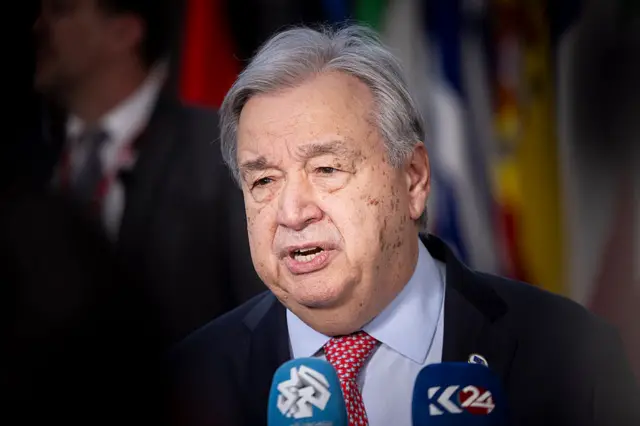
    UN Secretary General António Guterres speaking with two microphones in front of him. He wears a black jacket and red patterned tieImage source, Getty Images
    Image caption,

    UN Secretary General António Guterres

    UN Secretary General António Guterres just spoke to reporters in New York, where he called for an immediate end to the war and cessation of hostilities on all sides.

    "We are on the edge of a wider war that would engulf the whole Middle East with dramatic impacts around the globe," he says.

    He cited rising costs, saying people are already struggling from rising energy and food prices.

    "When the Strait of Hormuz is strangled, the world’s poorest and most vulnerable cannot breathe," he says.

    He calls for disputes to be settled "peacefully" and says that civilian infrastructure "including nuclear installations" should be "respected and protected".

    He goes on to say: "My message is clear, to the United States and Israel, it is high time to stop the war that is inflicting immense human suffering and already triggering devastating economic consequences.

    "To Iran, to stop attacking their neighbours."

  3. Seven million Iranians have stepped up to fight in the war - Iran's parliamentary speakerpublished at 15:00 BST

    Mohammad-Bagher Ghalibaf, the speaker of Iran's parliament, says seven million Iranians have volunteered for military service since the start of the war with Israel and the US.

    He says "a powerful national campaign" has led to the millions of Iranians declaring that they are "ready to pick up arms and stand in defense of our nation".

    "We've done it before, and we're ready to do it again. You come for our home...you're gonna meet the whole family," he said, adding: "Bring it on."

  4. BBC Verify

    Video shows fire at Iranian airport following reported strikespublished at 14:36 BST

    By Peter Mwai and Shayan Sardarizadeh

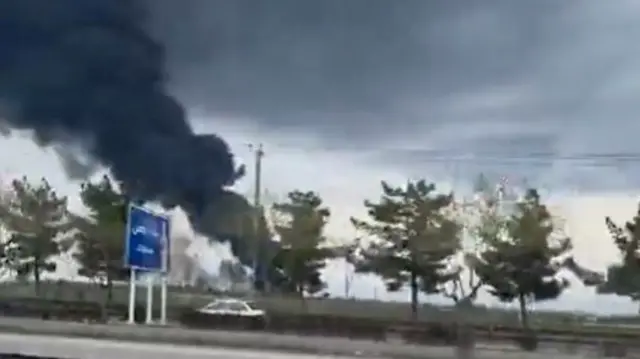
    BBC Verify has examined a video of a huge plume of smoke rising near the main airport in Mashhad, a city in north-eastern Iran.

    The verified clip was first shared this morning and was filmed from a vehicle driving near Mashhad International Airport.

    We were able to confirm it was moving along a major highway near Mashhad by identifying landmarks and matching them to street view imagery.

    Iranian media reports say fuel storage tanks and a warehouse may have been targeted. The airport also hosts one of the air bases of Iran’s air force, but it is not possible to identify what was hit from the video.

    A screengrab from a video being filmed as a car drives by a large plume of black smoke rising into the airImage source, X/Mamlekate
  5. Israel strikes Lebanon again, as thousands flee their homespublished at 14:13 BST

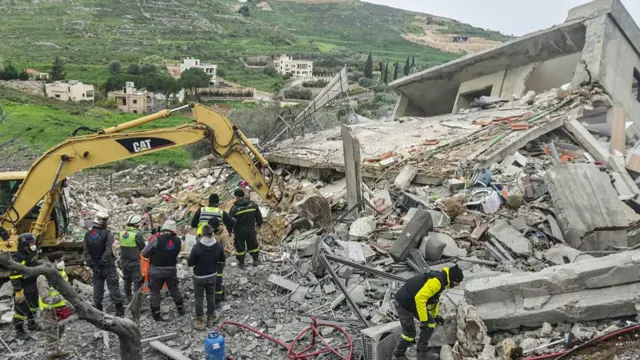
    First responders dig through the debris of a bombed out home collapsed on itself after a missile strikeImage source, AFP via Getty Images
    Image caption,

    First responders have been looking for survivors at the site of an overnight missile strike in the village of Zibdine

    We've just brought you some footage of explosions near a major Iranian missile base, and we're now seeing images of the aftermath of strikes in another part of the Middle East.

    In Lebanon, Israel is still carrying out an extensive bombing campaign targeting Hezbollah strongholds in the south of the country.

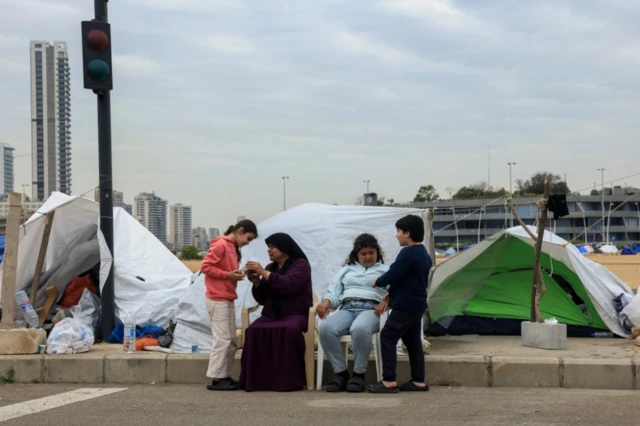
    Thousands of people have left their homes and set up tents on the streets and beaches to escape the attacks.

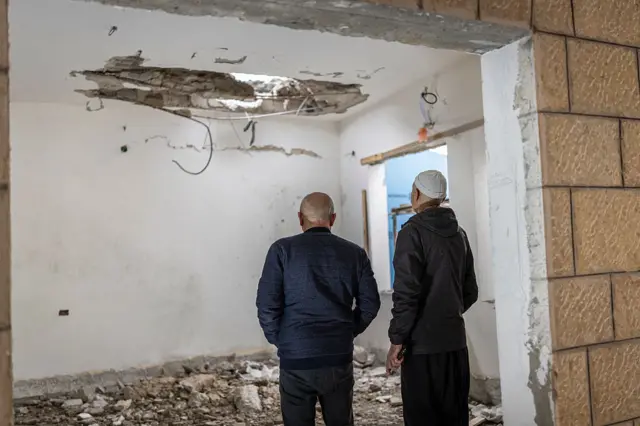
    Two men in dark clothing stand inside a room of a residential building heavily damaged. A large hole in the ceiling, debris scattered across the floorImage source, AFP via Getty Images
    Image caption,

    Members of the Druze community in the city of Shefa-Amr, southern Lebanon, have been assessing the extent of the damage caused by Israeli rocket fire

    A woman with a black head covering veil and clothing sits on a plastic chair next to her eldest daughter as she looks at something in her hands with her youngest daughter. A boy stands next to the chair talking, behind the group are three tents pitched on a streetImage source, Reuters
    Image caption,

    Thousands across Lebanon have been forced to flee their homes since the start of the Israeli strikes last month

  6. BBC Verify

    Major explosions at Isfahan missile base after strikespublished at 13:55 BST

    By Shayan Sardarizadeh and Sherie Ryder

    Videos showing huge explosions near a major Iranian missile base on the outskirts of Isfahan have been verified.

    BBC Verify has examined three clips first shared on social media yesterday, including one showing a large plume of smoke and fire debris in the air near the Isfahan South missile base. The man recording expresses his shock at the scale of the blast.

    The base is located on the edge of a mountain range in the south of Isfahan in central Iran.

    Another clip, filmed to the north of the base, shows smoke rising over the mountains from fires and several subsequent large secondary explosions. This suggests other explosive material has detonated following a US or Israeli strike.

    A third video from the nearby town of Baharestan shows the base burning for several minutes.

    Several secondary explosions are visible in this clip as well, which shows debris repeatedly thrown into the air towards the town or landing in the mountains.

  7. Iran war reaches day 34 - what's happened today so far?published at 13:52 BST

    Nabiha Ahmed
    Live reporter

    If you're just joining us, or are in need of a refresher, here's a glance at the latest developments in the US-Israeli war with Iran:

    • Renewed threats to escalate the war: Iran has warned of "crushing, broader and destructive" attacks to come, hours after President Trump warned that the US would hit Iran "extremely hard" in the next few weeks
    • Fresh strikes in Iran: Sources tell BBC Persian's Ghoncheh Habibiazad that Karaj, a city west of Tehran, has been "hit hard". Iranian media reports that a key bridge in the city has been targeted
    • Update on the Strait of Hormuz: Iran says it is permitting ships "not related" to the US or Israel to pass through the strait - but why is this passage so important?
    • Foreign ministers meet: Meanwhile, during a virtual summit between over 40 of her global counterparts to discuss the strait, British Foreign Secretary Yvette Cooper has reiterated the "urgent need" for it to reopen
    • Gulf countries targeted: Both Saudi Arabia and the United Arab Emirates have reported missiles and drones heading into their airspace today
  8. UAE says 19 missiles and 26 drones launched from Iran todaypublished at 13:30 BST

    We've had an update from the United Arab Emirates Ministry of Defence, which says that they have "engaged with" 19 missiles and 26 drones launched from Iran today.

    The ministry says in its update on X that since the war began, the UAE's air defences have tackled around 457 missiles and 2,038 drones.

  9. What do some Iranians think about Trump threat to take back Iran to ‘Stone Ages’published at 13:17 BST

    Ghoncheh Habibiazad
    Senior reporter, BBC Persian

    It's still very difficult to contact people inside Iran amid the internet outage, but some have managed to connect using satellite internet such as Starlink and other methods, though it comes at a high cost.

    Using or possessing Starlink can lead to up to two years in prison.

    I have been asking them what they think about Donald Trump’s threat to take Iran “back to the Stone Ages”.

    One woman in her 20s in Tehran says: “In my opinion, this claim is completely unrealistic and impossible. Given its current cultural, demographic, and economic structures, especially considering its historical experience, Iran has a strong capacity for reconstruction.”

    Meanwhile, a woman in her 40s in Tehran says: “I hope he won’t do it. I’m worried that he might want to strike all the oil and energy industries and infrastructure and completely destroy them. Rebuilding all of that takes a very long time.”

  10. 'It's not a show': Macron hits out at Trumppublished at 12:54 BST

    Hugh Schofield
    Paris Correspondent

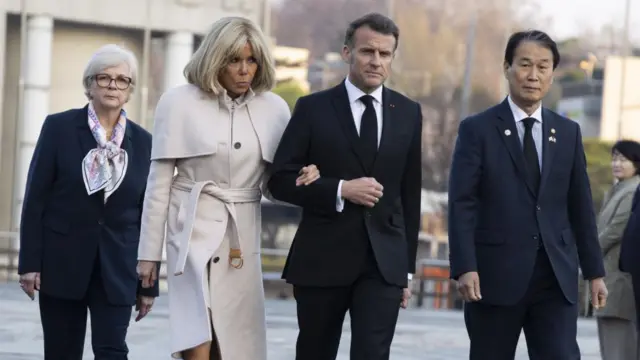
    French President Emmanuel Macron (2-R) and his wife Brigitte Macron (2-L) arrive to pay tribute to the victims of the Korean War during his visit to the war memorial in Seoul, South Korea.Image source, EPA
    Image caption,

    Macron, and his wife Brigitte, are in South Korea today where they paid a visit to the war memorial in Seoul

    President Trump has been on the offensive against France, which he accuses of failing to help in the war on Iran, and personally too against President Macron.

    Trump, on Wednesday, commented that Macron's wife Brigitte "treats him extremely badly".

    Macron said these comments were inelegant and unworthy and did not merit a response.

    On strategic matters, the French president said the Trump administration was constantly giving out contrary signals.

    "There’s too much talk" he said, adding "it’s going off in every direction. But we all need stability, calm, a return to peace. It’s not a show."

    "If you want to be serious, you can’t say each day the opposite of what you said the day before."

  11. Military planner talks will follow foreign ministers' discussions, says Cooperpublished at 12:40 BST

    Cooper says discussions today will be followed up by a meeting of military planners to look into what can be done to secure safe navigation in the area.

    The ongoing call will focus on discussing "collective mobilisation of our full range of diplomatic and economic tools and pressure," she says.

    They will also discuss "action to guarantee the safety of ships and seafarers," as well as "effective coordination that we need across the world to enable a safe and sustained opening of the strait," Cooper says.

  12. Cooper presses 'urgent need' to reopen Strait of Hormuzpublished at 12:35 BST

    British Foreign Secretary Yvette Cooper speaks during a virtual summit.Image source, Reuters

    Cooper tells the meeting of over 40 foreign ministers there is an "urgent need" to restore freedom of navigation for international shipping through the Strait of Hormuz.

    In the last 24 hours, she says, 25 vessels have passed through the strait - it would usually see 150 vessels pass through, but has been impacted by Iran's effective blockade of the key route.

    She adds there are some 20,000 tracked seafarers on some 2,000 trapped ships due to the strait's near-total closure.

  13. UK foreign secretary condemns Iranian 'recklessness' over global economypublished at 12:22 BST

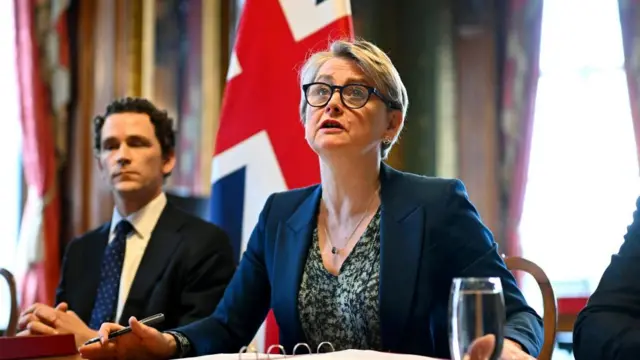
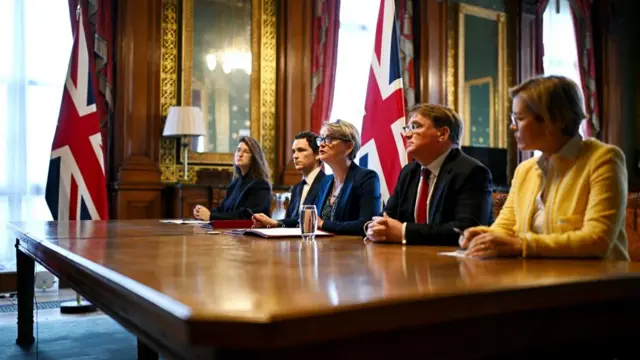
    Yvette Cooper hosting the virtual meeting of foreign ministersImage source, Reuters

    Foreign Secretary Yvette Cooper condemns Iran's "recklessness" for "hitting global economic security", as she addresses a virtual meeting of foreign ministers.

    The meeting is aimed at reopening the Strait of Hormuz - a vital shipping route in the Middle East.

    We will bring you more from the meeting when we can.

  14. When it comes to Hormuz, there are no easy answerspublished at 12:18 BST

    Frank Gardner
    Security correspondent, reporting from the FCDO

    How to reopen the Strait of Hormuz for normal business through diplomacy?

    That’s the question being addressed today in a virtual ‘summit’ of foreign ministers, hosted by UK Foreign Secretary Yvette Cooper here at the Foreign, Commonwealth and Development Office (FCDO) in Westminster.

    There are no easy answers.

    President Trump and Israel’s war on Iran has, bizarrely, left the Iranian regime in a far stronger bargaining position than it had before the war started. By threatening shipping passing through this vital waterway, Iran can effectively hold the global economy to ransom.

    With hundreds of ships stranded on either side of the strait, oil, gas and diesel prices have risen sharply.

    President Trump has vacillated between setting Iran an ultimatum to reopen the strait or indicating he will walk away from the problem.

    Now, he says that the countries that need the product coming out of the Gulf should deal with it themselves.

    We're keeping an eye on the developments at the virtual summit between 35 foreign ministers - stay with us.

  15. Iranian city Karaj 'hit hard' by strikes, sources saypublished at 12:04 BST
    Breaking

    Ghoncheh Habibiazad
    Senior reporter, BBC Persian

    I'm hearing from two sources that Karaj, a city west of Tehran, has been "hit hard".

    A source in Tehran tells me he could hear fighter jets passing above his house. Iranian outlets have also reported on strikes on Karaj.

  16. Iran internet blackout enters day 34published at 11:52 BST

    Ghoncheh Habibiazad
    Senior reporter, BBC Persian

    Iran's internet blackout has now entered day 34, with most users cut off from the outside world for over 792 hours, according to internet monitoring group NetBlocks.

    Connectivity to the outside world remains at 1% of normal levels.

    NetBlocks has said that “friends and family remain largely cut off from the outside world amid growing anxiety over wartime casualties, arrests, and executions”.

    A few people have managed to connect using satellite internet such as Starlink and other methods, but it comes at a high cost.

    In Iran, using or possessing Starlink can lead to up to two years in prison, and authorities are trying to crack down on it. Iranian outlets have reported that “hundreds” of Starlink devices have been confiscated since the war started.

  17. Badenoch says she disagrees with anything 'undermining Nato' after Trump commentspublished at 11:31 BST

    Conservative party leader Kemi Badenoch visits the Well-Safe Protector Oil Rig at Aberdeen's South HarbourImage source, Getty Images

    UK Conservative leader Kemi Badenoch has told the BBC that any signals of division within Nato could be a "gift" to countries like Iran and Russia.

    Badenoch was giving her reaction to Trump's threats to leave Nato in response to the perceived lack of support for his military action in Iran.

    "I think that we need to make sure that we do not give gifts to countries like Russia or Iran, making it seem as if there is a split in the Western alliance," Badenoch told BBC Breakfast. "What President Trump's words are, is creating that.

    "If they see that the Western countries are squabbling, that's a gift to them.

    "That's a gift to Russia and Iran and other enemies. We need to show that the Western alliance is still strong. I certainly disagree with anything that looks like it's undermining Nato."

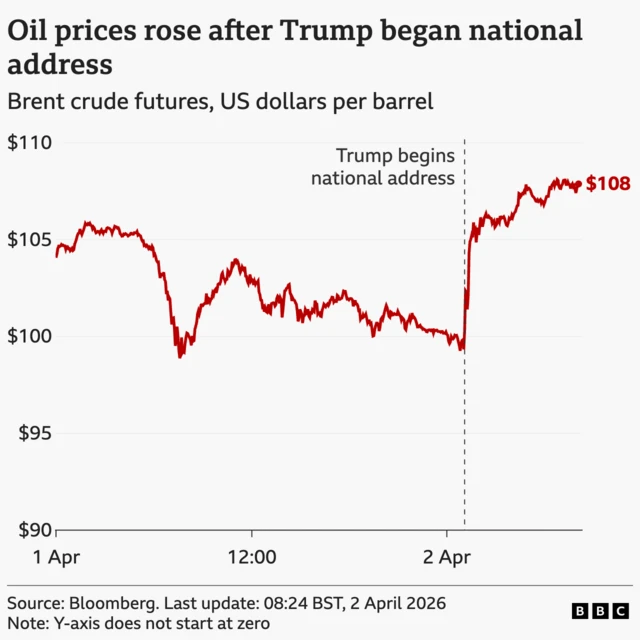
  18. Oil prices rose after Trump began national address on Wednesdaypublished at 11:12 BST

    A chart showing oil prices from 00:00 BST on 1 April to 08:24 BST on 2 April. Brent crude futures at US dollars per barrel are around $100 - $105 before Trump's national address, but then jump up to $108 as he begins his address, and continue to remain high.

    In Trump's address last night, he said countries that need oil from the Middle East should now take the lead to keep the Strait of Hormuz - a key oil shipping route - open.

    Around 20% of the world's oil supply normally passes through the strait.

    Our business reporter Peter Hoskins said earlier that Trump's address seemed to do nothing to reassure global oil markets - and the price of oil has jumped since his address.

  19. Strait of Hormuz - its significancepublished at 10:55 BST

    Iran's foreign ministry has, as we've just reported, reiterated that the Strait of Hormuz is open to ships as long as they do not belong to the US or Israel.

    And, later today, UK Foreign Secretary Yvette Cooper will discuss plans to ensure the reopening of the Strait of Hormuz with counterparts from 35 countries later today.

    The strait has been all but closed by Iran putting significant pressure on global supply chains and energy prices.

    Iran has said the route is only closed to tankers and ships belonging to countries involved in attacks against it.

    Let's take a look at why restoring regular traffic through the waterway is so important:

    This Flourish post cannot be displayed in your browser. Please enable Javascript or try a different browser.

  20. Strait of Hormuz open for ships 'not related' to US or Israel - Iran foreign ministrypublished at 10:33 BST

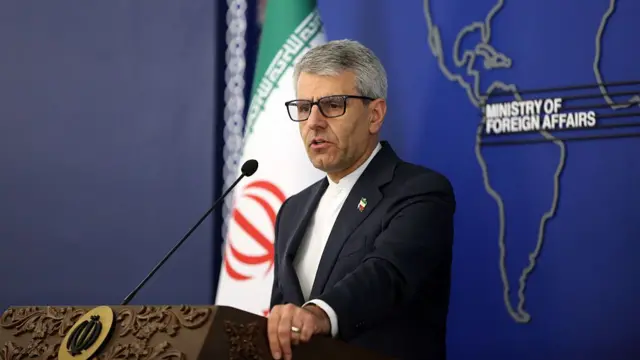
    Esmail Baghaei, Iran's foreign ministry spokesperson, stood at a podium speakingImage source, Anadolu via Getty Images

    Iran's foreign ministry spokesperson says it is allowing ships to pass through the Strait of Hormuz - the key oil shipping route - as long as they "do not belong to the aggressor and are not related to them".

    In an interview with TV channel Newzroom Afrika, Esmail Baghaei says ships would be allowed to pass through the strait "after necessary co-ordination with our authorities".

    Referring to the wider conflict, Baghaei says Iran would not tolerate a "vicious cycle of war, negotiations, ceasefire". In June, a 12-day war between Iran and Israel involved the US attacking several of Iran's nuclear and military sites.

    "They said let's stop, so we stopped, and after nine months, they started again," Baghaei says.