Summary

  • Iran warns of "broader" and "crushing" attacks in response to Trump's latest threat to hit Iran "extremely hard" over the coming weeks

  • A spokesperson for Iran's military says US-Israeli attacks on the country have been "insignificant", claiming the two countries have "incomplete" information about Tehran's military capabilities and equipment

  • In a national address, Trump told Americans he would finish the job "very fast", without setting any timeline for ending the conflict - what else did he say?

  • His speech was largely a rehash of what he's been saying for days - and it leaves four big questions unanswered, our chief North America correspondent writes

  • Global markets weren't reassured by the president's words, writes our Asia business reporter. Oil prices jumped to $106 a barrel and stocks slumped in Asia, a region where many countries are heavily reliant on Middle Eastern oil

  • Meanwhile, the war is causing deep rifts among Iranian families. Even among those opposed to the government, people disagree over whether the war will help or hinder change - read BBC Persian's report

  1. Strait of Hormuz open for ships 'not related' to US or Israel - Iran foreign ministrypublished at 10:33 BST
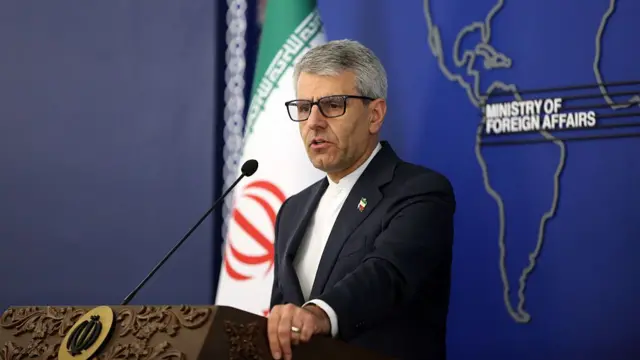
    Esmail Baghaei, Iran's foreign ministry spokesperson, stood at a podium speakingImage source, Anadolu via Getty Images

    Iran's foreign ministry spokesperson says it is allowing ships to pass through the Strait of Hormuz - the key oil shipping route - as long as they "do not belong to the aggressor and are not related to them".

    In an interview with TV channel Newzroom Afrika, Esmail Baghaei says ships would be allowed to pass through the strait "after necessary co-ordination with our authorities".

    Referring to the wider conflict, Baghaei says Iran would not tolerate a "vicious cycle of war, negotiations, ceasefire". In June, a 12-day war between Iran and Israel involved the US attacking several of Iran's nuclear and military sites.

    "They said let's stop, so we stopped, and after nine months, they started again," Baghaei says.
  2. Trump and Iran renew threats of escalationpublished at 10:24 BST

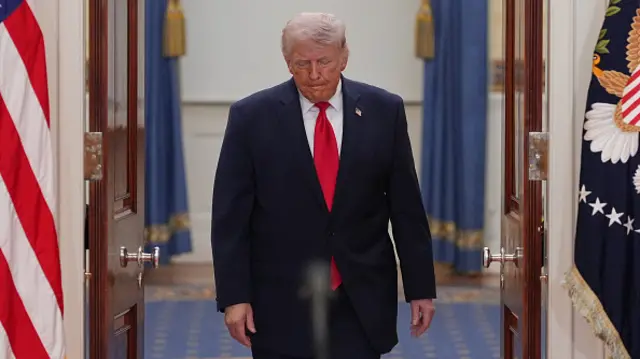
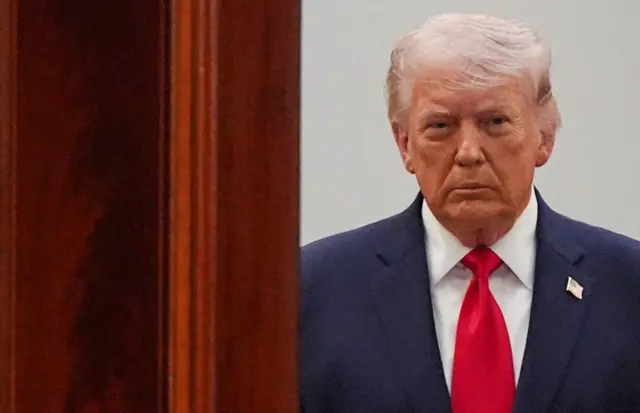
    Donald Trump in dark blue suit, white shirt and red tie, with a US flag pin at the top of his left lapel, waits outside a wooden doorImage source, Reuters

    Earlier today, Tehran warned the US and Israel of "crushing" attacks as strikes continue for the fifth consecutive week.

    The warning came only hours after President Donald Trump warned the US will hit Iran "extremely hard" over the next two to three weeks - this is the latest back and forth of threats between the two nations.

    On 21 March, Trump said American forces would "obliterate" Iranian power plants if Tehran failed to reopen the Strait of Hormuz within 48 hours.

    The threat was met with a strike near the Israeli town of Dimona, an area linked to Israel's undeclared nuclear programme. Meanwhile, Iran reiterated that the strait remains open to countries not participating in attacks against it.

    On 23 March, Trump said Washington and Tehran had had a "very good and productive conversation" and postponed strikes on energy infrastructure by five days.

    Three days later, on 26 March, the pause was extended to 10 days, following what he claimed was a request by the Iranian government.

    On 31 March, the IRGC renewed threats to American tech companies with operating sites in the Middle East - including Microsoft, Apple, and IBM. Trump brushed off the threat, telling reporters he questions what Iran could do, saying will they use "bb guns".

  3. BBC Verify

    Is Trump right to claim US imports 'almost no oil' via Strait of Hormuz?published at 10:08 BST

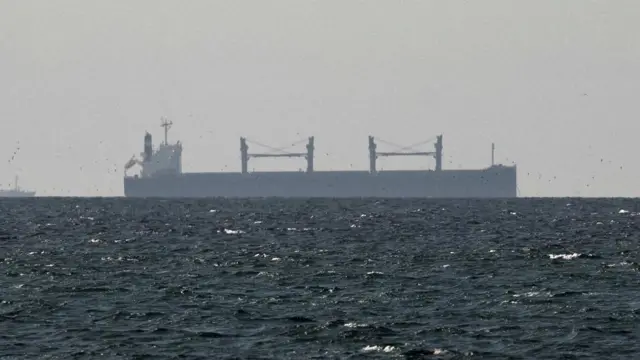
    A cargo ship in the Gulf, near the Strait of Hormuz.Image source, Reuters

    By Tom Edgington

    In his address to the nation last night, Donald Trump downplayed the importance of the Strait of Hormuz and claimed the US imports "almost no oil" through the route.

    However, data from the US Energy Information Administration (EIA) shows that the US imported about 0.4 million barrels per day of crude oil and condensate via the strait in the first half of 2025. This accounted for about 7% of US crude oil and condensate imports., external

    While this share is relatively small, it is not negligible. The EIA also notes US imports from countries in the Gulf have “fallen to the lowest level in 40 years as domestic production has increased”.

    Overall the US is a net exporter of oil, but it still imports some because its refineries are designed to process different types of crude - including some that can’t be produced domestically.

    In these cases the American Fuel & Petrochemical Manufacturers says it is more practical and cost effective to import it., external

  4. Rifts erupt between Iranian families as war rages onpublished at 09:21 BST

    Ghoncheh Habibiazad
    Senior reporter, BBC Persian

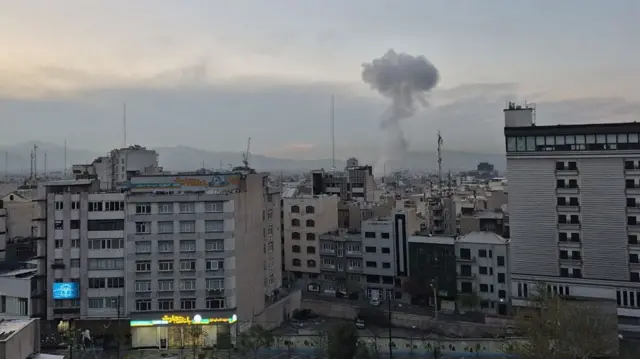
    Wide shot of a residential area of Tehran, a grey cloud of smoke billowing into the air in the far background following an explosionImage source, Getty Images

    "He said to her: 'You're no longer my sister', and she told him to go to hell."

    This argument between a man and his sister in a city near Tehran - witnessed and recounted by one of their relatives - gives a telling insight into the painful rows erupting among families and friends as US and Israeli strikes continue.

    The relative, who we are calling Sina, says that when his family recently got together, emotions quickly exploded, exposing stark divisions.

    His uncle, a member of the Basij - a volunteer militia often deployed to suppress dissent in Iran - refused to even greet his own sister, who is opposed to the ruling regime.

    After their exchange, the uncle was "very quiet… and left early", Sina says.

    In some surprisingly personal notes, he and other young Iranians have described emotional scenes as rifts open up over the war.

    You can read more on how the ongoing war is causing division among families in Iran in my story

  5. Analysis

    Israel's perpetual war with Iran may be hard to win with military might alonepublished at 09:02 BST

    Lucy Williamson
    Middle East correspondent, reporting from Israel

    On the highway from Tel Aviv to Jerusalem, American flags now hang alongside Israeli ones – a public sign of appreciation for US involvement in fighting Iran.

    "We used to beg American administrations only to recognise a Credible Military Threat [from Iran]," said Israel's former National Security Advisor, Tzachi Hangebi, who left office four months before this war began.

    "The fact that both Israel and the US are working day in, day out to diminish the capabilities of Iran, that's beyond my most utopian fantasies."

    America's decision to jointly wage war on Iran opened-up possibilities for Israel to attack its old enemy in new ways – officials here talk of dividing up targets with their US counterparts according to their respective capabilities.

    But this war has so far not resolved any of Israel's regional conflicts in the way its prime minister suggested it would.

    The war was framed as a chance to tackle Israel's existential threats. But the lessons from Israel's other wars suggest military might alone may not be enough.

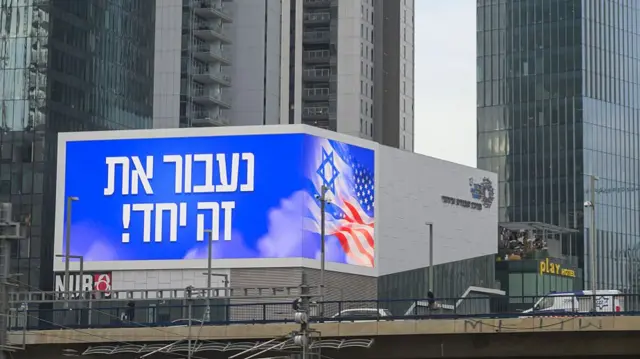
    A billboard in Tel Aviv, pictured on 18 March, with the US and Israeli flags and the message: "Together we will get through this"Image source, Gett
    Image caption,

    A billboard in Tel Aviv, pictured on 18 March, with the US and Israeli flags and the message: "Together we will get through this"

  6. Analysis

    Foreign ministers to discuss reopening Strait of Hormuz - but US won't be therepublished at 08:27 BST

    Iain Watson
    Political correspondent

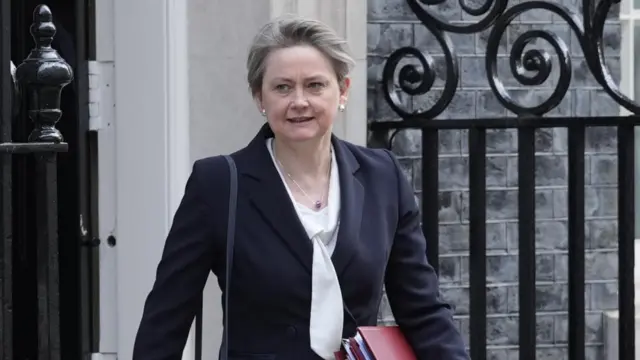
    UK Foreign Secretary Yvette Cooper leaving Downing Street in a suit holding red folders.Image source, PA Media
    Image caption,

    UK Foreign Secretary Yvette Cooper will take part in the virtual summit later today

    Leaders of 35 countries recently signed a joint statement in which they said they were willing to contribute to "appropriate efforts to ensure safe passage through the Strait of Hormuz".

    Many of their foreign ministers will take part in a "virtual summit" around lunchtime today. The remit is to discuss "viable diplomatic and political" solutions to reopen the route.

    Given Iran says it remains closed to "enemies of the nation" it’s not surprising that Keir Starmer said yesterday this would not be an easy task.

    While the UK, France, Germany, Australia, and Gulf states are likely virtual attendees at the summit, crucially the US is not.

    Overnight, Trump suggested the strait - a crucial shipping route - could open "automatically" when the conflict ends. Other nations are not so sure.

    De-mining, for example, may be necessary. So, multi-national military planners are also meeting to discuss how the strait could be made safe after the fighting has stopped.

    The priority is to ensure safe navigation for shipping and, in turn, bring oil prices down and push the supply of fertiliser for food production up.

  7. Trump's rhetorical flip-flopping fails to calm traders' fearspublished at 08:07 BST

    Lucy Hooker
    Business reporter

    Earlier this week, Trump seemed eager to calm traders’ fears, promising that an end to this conflict was in sight, and sending Brent Crude briefly below $100 a barrel.

    Wednesday’s speech seems to have done the opposite. On Thursday Brent Crude is back up over $107.

    That’s a reflection in part of the bellicose rhetoric around sending Iran "back to the stone ages".

    But just as importantly perhaps there was nothing in the speech indicating how progress towards peace might be made, or how the Strait of Hormuz, the route for a large proportion of the world’s energy supply, would be reopened, beyond suggesting he doesn’t see it as America’s problem.

    Trump is still talking about an end to the conflict within a few weeks.

    But after the last month of rhetorical flip-flopping oil traders will need a bit more convincing than that.

  8. Saudi Arabia intercepts drones and downs ballistic missile - Ministry of Defensepublished at 07:57 BST

    In the last hour, a spokesperson for the Saudi Arabian Ministry of Defense said the country has intercepted a new wave of drones.

    They say four unmanned vehicles were intercepted and destroyed.

    Earlier, the ministry said it had also downed a ballistic missile heading to the eastern region of the country.

  9. Iran says US-Israeli attacks have been 'insignificant' and warns of 'broader' responsepublished at 07:29 BST

    A spokesperson for the Iranian military says the US and Israel have been striking "insignificant" targets as he warns of incoming "crushing, broader and destructive" attacks.

    In a statement shared by the IRGC-affiliated Tasnim news agency and the semi-official Fars news agency, he says the two countries have "incomplete" information about Tehran's military capabilities and equipment.

    The spokesperson adds that Iran's military production "takes place in places that you do not know at all" - as he rejects Trump's claims that Iran's weapons stock has been widely depleted.

    He says the US and Israel "must pay for the aggression you initiated".

  10. What Trump said in his primetime address to the nationpublished at 07:18 BST

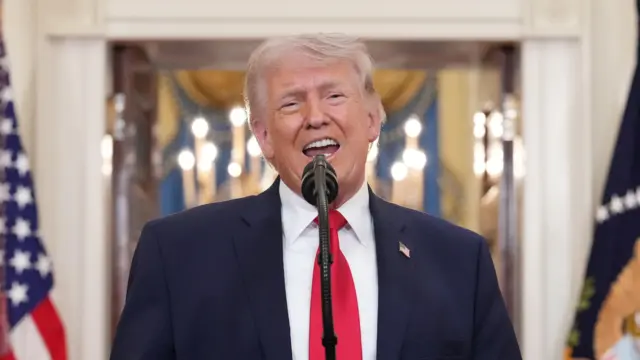
    US President Donald Trump arrives to address the nation from the Cross Hall of the White House. He is wearing a red tie and is flanked by US flagsImage source, Getty Images

    Trump's address to the nation last night was largely repetitive, with little new information garnered.

    The president offered few answers. Our North America correspondent takes a closer look at the glaring omissions and plethora of questions unanswered.

    Here's a look back at what Trump said in his primetime address:

    • Trump said the US is on track to soon complete all of its military objectives against Iran
    • He vowed the US would hit the Iranians extremely hard over the next two to three weeks
    • The president urged countries reliant on oil from the Middle East to go to the Strait of Hormuz and "just take it". Trump also called for countries to buy US oil instead
    • He claimed Iran was "right at the doorstep" of making a nuclear weapon, adding the US "obliterated" the country's nuclear sites
    • He warned that if no deal was made within the next few weeks the US would strike Iran's power plants
  11. A quick guide to oil, as prices climb after Trump's addresspublished at 06:42 BST

    In the hours after President Donald Trump's primetime address to the nation oil prices have climbed. Brent crude oil jumped 5% to $106 a barrel.

    Trump's address appears to have done nothing to reassure global oil markets that disruption to the key Strait of Hormuz shipping route will ease anytime soon, our business reporter writes.

    In his address, the US president said countries that need oil from the Middle East should now take the lead to keep the key waterway open - around 20% of the world’s oil supply normally passes through the strait.

    Iran has effectively blocked the Strait of Hormuz, causing energy prices to become volatile and remain well above levels before the conflict began.

    This Flourish post cannot be displayed in your browser. Please enable Javascript or try a different browser.

  12. Trump's 'mission nearly accomplished' momentpublished at 06:13 BST

    Tom Bateman
    US State Department correspondent

    This appeared to be President Trump’s "mission nearly accomplished" moment; but with the extraordinary caveat that Iran’s grip over oil transiting through the Strait of Hormuz was essentially not America’s problem.

    While he said the US would help, he reiterated his demand that countries who rely on the strait for their energy supplies should take the lead in re-opening it.

    Trump suggested the US could wrap up its military operations soon; but in the meantime he threatened overwhelming destruction.

    "We will hit them extremely hard over next two to three weeks," he says. "We will bring them back to the Stone Ages where they belong."

    Despite saying Iran had been crushed militarily, Trump still demanded that it do a deal with the US, without setting out anything about the terms. He once again vowed that if it didn’t, the US would bomb all of Iran’s power plants.

  13. Trump did not mention Nato in his 19-minute speechpublished at 05:51 BST

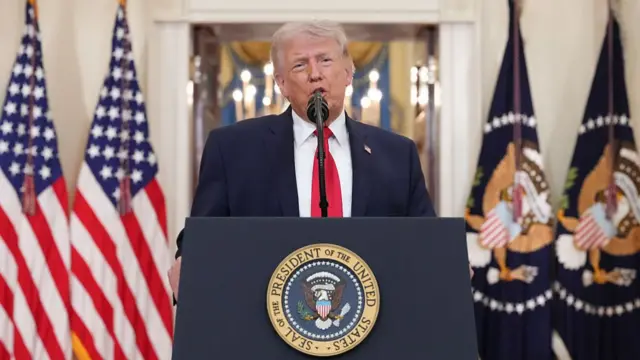
    US President Donald Trump speaks about about the Iran war on 1 April 2026.Image source, EPA

    One glaring omission from President Trump's speech was Nato - made all the more obvious after he reportedly told the Telegraph he was considering pulling the US out of the alliance late on Wednesday evening.

    The president told the paper that the alliance is a "paper tiger" and when asked if he would reconsider the US's membership of the alliance after the conflict in the Middle East, said: "Oh yes, I would say [it’s] beyond reconsideration."

    As pointed out by the BBC's White House correspondent earlier, the president would face significant legislative hurdles if he was to go ahead with this withdrawal.

    Given that Trump has revisited a number of previous talking points in his primetime address, it's notable that the alliance hasn't been one of them.

  14. Oil prices spike and stocks fall as Trump's speech fails to reassure marketspublished at 05:26 BST

    Nick Marsh
    Asia Business Reporter, Singapore

    Donald Trump addresses the nation at the White HouseImage source, Getty Images

    In Asia morning trade, the price of oil spiked and stocks fell in response to US President Donald Trump's speech, which failed to reassure global markets that the war was any closer to ending and that shipping through the Strait of Hormuz would return to normal.

    As soon as Trump finished speaking, the price of Brent crude, the global oil benchmark, jumped 5% to $106 a barrel. Stock markets in Asia also began to slide.

    Although Trump reiterated his two to three week timeline, he offered no concrete update to investors on just how exactly this war would end.

    His promise to bomb Iran "back to the Stone Ages" if it didn't agree to a deal certainly won't have reassured markets. Even if the conflict did end this month, it would still take considerable time for normal levels of shipping to resume through the Strait of Hormuz.

  15. 'Not clear' what more to be achieved in Iran, says Australian PMpublished at 04:43 BST

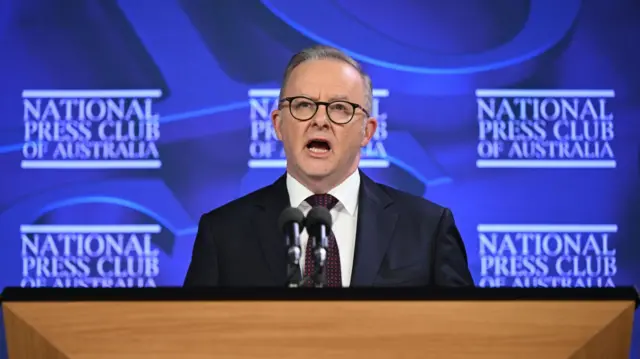
    Anthony Albanese stands at a podium before a blue backdrop.Image source, EPA

    Australian Prime Minister Anthony Albanese says that while Australia supported the objective of "preventing Iran from ever obtaining a nuclear weapon", it is now unclear "what more needs to be achieved or what the end point looks like".

    His comments came during an address to the National Press Club, which was occurring at the same time as Trump's speech.

    The prime minister was also asked specifically about the time frame Trump has laid out for an end to the conflict, to which he said that "Australia wasn't consulted before this began".

    "What I have said very clearly is that we do want to see a de-escalation and I want there to be recognition, greater clarity about how this ends," he says.

    The remarks follow a short speech from Albanese nearly 24 hours ago, in which he warned Australians that "the months ahead may not be easy".

    "Australia is not an active participant in this war. But all Australians are paying higher prices because of it," he said.

  16. Analysis

    More glaring omissions from Trump - and four questions it leavespublished at 04:15 BST

    Gary O'Donoghue
    Chief North America correspondent

    President Trump's speech was largely a rehash of what he has been saying for days. Copy and paste his social media posts over the last week or so, and you get this address to the nation.

    There were also a number of glaring omissions which leave a plethora of questions unanswered.

    First: Israel. Does Benjamin Netanyahu's government agree with this timetable? We just don't know.

    Second: what happened to the idea of retrieving the hundreds of kilos of enriched uranium buried under rubble from last year's 12-day war?

    Third: what is the president's settled view on the reopening of the Strait of Hormuz? He now says it would reopen "naturally" when the war is over.

    Fourth: is he serious about pulling out of Nato?

    The truth is, that after twenty minutes of a national address, we're really none the wiser about what victory in this war looks like.

    And given the often conflicting nature of the president's views from one day to the next, everything could change at any time.

  17. More reactions to Trump's speech are coming inpublished at 03:43 BST

    Trump's threats to bomb Iran "back to the Stone Ages where they belong" drew sharp criticism from some lawmakers.

    "He’s talking about a country of 90 million people," Representative Yassamin Ansari, a Democrat from Arizona, says. "Vile, horrifying, evil."

    On X, US Defence Secretary Pete Hegseth wrote simply: "Back to the Stone Age."

    Maryland Senator Chris Van Hollen, is also critical of the address. "Trump, as always, lied to us," Van Hollen, a Democrat, says. "Over 2 weeks ago he said 'we won.' If so, then why are we still there? What’s next? All we can count on is more lies from Trump. This delusional man is a danger to our country and the world."

    US House Majority Leader Steve Scalise complimented the speech.

    "Tonight, President Trump laid out an incredibly compelling case to the nation for Operation Epic Fury," Scalise, a Republican from Louisiana, says. "The Iranian regime's long history of terror and murdering Americans demonstrates why it was necessary to stop them from getting a nuclear weapon."

  18. Many of Trump's talking points have been said beforepublished at 03:27 BST

    Trump revisited many of the points he has raised before today during his primetime address.

    The president said the war was a response to 47 years of violence by Iran and their proxies, recalling the bombing of a US Marine barracks nearly four decades ago and the attack on the USS Cole in 2000.

    Trump previously wrote on social media on 13 March that the Iran regime has been "killing innocent people all over the world for 47 years now".

    "And now I, as the 47th President of the United States of America, am killing them. What a great honor it is to do so!" Trump wrote then.

    On Wednesday, he also repeated that the US will "leave" Iran within two to three weeks, which would extend the conflict past the four-to-six week deadline that the administration had given at the start of the war.

    The US will spend the coming weeks bombing Iran "back to the Stone Ages", said Trump, repeating threats he made earlier this week.

    "We are going to hit ​them extremely ​hard over the next two ‌to ⁠three weeks. We are going to bring ​them ​back ⁠to the Stone Ages, where ​they belong," he said in his address.

  19. Asia stock markets fallpublished at 03:24 BST

    Peter Hoskins
    Business reporter, Singapore

    Major stock indexes in Asia are trading lower after Trump's address, reversing earlier gains.

    The Nikkei 225 in Japan is down by 1.5%, South Korea's Kospi is 2.6% lower and the Hang Seng in Hong Kong is 1% lower.

    The region's stock markets have been volatile since the Iran war started at the end of February.

    Asia is particularly vulnerable to the impact of the conflict as it is heavily reliant on the Middle East for its energy supplies.

  20. IDF says Israel targeted by Iranian missilespublished at 03:18 BST

    The Israel Defense Forces (IDF) says it has identified missiles launched from Iran towards Israel "a short while ago", in a fresh update via Telegram.

    The report came just 15 minutes after Trump wrapped up his 19-minute speech, where he said that the strategic objectives in the US war with Iran were "nearing completion", and the Tehran's military capabilities has been destroyed.

    Stay with us as we bring you the latest updates.