

EXPLORE EPISODE FOUR - 28 to 25
Local Navigation

Bringing to life spectacles of natural wonder on our doorstep
No.25
Pine Martens
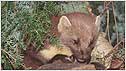
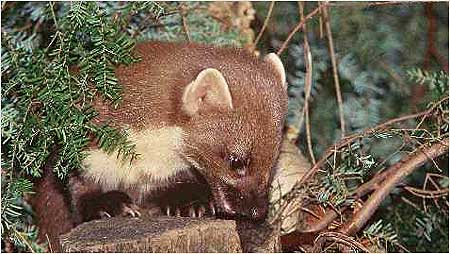
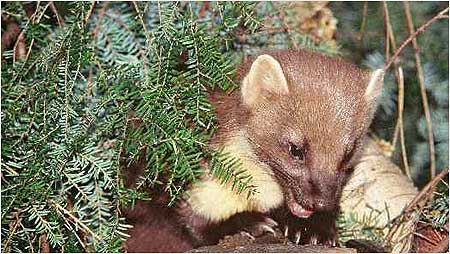
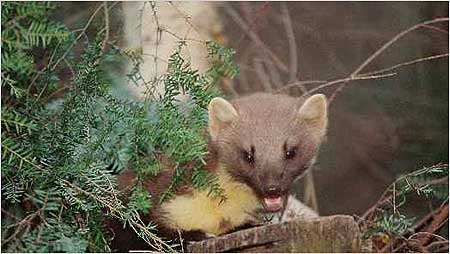
ThePine Marten is a slender, colourful and shy creature with a red-brown coat and long chocolate coloured bushy tail. It's about the size of a domestic cat and looks similar to a stoat. This long, thin mammal belongs to the weasel family and is distinguished by its small, cute face with a pointed nose.
The Pine Marten can be ferocious with sharp teeth and claws which help it to hunt birds, squirrels and other rodents. The Pine Marten (Martes martes) is the only member of mustelidae family with semi- retractable claws. As a result, they are good runners on the ground and can climb and scamper up trees with a squirrel-like agility.
The Pine Marten's den is usually found in hollow trees, the fallen roots of Scots Pines and sometimes in scrub-covered rock crevices and cliffs. The Pine Marten has a scent gland underneath its tail to mark out its territory, although the animals are not aggressively territorial. The male's territory extends to about 10-25 square metres.
Pine Martens eat a variety of foods including small mammals and birds, insects, worms, nuts and berries. They can live about eight years in the wild although some have been known to live for up to 17 years in captivity.
This elusive mammal is largely nocturnal. It has amazing ears, which are highly sensitive, to alert it to predators and the sound of potential prey.
Web links
The BBC is not responsible for the content of external internet sites.
Photo gallery
Watch and Listen
Go Pine Marten spotting in Scotland with presenter Chris Packham:
Help playing audio/video
Tips
Tips for viewing this species:
- Be prepared to stay up late - the Pine Marten is largely nocturnal and is rarely seen in daylight hours. The best places to see them are coniferous woodlands especially those with Caledonian pines and a high population of voles, one of their favourite foods.
- Look out for Pine Marten droppings or "scats" - which are black, cylindrical and long in shape. These territorial markings can sometimes be found on raised areas or along forest trails where they can be spotted by other martens.
- Scan open areas for Pine Marten prints on soft ground - these are very distinctive with five claws and a palm-shaped pad. The prints are about 35mm wide and 30mm in length. Look along forest trails especially in areas of Caledonian pines.
- Look for a glimpse of the Pine Marten's yellow throat, reddish-brown fur and bushy, chocolate brown tail. Watch for their bounding style of movement especially along forest tracks. Look above ground level to see them scampering up trees.
- If you want to see Pine Martens in the wild, the best places to spot them are in Scotland, especially the Highlands. Watch from the comfort of a hide and enjoy a close encounter at the Aigas Field Centre in Beauly, Inverness-shire. The animals have a very sweet tooth - and the centre has a special area where the wardens set out treats like peanut butter and sticky jam to attract the Pine Martens. Telephone 01463 782443 for opening times and news of events.
Habitat
The Pine Marten was persecuted throughout the 17th Century, being hunted and trapped for its fur. In the early 1900s the Pine Marten was almost extinct in most parts of the British Isles. The animal's favourite habitat - Caledonian pine forest - was also in decline due to forest clearance and deforestation. Some people also saw them as vermin as a result of attacks on game birds and chickens. Other Pine Martens were run over by cars as their traditional habitats were disturbed by roads.
Today the Pine Marten is a protected species and, as a result, is becoming increasingly common in the Scottish Highlands and Grampian. There are also isolated populations in the south of Scotland. However, there are few signs of them naturally re-colonising in England, although it is thought that there are some isolated animals in Northumberland and North Yorkshire.
Pine Martens live in dense woodland habitats, especially coniferous forests with high densities of voles, one of the animal's favourite foods. They can also be found in some mixed woodlands.
Female Pine Martens or bitches with young kits are very sensitive to human disturbance. This can result in the female moving her kits to a new den elsewhere
Conservation and forest management are helping to sustain and expand the Pine Marten population - and there are now thought to be more than 35,000 animals across the British Isles, mostly in Scotland.
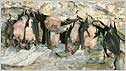
No. 28 - Roosting bats
Seventeen species of bats can be found in Britain from two main families - find out about their roosting habits.
Best places to see - Dalby Forest (North Yorkshire), Cheddar Caves, Crom (Northern Ireland).
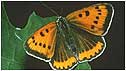
No. 27 - Butterflies
Butterflies boast some of the most vivid colours of any of the UK’s wildlife. In summer the spectacle of clouds of butterflies is a sight to behold.
Best places to see - Great Orme (Wales). Summer meadows.
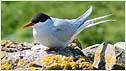
No. 26 - Arctic Terns
The Arctic Tern is a maritime bird which visits the British Isles when it can often be seen dive bombing passers by!
Best place to see - Farne Islands (Northumberland).


Also on Nature's Top 40
BBC Nature & Wildlife

More from bbc.co.uk nature

BBC iD
BBC iDBBC navigation
BBC links

BBC © 2014The BBC is not responsible for the content of external sites. Read more.
This page is best viewed in an up-to-date web browser with style sheets (CSS) enabled. While you will be able to view the content of this page in your current browser, you will not be able to get the full visual experience. Please consider upgrading your browser software or enabling style sheets (CSS) if you are able to do so.
