"Just as Chapel Allerton has retained its village atmosphere it has also retained many of its old pubs. And they still have a place in the heart of the community.  | | The Regent |
"At the Regent, named like many pubs after royalty (the Prince Regent), the building has stood little changed since the early eighteeneth century. Favourite
"This pub is a favourite with people having a pint straight after work on their way home. "Close by is the Nag's Head, although there have been some interior alterations the building's structure remains original.  | | The mounting step outside the Nag's Head |
"This pub sat on the original route of the Harrogate turnpike. "Outside the front entrance a mounting block can still be seen along with a serving window in the wall to allow mounted customers to be served on horseback! Turnpike existence
"Many of the pubs owe their existence to the turnpike. The terminus junction was at a pub now called the Three Hulats. Prior to that it was called the Mexborough Arms and its original name was the Bowling Green Inn. 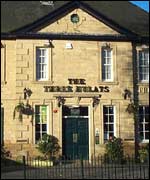 | | The Three Hulats |
"The bowling green stood close to the inn and survived until 1978, when it became a car park and latterly a supermarket. "In 1757 this area was said to be host to the first game of cricket held in Yorkshire. "Incidentally archery was also once a popular pastime on nearby Chapletown Moor. "The Shoulder of Mutton on nearby Potternewton Lane also had a bowling green, this has now been converted to a beer garden.  | | The Shoulder of Mutton |
"Yet another bowling green was behind the Queens on Harrogate Road. "This pub has recently been subject to bewildering changes of image and names and has now opened as part of the Embers group following a renovation. "Chapel Allerton has lost two pubs - a pair of swans. The Black Swan stood in Woodland Lane until the 1950s while the White Swan stood in Well Lane. "After a rather bawdy history the White Swan had a change of use. Losing its license in 1867 it became a British Workmen's Public House or temperance hotel! It served non-alcholic drinks for a further thirty years." |