บทเรียน 21: Fakes and phrasals
Phrasal verbs and misspelt words
เลือกบทเรียน
- 1Pop-ups
- 2Hidden talents
- 3Can't buy me love
- 4Travellers' tales
- 5The colleague from hell
- 6Jurassic mystery: unpacking the past
- 7Career changes
- 8Art
- 9Project management
- 10The dog ate my homework!
- 11The diary of a double agent
- 12Fashion forward
- 13Flat pack skyscrapers
- 14Extreme sports
- 15Food fads
- 16Me, my selfie and I
- 17Endangered animals
- 18A nip and a tuck: cosmetic surgery
- 19I'm really sorry...
- 20Telling stories
- 21Fakes and phrasals
- 22Looking to the future
- 23Becoming familiar with things
- 24From rags to riches
- 25Against the odds
- 26Our future on Mars?
- 27Where is it illegal to get a fish drunk?
- 28Dodgy dating
- 29Annoying advice
- 30I'll have been studying English for thirty weeks
บทเรียนย่อย 3
Read the story of a family who fooled the art market - and made a fortune. Learn some phrasal verbs and do some exercises to check how well you understood the story.
แบบฝึกหัด 2
Reading comprehension
What did you understand?
Now it's time to test how much you really understood about about the Greenhalgh family's con trick on the art world.
To do
Read this article once again. We are not from the police but we have some more questions to ask you...
อ่านเนื้อหาพร้อมทำแบบฝีกหัด
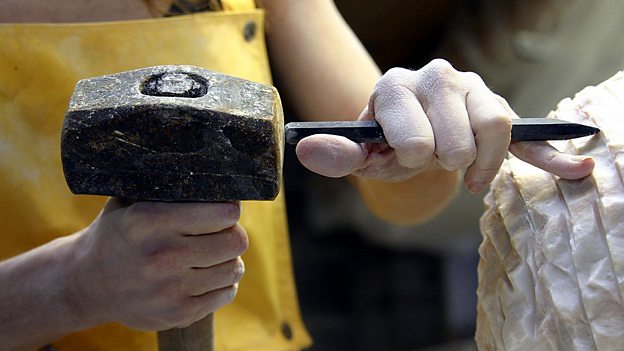
Getting forgery down to a fine art
Part 1
Shaun Greenhalgh left school with no qualifications, but he tried his hand at a wide range of crafts – from water colour painting to sculpture. His own pieces were not admired, so he started to copy from others, says detective Ian Lawson from Scotland Yard's Art and Antiques Unit. Shaun worked in the family's garden shed and ended up creating a cottage industry. The plan was to approach art galleries and museums and make them think the items were family heirlooms.
Part 2
If the son had a talent for art, the father – George Greenhalgh - had the gift of the gab and approached potential buyers with detailed stories about how he had found artworks which were lost for generations. In 2003, he sold a 50cm statue called Amarna Princess to Bolton Museum saying that his own grandfather had bought it at an auction in 1892 at an aristocrat’s home. The old original auction catalogue that the forgers had bought earlier backed the claim up. It mentioned "Egyptian figures". This could be one of these, couldn't it?
Part 3
After talking to art experts, the museum paid more than £400,000 for the statue, which was supposed to represent one of the daughters of the Pharaoh Akhenaten. The successful con made the forgers grow bolder. They approached one of the most prestigious art institutions in the world: the British Museum. The pieces on offer were supposed to be three Assyrian reliefs of soldiers and horses with some inscriptions from 600 BC. One expert spotted a mistake in the writing and examined the items more carefully. The expert was suspicious and the museum tipped off the police. Shaun Greenhalgh might have been a good forger, but cuneiform spelling was not his forte.
Part 4
After 18 months of investigations in which more fakes were uncovered, the Old Bill knocked at the family's door. They were surprised by the Greenhalgh's humble home. Where were the riches of successful criminals? The police concluded that Shaun was motivated by resentment of the lack of appreciation of his own artistic talent, rather than by money. In 2007, the elderly couple were given a 12-month suspended sentence and their son was jailed for four and a half years - and they were ordered to pay back the money to the art institutions they had fooled.
Part 5
And what is Shaun Greenhalgh doing today, you might ask? Has he learnt his lesson: that copying other people's work is not a good idea? No, he hasn't. The difference is that this time he admits his forgeries are made by himself. And his old pieces have even made it into the Victoria and Albert Museum in London – the 2010 exhibition they appeared in was called The Art of Crime.
Part 6
How did he manage to fool so many experts? Irvin Finkel from the British Museum has an explanation: "The clever thing about these people is they produced things that in a way we were looking for already. So when we saw it we wanted to embrace this long-lost treasure. They were very clever and they nearly fooled us." Shaun's case also helped the museums to wise up. A museum security group to share information and concerns was set up to avoid successful scams.
To do
Answer the questions to test your understanding of the article.
Art forgery quiz
6 Questions
Choose the best answers to the questions about the family who sold fake art
ช่วยเหลือ
แบบฝึกหัด
Choose the best answers to the questions about the family who sold fake art
คำใบ้
Read part 1 carefully.Question 1 of 6
ช่วยเหลือ
แบบฝึกหัด
Choose the best answers to the questions about the family who sold fake art
คำใบ้
Who had the gift of the gab?Question 2 of 6
ช่วยเหลือ
แบบฝึกหัด
Choose the best answers to the questions about the family who sold fake art
คำใบ้
Read part 3 carefully.Question 3 of 6
ช่วยเหลือ
แบบฝึกหัด
Choose the best answers to the questions about the family who sold fake art
คำใบ้
Did the Greenhalgh family live in luxury?Question 4 of 6
ช่วยเหลือ
แบบฝึกหัด
Choose the best answers to the questions about the family who sold fake art
คำใบ้
Which institution showed an exhibition of fake art?Question 5 of 6
ช่วยเหลือ
แบบฝึกหัด
Choose the best answers to the questions about the family who sold fake art
คำใบ้
Read part 6 carefully.Question 6 of 6
Excellent!เยี่ยม!แย่หน่อย!คุณทำคะแนนได้:
End of Session 3
That's it for this session. We hope you enjoyed it. Now go to Session 4 to hear from Marcus the Roman soldier who has time-travelled to modern-day London and has trouble with his phrasal verbs...
Session Vocabulary
catch up with someone
(here) find out that somebody is doing something wrong and punish thempull something off
do something successfully even though it is very difficultend up
finally be in a particular situationback up
use something as evidence or proof that something else is truetip off
secretly give information to someonewise up to something
become more aware of something unpleasantset up
create or start something, such as a system, process or organisation
