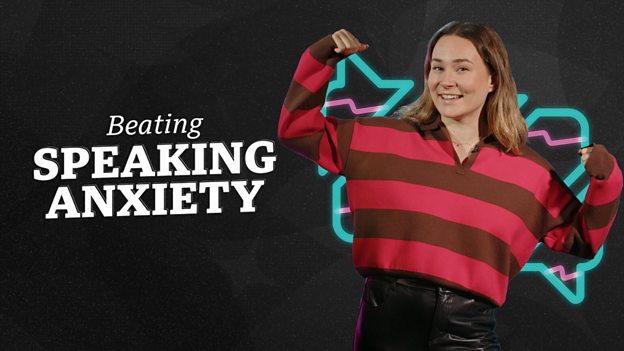
"I felt really insecure sometimes because I was like, oh, am I saying the right things?" - Deivid
"I put pressure on myself to avoid making mistakes and being foolish." - Elisa
All episodes
_____________________________________________________________
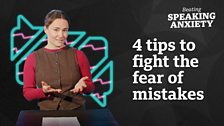
Watch Georgie's video about mistakes
_____________________________________________________________
Introduction
The fear of making mistakes can be related to the fear of judgement and personality traits like being a perfectionist. Learn from experts about this topic and get tips on how to reduce this fear.
With professor of Chinese Han Luo and speaking coach Barnaby Griffiths.
Reflect
Discuss in pairs/groups or write some notes.
Before listening:
- Do you feel nervous when speaking English? When? Why?
- Do you worry about making mistakes? Why/why not?
After listening:
- Do you think you have any irrational beliefs when it comes to learning or speaking English? Why are they irrational?
- What did you learn from this episode? Do you feel differently about making mistakes when speaking English?
_____________________________________________________________
Vocabulary
dread
fear about something that will or might happen
irrational beliefs
beliefs that aren't based on things that are true
implicit beliefs
beliefs we don't notice
conscious beliefs
beliefs we do notice
self-perception
how you view yourself
in the same boat
in the same difficult situation (as other people)
_____________________________________________________________
Transcript
Hanan
Do you get anxious when you speak English? You're not alone.
Miguel
I guess I'd say that my experience speaking English is full of dread and regret. I don't know why, but I cannot find the courage to speak to someone.
Kristina
For me, it was very important to be good in English. And I was like thinking what people will think about me when I'm speaking the wrong way or my pronunciation is not correct.
Han Luo
Imagine that if you are able to sound very intelligent, very wise, very smart in your first language, but then in the second language, you are not able to do that.
Barnaby Griffiths
It isn't about perfection, and it isn't about necessarily being very fluent. It's about communicating well.
Georgie
In this special series from BBC Learning English, we'll be helping you understand speaking anxiety and improve your confidence in English. Hello and welcome to Beating Speaking Anxiety. I'm Georgie, an English teacher and presenter at BBC Learning English.
Hanan
And I'm Hanan, a bilingual reporter for BBC Arabic and presenter of the Arabic educational series, Dars.
Georgie
So, as an English teacher, something my students used to ask me all the time was, "How can I get better at speaking?" And sometimes they mean they want to make fewer mistakes, but most often it's about confidence and wanting to stop feeling so nervous. They're worried about being judged for their mistakes. They're scared they'll forget their words, that people won't understand their accent. There are so many fears when it comes to speaking a foreign language.
Hanan
Yes, it's something I struggled with too when I moved to the UK to work at the BBC. My English was actually pretty good, but having conversations with people, I found it really difficult. So when I first joined the BBC, the Learning English team made an assessment of my English level, which they used to do for all new joiners to see if they need any help or courses. My results were pretty good, and I was fluent, but on that very same day, leaving the building and going to get some coffee, I couldn't really understand what the barista was saying, and I felt pretty nervous to order coffee and was trying to stress every single word, hoping that my grammar is correct and I am pronouncing the words right.
Georgie
Yeah, I'm sure that's a situation lots of people can relate to. So, in this series, we're going to look at all the things that make us afraid of speaking in a new language. We'll speak to experts to understand why speaking makes us so anxious, learn about what happens to our brain when we learn a new language, and explore some tips to help make speaking English less stressful.
Hanan
Each week for the next eight weeks, we will focus on a different fear learners have when speaking English.
Georgie
And we start with one of the most common fears for learners: I'm scared of making mistakes. Let's hear more from some learners – Cindy from Colombia, David from Brazil and Elisa from Mexico.
Cindy
And I feel afraid when I speak English because I don't have more vocabulary and I feel afraid for mistake and can't communicate my idea.
Deivid
I felt very self-conscious. I felt really insecure sometimes because I was like, oh, am I saying the right things? Do I say, do I know things well enough?
Elisa
I don't like making mistakes and knowing they know more than me. I put pressure on myself to avoid making mistakes and being foolish.
Hanan
All of those learners are worried about making mistakes.
Georgie
Yes. A time when I felt this fear the most was when I worked as an English teacher in Spain, and I had to have meetings with my students' parents to discuss their progress, all in Spanish. I was so scared of making mistakes because in my head it was linked to my job and my professionalism. I didn't want the parents to judge me and think I was a bad teacher.
Hanan
Totally. And you know, it's not just new learners of English who are worried about making mistakes. Even advanced learners talk about this. So what's going on?
Han Luo
You know, usually the beliefs that cause anxiety, especially severe anxiety, are, we call it 'irrationalbeliefs'. And also like, some low self-perceptions, fear of negative evaluation. All those learner internal, you know, factors.
Georgie
This is Han Luo, associate professor of Chinese at Lafayette College in the United States. Han has done lots of research into the sources of anxiety, or where that fear comes from. Han says irrationalbeliefs can make us anxious. Irrationalbeliefs are beliefs that aren't based on things that are true. And Han says that learners worry about mistakes because they're scared of 'negative evaluation'. In other words, that people will judge them for their mistakes and think badly of them.
Han Luo
Imagine that if you are able to sound very intelligent, very wise, very smart in your first language. You are, you know, admired by people, but then in the second language, you are not able to do that, right?
Hanan
When people speak in another language, they worry about what other people might think about them. But Han says this judgement doesn't come from other people. It comes from within.
Georgie
Yes. But in the moment when we try to speak, we're often not aware of what's causing the anxiety and stress. And so the first step to reducing the fear of making mistakes is to recognise that fear.
Han Luo
We want to make those implicitbeliefs into consciousbeliefs. That is already like a very, very important step.
Georgie
Often the beliefs that are making us anxious are implicit – we don't notice them, and we need to make them conscious so that we do notice them.
Han
You realise it now – 'Oh, nobody will laugh at me, uh, if I make a mistake', because everyone is in the same boat, right? So when you realise this, you know, now, I tell you, "You don't have to worry about it". So are you able to just remove your anxiety, you know, and then your your beliefs are changed?
_____________________________________________________________
Watch an explainer video
_____________________________________________________________
Georgie
I find what Han said about irrationalbeliefs really interesting. So I'm an English teacher, so I know that mistakes help us learn. And also that as long as you communicate your ideas effectively, it doesn't really matter if you make a few mistakes. But I still have an irrational fear of making mistakes in Spanish. I need to make my feelings match my belief that making mistakes is fine.
Hanan
And you know what, Georgie? Um, we already make mistakes in our own languages, so I feel like we should encourage ourselves and tell ourselves it's OK to make mistakes.
Georgie
A hundred per cent, I totally agree. Han says recognising that these fears of making mistakes are irrational is the first step. But is there anything we can do practically to help get rid of this fear?
Barnaby Griffiths
It isn't about perfection, and it isn't about necessarily being very fluent. It's about communicating well.
Hanan
This is Barnaby Griffiths. He's a speaking coach who works with the students who want to improve their speaking in English.
Georgie
Barnaby says if we think about speaking as communicating rather than like a test, then we can relax. So embrace your mistakes.
Barnaby Griffiths
Above all, allow for mistakes. So self-correct is fine. Allow pauses and silence within your communication and learn to correct yourself and also introduce elements such as humour and smile and laugh when things go wrong and say, 'Oh, I didn't mean to say that' and have phrases like, 'Let me rephrase that', or 'I need to say that again' and be vulnerable.
Hanan
I love Barnaby's advice to just smile and laugh when things go wrong, but I imagine it might be difficult to be vulnerable like Barnaby says. Do you have any tips, Georgie?
Georgie
Yes, I do. I think the best way to get comfortable making mistakes is to start in situations where you feel safe. So you could practise with someone you feel comfortable with. And another idea is to do a language exchange. So this is when you find someone who wants to practise your language and you want to practise their language. This is really good because you're both practising languages and you're both making mistakes, and you're kind of in the same situation.
Hanan
That's true. I had a similar experience actually when I was learning Turkish, so I did an exchange with a Turkish friend. She was teaching me Turkish and I was funnily enough, I was actually giving her some English tips. Um, and it was really good because it is with someone you know and you feel comfortable with and you don't worry too much about mistakes. I was making mistakes in both languages, and, uh, that felt OK.
Georgie
Yeah, it's great because there's no judgement, is there?
Hanan
Exactly. Thanks for listening to this episode of Beating Speaking Anxiety. To learn more about speaking anxiety, head to our website where Georgie has made videos for each of the speaking fears we talk about in this series. You will hear more advice and see some tips in action with real learners. Use the link in the notes for this episode or visit bbclearningenglish.com
Georgie
And we'd love to hear about your experience speaking English. Please send us an email and tell us what scares you about speaking. Our email address is learningenglish@bbc.co.uk. And in the next episode, we'll be talking about what to do when you're speaking English and your mind suddenly goes blank. See you then.
Hanan
Bye.
Next
Watch the video to see learners in action.
Discover programmes to improve your skills.
Latest Beating Speaking Anxiety
How to be yourself in English
Episode 260310 / 10 Mar 2026
Do you feel like you can show your personality in English?
I'm scared I can't be myself - podcast
Episode 260309 / 09 Mar 2026
Georgie and Hanan talk about how to show your personality when you speak English.
How to celebrate your progress
Episode 260303 / 03 Mar 2026
Do you ever feel like you're trying really hard but can't see your progress?
I'm scared I'm not improving - podcast
Episode 260302 / 02 Mar 2026
Georgie and Hanan talk about what to do when you feel like you're not getting better at English.
How to show your funny side in English
Episode 260224 / 24 Feb 2026
Get tips for showing your sense of humour in English
I'm scared I won't get the joke - podcast
Episode 260223 / 23 Feb 2026
Georgie and Hanan talk about understanding and making jokes in English.
How to speak clearly in English
Episode 260217 / 17 Feb 2026
Tips for making sure your accent in English is easy to understand
I'm scared people won't understand me - podcast
Episode 260216 / 16 Feb 2026
Georgie and Hanan talk about accents and what to do when someone doesn't understand yours.
How to build your speaking confidence
Episode 260210 / 10 Feb 2026
The fear of public speaking is common even in a person’s first language, and in a foreign language, it can feel even scarier
I'm scared of speaking in front of people - podcast
Episode 260209 / 09 Feb 2026
Georgie and Hanan talk about public speaking and speaking in bigger groups.
What to do if you can't understand someone
Episode 260203 / 03 Feb 2026
How to get better at understanding people around the world
I'm scared I won't understand people - podcast
Episode 260202 / 02 Feb 2026
Georgie and Hanan talk about how you can improve your listening in real life conversations.
What to do when your mind goes blank
Episode 260127 / 27 Jan 2026
Tips for when you forget your words during a conversation
I'm scared I'll forget my words - podcast
Episode 260126 / 26 Jan 2026
Have you ever been having a conversation in English, and suddenly your forget your words?
How to fight the fear of mistakes
Episode 260120 / 20 Jan 2026
Understand the fear of mistakes and hear tips for how to overcome it
I'm scared of making mistakes - podcast
Episode 260119 / 19 Jan 2026
Does the fear of making mistakes stop you progressing in English?