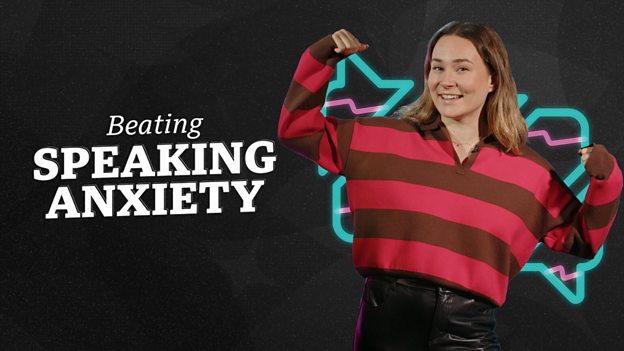
"I am an introvert, and I tend to be very self-conscious about what I speak and how I speak. The whole situation is such an anxiety-inducing experience." – Majd, Syria
"In this language, I appear to be really shy. I appear to be someone that doesn't know or that is insecure or doesn't have an opinion, and I actually have an opinion and I have a perspective." - Pepa, Peru
All episodes
_____________________________________________________________
Watch Georgie's video about showing your personality

_____________________________________________________________
Introduction
It can be harder to express our personality in a foreign language because we have fewer language tools available and speaking anxiety can make it harder to let our personalities shine. Learn from experts about this topic and get tips on how to show your true self in English.
With Han Luo, Professor of Chinese, Lafayette Universty, and speaking coach Rhiannon Carter.
Reflect
Discuss in pairs/groups or make self-reflections.
Before listening:
- How would you describe your personality?
- Do you feel like you can express your personality in English? Why/why not?
After listening:
- How do you think speaking is related to your identity and personality in a way that other language skills (reading, listening) aren’t? How could this make someone more anxious to speak?
- What did you learn from this episode? What do you think about the advice given by Rhiannon Carter and the presenters?
_____________________________________________________________
Vocabulary
introvert
a person who is shy and enjoys spending time alone
self-conscious
feeling uncomfortable because you are very aware of what others think about you
succinct
expressed using few words in a clear way
self-concept
ideas you have about yourself
post-match analysis
(analogy) the review of a sports game, used here to mean a review of one’s own English performance
immerse oneself
become totally involved in something
_____________________________________________________________
Transcript
Hanan
Do you think your personality is different when you speak English?
Pepa Duarte
I was like, 'Woah! In this language, I appear to be really shy. I appear to be someone that doesn't know or that is insecure or doesn't have an opinion, and I actually have an opinion and I have a perspective.'
Majd
I am an introvert, and I tend to be very self-conscious about what I speak and how I speak. The whole situation is such an anxiety-inducing experience.
Han Luo
It's like you want to tell everyone that I'm actually a cool person, right? It's not like, you know, I presented the way I presented in, in a second language.
Georgie
In today's episode, we're talking about ways you can express your personality in English.
Hanan
Hello and welcome to Beating Speaking Anxiety, our special series to help you fight your fears of speaking English. I'm Hanan.
Georgie
And I'm Georgie. You can find a transcript of this episode to help you learn on our website, bbclearningenglish.com. So, we heard from some learners at the start of the programme that they sometimes feel like they can't be themselves when they speak English, and I also know this feeling from my time learning Spanish. I have quite a friendly personality, I enjoy getting to know people, but in group conversations, sometimes I'd just be really quiet because I was too scared to speak. And I found that so frustrating because I wanted people to know my personality. But it's hard when you don't say anything.
Hanan
Well, funnily enough, I find myself, um, comfortable and confident speaking English and especially at my job, it feels natural.
Georgie
That's really interesting. So you feel yourself in English?
Hanan
Exactly. Even though that it's not my native language.
Georgie
Fascinating. Well, in an earlier episode of this series, we met Pepa, who told us about her experience learning English and telling jokes in a new language. But when she first moved to the UK, Pepa also felt like her English skills were stopping her from showing her personality.
Pepa Duarte
Spanish is a way more, um, I don't know, it's a language that needs more words to express, whereas English is very direct and succinct, sort of like straight to the point kind of thing.
Hanan
In her native language, Spanish, Pepa was a confident person, but when she spoke English, she found it difficult to be herself.
Pepa Duarte
I was like, 'Woah! In this language, I appear to be really shy. I appear to be someone that doesn't know or that is insecure or doesn't have an opinion, and I actually have an opinion and I have a perspective.' So yeah, it was about bringing my real personality, who I really was, into the space, even when I didn't have all the tools, the language tools to do so.
Georgie
Pepa wanted to show her personality, even if her English wasn't perfect. You can hear more of her story in episode six of this programme – I'm scared I won't get the joke. But why do different languages sometimes make us feel like different people?
Han Luo
In terms of speaking, it's, it's, it's related to our self-concepts and identity.
Hanan
This is language anxiety expert Han Luo, who we've heard from before in the podcast. She believes that people often feel awkward and anxious speaking a new language because they don't think they can represent their real personality.
Han Luo
It's like you want to tell everyone that 'I'm actually a cool person, right?' It's not like, you know, I presented the way I presented it in in the second language.
_____________________________________________________________
Watch an explainer video
_____________________________________________________________
Georgie
Of course, feeling like you can't be yourself might make you feel more nervous. And if you're nervous, you're more likely to make mistakes. It can be hard to avoid these feelings. Speaking coach Rhiannon has worked with a lot of people who spend all day worrying about whether they did well enough in a meeting or conversation.
Rhiannon Carter
A lot of clients I work with have what I often call post-match analysis. So, like in the moment they manage to do the thing you know quite well, well enough, and then afterwards they're like, 'Oh, I should have done this, I should have done that.'
Hanan
To try and stop this anxious post-match analysis, where people worry all day about how things went, Rhiannon encourages people to keep a diary and notice how they are feeling before moments when they have to use English.
Rhiannon Carter
Let's take the example of there's a Tuesday meeting and it's the heads of departments across Europe. This is the case of one of my clients. She was absolutely fine working with her team in Italy, but as soon as she was working internationally, she was like, 'Ugh!' – this was terrifying.
Georgie
Rhiannon's client found a particular Tuesday meeting where she had to speak in English really stressful. So Rhiannon asked her to keep a diary about how she felt.
Rhiannon Carter
She's just making notes and she's observing. She's not trying to change anything. And then she's saying, 'OK, so I arrive at work and the meeting's at ten o'clock in the morning, say. What's my behaviour like in that 9 to 10am slot? How am I feeling in those moments? Is the anxiety already showing up in some of my other behaviours? What thoughts are going through my head?'
Hanan
Rhiannon says that by writing things down, her clients start to find small things they can change to feel calmer when they speak English, and if people feel calmer, they are more likely to be themselves.
Rhiannon Carter
Take five minutes before a meeting, go to the bathroom, or go downstairs outside your office and just take five minutes. Have a couple of deep breaths, look at some trees, touch grass and then come back in. Am I feeling better? And it's not necessarily that you get it right first time. Maybe you try something, it makes no difference. But it's about saying, 'OK, well, now that I really know what's happening, where can I see opportunities to change it?'
Hanan
Rhiannon's approach is to look at what small, practical things people can do to reduce anxiety, rather than focus directly on language. But is there anything else people can do to help their personality shine when they speak English?
Georgie
Yeah, try to do things in English that you enjoy, so you could listen to podcasts if that's something you like doing. Join a discussion group about something you're interested in, and you could also start a hobby and meet people who have similar interests and have conversations about the things that you're passionate about, all in English. Basically, what we're trying to say is to use English outside of stressful situations like work or study, and try to use English for things that you enjoy and that are fun.
Hanan
Or in other words, immerse yourself in the language.
Georgie
That's it for this episode and for the series. We hope you've heard some useful tips for feeling better when speaking English. Remember, the most important thing is to know that lots of people feel the same way, and with practice, you can become more confident. We'd love to hear about your experience speaking English. Please send us an email and let us know what you thought of this series. Our email address is learningenglish@bbc.co.uk.
Hanan
If you'd like more practical advice to improve your English speaking skills, Georgie's made some videos about all the topics we've covered in this series. Each one has ideas for how to practise your speaking that we've tried out with learners. You can find the videos at bbclearningenglish.com.
Georgie
Thanks so much for joining us for this special series. Bye for now.
Hanan
Goodbye.
Next
Watch the video to see learners in action.
Discover more programmes to improve your skills.
Latest Beating Speaking Anxiety
How to be yourself in English
Episode 260310 / 10 Mar 2026
Do you feel like you can show your personality in English?
I'm scared I can't be myself - podcast
Episode 260309 / 09 Mar 2026
Georgie and Hanan talk about how to show your personality when you speak English.
How to celebrate your progress
Episode 260303 / 03 Mar 2026
Do you ever feel like you're trying really hard but can't see your progress?
I'm scared I'm not improving - podcast
Episode 260302 / 02 Mar 2026
Georgie and Hanan talk about what to do when you feel like you're not getting better at English.
How to show your funny side in English
Episode 260224 / 24 Feb 2026
Get tips for showing your sense of humour in English
I'm scared I won't get the joke - podcast
Episode 260223 / 23 Feb 2026
Georgie and Hanan talk about understanding and making jokes in English.
How to speak clearly in English
Episode 260217 / 17 Feb 2026
Tips for making sure your accent in English is easy to understand
I'm scared people won't understand me - podcast
Episode 260216 / 16 Feb 2026
Georgie and Hanan talk about accents and what to do when someone doesn't understand yours.
How to build your speaking confidence
Episode 260210 / 10 Feb 2026
The fear of public speaking is common even in a person’s first language, and in a foreign language, it can feel even scarier
I'm scared of speaking in front of people - podcast
Episode 260209 / 09 Feb 2026
Georgie and Hanan talk about public speaking and speaking in bigger groups.
What to do if you can't understand someone
Episode 260203 / 03 Feb 2026
How to get better at understanding people around the world
I'm scared I won't understand people - podcast
Episode 260202 / 02 Feb 2026
Georgie and Hanan talk about how you can improve your listening in real life conversations.
What to do when your mind goes blank
Episode 260127 / 27 Jan 2026
Tips for when you forget your words during a conversation
I'm scared I'll forget my words - podcast
Episode 260126 / 26 Jan 2026
Have you ever been having a conversation in English, and suddenly your forget your words?
How to fight the fear of mistakes
Episode 260120 / 20 Jan 2026
Understand the fear of mistakes and hear tips for how to overcome it
I'm scared of making mistakes - podcast
Episode 260119 / 19 Jan 2026
Does the fear of making mistakes stop you progressing in English?