Our World in English
Upper Intermediate level
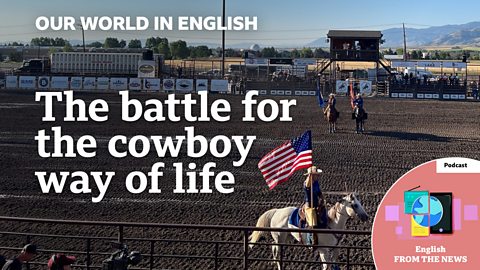
The battle for the cowboy way of life
Episode 260213 / 13 Feb 2026

(photo credit: Ellie House/BBC)
Introduction
Nearly half of all the land in the American west is owned by the federal government. Some people want to change that, and sell the land to build houses and businesses.
But in Montana, a western state known for wide open spaces and cowboys, lots of people rely on the government land. They worry that their cowboy way of life is under threat.
In this short documentary, we meet Brud Smith, who owns a farm in Montana and hear about how the place is changing.
Vocabulary from the story
ranch
a very large farm
cattle
cows
federal land
land owned by the US government, also called public land
backlash
when people feel or argue strongly against a political change or plan
rodeo
a traditional sport where someone tries to stay on the back of a bull
artisanal
made in a traditional way
sullied
ruined
Transcript
Pippa
At the BBC, our colleagues investigate important stories around the world. In this special series, Our World in English, we’re bringing you the best documentaries from the BBC in language you can understand. This episode is called The battle for the cowboy way of life.
Ellie
I hop into Brud's dusty 4x4 truck.
Pippa
BBC Journalist Ellie House has travelled to Montana in the United States. Montana is a western US state that goes all the way up to the Canadian border. You might have seen old western movies set in places like this. Montana is full of wide open spaces with huge areas of flat land. In these films you’ll find cowboys, with wide brim hats and guns, who enjoy the outdoors, horses, farming. And a modern cowboy way of life still exists here.
Ellie’s being shown around by Brud Smith.
Brud
Do you see where the brown is over there? Where it starts out there?
Ellie
Yeah.
Brud
That's the edge of our ranch there. And we probably go over to where the trees, just the side of the, the big trees down there.
Pippa
A ranch is a very large farm. Brud’s family have owned a ranch here for five generations, farming cattle, which means cows.
And Brud’s ranch relies on his own private land…
Brud
And actually, that's private land up to that sign up there.
Pippa
And federal land, owned by the national government…
Brud
But the this is all federal land here. And then it's federal land beyond that.
Pippa
In the US, each state has its own government, but the national leadership, currently headed up by President Trump, is the federal government in Washington DC. About 30% of Montana is owned by the federal government. This land is often called public or federal land. And this land is at the centre of a debate. Some think the government shouldn’t own so much and that parts of it should be sold or transferred to the state authorities. But Brud says access to this land, and keeping it publicly owned, is important for his ranch. This is the story of the modern day cowboys that live in Montana, and whether the public land they use, and the way they live, is under threat.
Brud takes BBC reporter Ellie House to see some of the public land he wants to protect.
Ellie
So this, is this is public land. So, explain to me how it works.
Brud
Well, we have a permit, a certain amount that we could run up here on a forest permit during the months of middle of June to the middle of October.
Pippa
Brud rents this land from the government, so that his cattle can graze up here in the summer. He pays $1.35 for each cow every month, much cheaper than renting private land.
Ellie
How important is having access to this public land for your business? For your ranch?
Brud
Incredibly important because without it, you would have to cut down your operation as to the number of cattle you run, and most of the time you're running kind of on a margin. The cost of running a ranch, unfortunately, is very high too. Equipment's high, fuel's high, all that.
Ellie
So the ranching industry here really relies on having access to public land?
Brud
Oh definitely, definitely
Pippa
But some politicians believe parts of the public land should be sold. One US Senator, called Mike Lee, campaigned for President Trump to support a plan to sell off up to three million acres of public land in the west, for housebuilding amid a nationwide shortage.
Here he is talking about the idea in a promotional video published on the social media platform X.
Senator Mike Lee (promotional video)
Nearly one out of every three acres in America is owned by the federal government. In states like Utah, it's even more extreme. Almost 70% of our land is controlled by Washington, D.C. That's not sustainable. It's not fair. It's not serving the Americans who actually live here.
Pippa
Senator Lee’s plan faced a big backlash in Montana. A backlash is when people feel and argue strongly against a political change or plan.
Lots of people want to keep the federal land public. Ellie met Tracy-Stone-Manning by a stream on public land near the city of Missoula in Montana.
Ellie
Wow.
Tracy
That was a mother whitetail deer and her fawn still with spots.
Ellie
They were just galloping in front of us.
Tracy
Just galloped away from us.
Pippa
Tracy was head of the Bureau of Land Management under the previous US president, Joe Biden. She’s now in charge of the Wilderness Society, which is an environmental conservation organisation.
Tracy
The current administration under President Trump talks about our public lands in the form of a balance sheet. That kind of language and that kind of approach is about today's profits, not about what we need to pay forward to the future so that future generations have the ability to access and touch nature, have the ability to hunt and fish and camp and birdwatch and picnic like, like we do.
Pippa
Senator Lee’s plan didn’t include national parks, monuments or protected wilderness areas. He insisted it only covered a tiny portion of land, close to existing towns or cities. But many people believe that once some public land is sold, more could follow.
Ellie
Senator Lee was pretty clear that it would be maximum 0.75% of public lands that would be eligible for sale, which is a pretty small percentage.
Tracy
The idea that this year they’re just going to sell off just 3 million acres… what about next year? And what about the year after that? If you do that every year for a hundred years, you don't have public lands left, right? So I think that's really what drove the backlash, people understanding this was the beginning of a very bad idea.
Pippa
In the end, Senator Lee faced opposition to his proposal and was forced to stop his plan. But Tracy believes he won’t give up.
Tracy
Senator Lee, when he withdrew his language, was very clear that he wasn't done. So the threat of losing this identity that we have in common as Americans that we have this cherished thing called public lands is real and the risk to tinkering with that is more risk than reward.
Pippa
The BBC tried to speak with Senator Lee, but he didn’t respond to the interview request.
And some people do think that the federal government owns too much land in western states like Montana.
William
The United States government owns one third of the country, 640 million acres. Most of that's in the American west.
Pippa
This is lawyer William Perry Pendley. William is a controversial figure. He was head of the Bureau of Land Management in Trump’s first term as president, but a judge ruled that he was in the position unlawfully, because his appointment was never confirmed by the Senate.
He was also an author on Project 2025, a conservative plan for Trump’s second presidency.
William
So when the federal government sneezes, we catch a cold. We really can't do anything economically without the permission of the federal government.
Pippa
William is saying that because so much land in western states is owned by the federal government, it is difficult to build homes and expand businesses in the area. He points to Las Vegas as an example of where selling public land can create opportunities.
William
When I was running the Bureau of Land Management for President Trump during his first term, I went down to Las Vegas.
Pippa
Las Vegas, the casino city in Nevada, is surrounded by federally-owned desert land, making economic growth difficult. Since the 1990s, some of this land has been sold and built on.
William
And I met with a BLM official and he pointed out all the things that were there, housing developments, commercial activity, recreation facilities. And he said, "Mr Pendley, I got to tell you, if we had not been authorised to dispose of all of this land, none of this would have been possible, and all this economic activity that you see here would have been prevented". I frankly think that fully informed the American people would, would agree with that.
Pippa
But in Montana, many people are worried that selling public land like this will mean an end to modern ranches, and the cowboy lifestyle.
And even without selling public land, the area is changing. Country music and the western lifestyle is becoming more popular. New people are moving in to enjoy the big open spaces and traditional cowboy sports like the rodeo, where people try to stay on the back of an angry bull.
Ellie (at the rodeo)
Ooh and he's off right away. Ah, ok he's off.
Pippa
One place where the new popularity of the cowboy way of life is clear is a city called Bozeman. BBC reporter Ellie House went to see it.
Ellie
It is five PM in downtown Bozeman, and I'm standing on the main street. And this city is the centre of Montana's development and population boom. And you can really feel that here. It's absolutely buzzing. It's almost like a Disney version of the American west. You've got all of the cowboy paraphernalia, but it's sold for quite high prices next to things like artisanal soap and handcrafted jewellery.
Pippa
Bozeman is one of America’s fastest-growing cities. Locals say wealthy Californians are moving in and causing price increases.
Back on Brud’s ranch, Ellie’s having lunch with the family on the patio. Brud’s wife, Terry, explains what a changing Montana means to her.
Terry
And then you get off the plane in Bozeman and there's all these people with cowboy hats. Well, they have nothing to do with agriculture, nothing to with ranching, nothing to do with really Montana.
Pippa
Brud’s daughter Darby has just moved back to Montana from New York to take over the ranch from her father. She also worries about the new developments in the area and the new people who are buying them.
Darby
It is disheartening to see the larger trends happening to our neighbours and to the land around us. I think because we are in this for the long haul, you know, there's no, no way that we're going to sell this place.
Pippa
Darby says her family are in it for the long haul, meaning plan to stay in Montana for a long time into the future. And Darby’s worried that, as development continues, whether it’s the sale of public land, or wealthy outsiders moving to the area, Montana won’t feel the same in the future, that it will be sullied, or ruined.
Darby
Once you pave wilderness, it's not going to come back. It's forever that way. And people who buy those sorts of places are trying to get a version of Montana that, we understand, it's really appealing to feel like you have your own slice of paradise. But you have to realise that in doing that, you're sullying the very thing that you came for.
Pippa
Thanks for listening to this episode of Our World in English, based on the documentary The real Yellowstone: A battle for the cowboy way of life from Assignment on the BBC World Service. The original programme was reported by Ellie House and produced by Josephine Casserly. You can find more information about Assignment by following the link in the notes below this programme.
Listen to the full programme
More from Assignment
Next
Learn more English from the news.
Discover our latest programmes.
Latest Our World in English
The battle for the cowboy way of life
Episode 260213 / 13 Feb 2026
People in Montana, US worry that they will lose the land the makes the place special. Adapted from Assignment from the BBC World Service.
Love in a war zone
Episode 251215 / 15 Dec 2025
Adela falls in love and moves to Kharkiv in Ukraine. Adapted from a BBC Eye documentary.