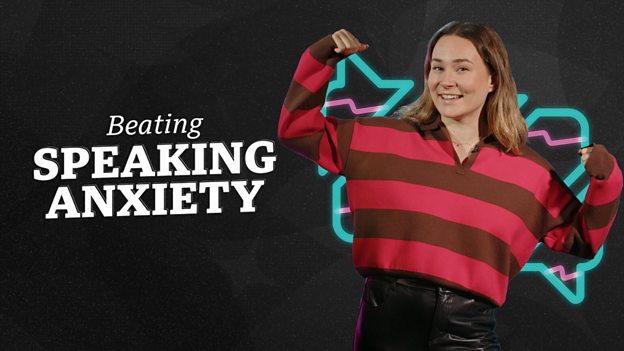
"I know what I want to say, but no words come to mind. It's like my mind just shuts down.” – Miguel
" I forgot, I forget the word when I try to speak. For a moment my mind is blank." – Elizabeth
All episodes
_____________________________________________________________
Learn what to do when you forget words
_____________________________________________________________
Introduction
It’s a common experience for language learners to be in the middle of a conversation and suddenly your mind goes blank, and you forget the words you need – even simple words. Learn from experts about this topic and get tips on how not to panic when communication breaks down.
With Alissa Melinger, Professor of psycholinguistics at the University of Dundee.
Reflect
Discuss in pairs/groups or write some notes.
Before listening:
- Can you think of a time you were speaking English and suddenly your mind went blank? How did it feel?
- What do you do when this happens?
After listening:
- Do you relate to Maria’s experience of forgetting simple words but remembering more complex words?
- What did you learn from this episode? How do Alissa’s explanations compare with your own experience?
_____________________________________________________________
Vocabulary
mind is/goes blank
cannot remember a particular thing
bilingual
a person who speaks two or more languages
vicious cycle
a bad situation that keeps making itself worse
conscious
being aware of something
processing overload
when your brain is trying to do too much at once
native language
the first language(s) someone learns during childhood
_____________________________________________________________
Transcript
Georgie
Have you ever been speaking English, and suddenly you forget a word?
Elizabeth
I forgot, I forget the word when I try to speak. For a moment my mind is blank.
Miguel
I know what I want to say, but no words come to mind. It's like my mind just shuts down.
Alissa Melinger
The bilingual faces a big challenge in that they have double of everything.
Hanan
In today's episode, we're going to talk about how to avoid panicking when things go wrong speaking English.
Georgie
Hello and welcome to Beating Speaking Anxiety, the podcast to help you fight your fears of speaking English. I'm Georgie, an English teacher and presenter at BBC Learning English.
Hanan
And I'm Hanan, a bilingual reporter for BBC Arabic and presenter of the Arabic educational series, Dars.
Georgie
You can find a transcript for this episode and other resources to help you on our website, bbclearningenglish.com.
Hanan
We heard at the start of the programme about that terrifying feeling when you forget your words when you're speaking a new language. Has that ever happened to you, Georgie?
Georgie
Oh, so many times. It happened all the time when I was learning Spanish. Your mind goes blank. There's an awkward pause, that makes you stressed, and then it's even harder to remember the word. It's a vicious cycle. And this is very common when you're using a second language. Even if you feel like you know lots of vocabulary. We spoke to Maria from Ukraine, who finds her mind goes blank when speaking English.
Maria
I noticed that I forgot even simple words, because for me, it's easier to have a conversation with a difficult topic connected with water supply, with some political situation.
Hanan
Maria can have a conversation about complicated things, like politics. But she finds it harder to remember words for everyday situations.
Maria
But when I need to ask something really simple, for example, in a bus or trying to find some place, I'm completely lost and frustrated. I don't know why.
Georgie
It's not that Maria doesn't know the words for these situations, but in the moment she finds it difficult to remember them. So why does this happen? Well, to answer that question, we need to understand what's happening in our brains when we learn a new language.
Alissa Melinger
So when you're first learning a language, you're doing a lot of really conscious activity that you don't do when you're speaking your native language.
Georgie
This is Alissa Melinger, a professor at the University of Dundee. Alissa researches the way we choose our words when we're speaking, and she says that speaking a new language requires conscious activity. That means your brain has to think things through with a lot of effort, rather than doing things automatically, like you would when you speak your first language.
Alissa Melinger
Consciously thinking, 'This word first, then that word, now I have to put this other word that I wouldn't normally put here, but this is where it goes, I must remember that this is where it goes'. So you're doing a lot of kind of very explicit thinking.
Hanan
Alissa says that because your brain is doing all this work, it can struggle to reach the final step of finding a specific word to say, even if it’s a word you know.
Alissa Melinger
It could be, it could be a sort of processing overload that you, you can't find the word because you spent so much energy trying to remember what order the words are supposed to go in.
Georgie
Alissa calls this situation 'a processing overload'. Your brain is trying to do too much at once. And she says it can be a particular problem in the early stages of learning a language.
Alissa Melinger
You think like you go on holiday and you think, 'Right, I need to learn how to say please, I need to learn how to say thank you, I need to learn how to, you know, ask for the bill'. You're not really learning those words or learning that language, you're just memorising sort of sounds.
Hanan
When you only know words as a translation of your native language and you haven't used them, they're much harder for your brain to find in that stressful moment where you need to order a coffee or ask directions.
Alissa Melinger
Those words that you're learning, they don't have their own kind of meanings. They're not grounded in your experience of having used them. You can fail to access them because they were only sort of, they were never very strongly represented in the first place.
_____________________________________________________________
Watch an explainer video
_____________________________________________________________
Georgie
And so for Maria, who we heard from at the start of the programme, her problem remembering simple words could be because she hasn't used them enough. But as we know, advanced learners often forget words too. According to Alissa, this could just be a part of being bilingual, which is how we describe someone who can speak two languages.
Alissa Melinger
The bilingual faces a big challenge in that they have double of everything. So they have double the, the vocabulary.
Hanan
When you're switching between two languages, you are probably using the words in both languages less frequently. As we know, if you use words less, they are harder for your brain to remember when you're speaking.
Alissa Melinger
One explanation is that the two languages are competing with one another, and so that just introduces uncertainty or interference in the processing and makes it harder for you to, to, to eventually find the sounds that you're looking for. Alternatively, it's because for any bilingual, you're using each language half as much as a monolingual would use their single language, so all your representations are sort of weaker.
Georgie
Hearing from Alissa, it makes me realise how amazing our brains are and how hard they have to work when we speak a different language.
Hanan
Yes, and it sounds like things can get easier the more you practise speaking and using the words you learn – the words become more accessible the more you use them.
Georgie
Yeah, exactly. But as Alissa says, even fluent bilinguals forget words. It's just part of holding two languages in your head. So we need to have some ideas for what to do when this happens.
Hanan
Yes, Georgie, do you have any tips?
Georgie
I think the best way is to find a way to describe that word. So if you can't remember the word 'table', for example, you can say something like 'It's something we eat food off, it's flat and has four legs'. Then the other person can guess the word and you can continue with your conversation, so the idea is to not get stuck. But if you really do want to find that specific word, learn some what we call 'buying time phrases'. For example, 'Sorry, I can't think of the word – just bear with me' or 'My mind has gone blank – just give me a second'.
Hanan
I love that and do you remember, Georgie, we have some tips from last week that you, feel free to be vulnerable, make a joke out of it, share your embarrassment and you know the other person will probably help you.
Georgie
Yeah, people are kinder than we think sometimes.
Hanan
That's it for this episode of Beating Speaking Anxiety. Find the video with more tips to help you with your anxiety on our website, visit bbclearningenglish.com.
Georgie
Next up in this series: What to do when you don't understand the other person in the conversation. Goodbye for now.
Hanan
Bye bye.
Next
Watch the video to see learners in action.
Discover programmes to improve your skills.
የቅርብ Beating Speaking Anxiety
How to show your funny side in English
Episode 260224 / 24 Feb 2026
Get tips for showing your sense of humour in English
I'm scared I won't get the joke - podcast
Episode 260223 / 23 Feb 2026
Georgie and Hanan talk about understanding and making jokes in English.
How to speak clearly in English
Episode 260217 / 17 Feb 2026
Tips for making sure your accent in English is easy to understand
I'm scared people won't understand me - podcast
Episode 260216 / 16 Feb 2026
Georgie and Hanan talk about accents and what to do when someone doesn't understand yours.
How to build your speaking confidence
Episode 260210 / 10 Feb 2026
The fear of public speaking is common even in a person’s first language, and in a foreign language, it can feel even scarier
I'm scared of speaking in front of people - podcast
Episode 260209 / 09 Feb 2026
Georgie and Hanan talk about public speaking and speaking in bigger groups.
What to do if you can't understand someone
Episode 260203 / 03 Feb 2026
How to get better at understanding people around the world
I'm scared I won't understand people - podcast
Episode 260202 / 02 Feb 2026
Georgie and Hanan talk about how you can improve your listening in real life conversations.
What to do when your mind goes blank
Episode 260127 / 27 Jan 2026
Tips for when you forget your words during a conversation
I'm scared I'll forget my words - podcast
Episode 260126 / 26 Jan 2026
Have you ever been having a conversation in English, and suddenly your forget your words?
How to fight the fear of mistakes
Episode 260120 / 20 Jan 2026
Understand the fear of mistakes and hear tips for how to overcome it
I'm scared of making mistakes - podcast
Episode 260119 / 19 Jan 2026
Does the fear of making mistakes stop you progressing in English?