

- Contributed by
- actiondesksheffield
- People in story:
- *WALTER HOBSON*, Dr. Johnson, Sgt. Holmes, Jack Slingsby, Len Hoy, Dickie Clayton, Major Cleaver (My C.O.), A.J. Cronin, Pony Moore, Walter Wilson, Bill Cotton, Reg Sykes, Jack Richie, Jerry Strachen, Sgt. Major FrieCol John Frost, Bill Bennetl, Brian Watts and Jack Wright
- Location of story:
- UK, North Africa, Sicily, Italy, Austria, Switzerland & Germany
- Background to story:
- Army
- Article ID:
- A4178388
- Contributed on:
- 11 June 2005
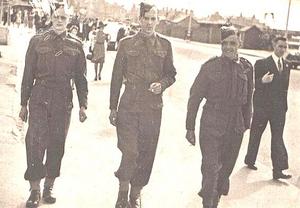
Jack Sligsby, Dickie Clayton and Walter in Morcambe, 1940.
This story was submitted to the People’s War site by Bill Ross of the ‘Action Desk — Sheffield’ Team on behalf of Walter Hobson, and has been added to the site with his permission. Mr. Hobson fully understands the site's terms and conditions.
==================================================
This story tells in graphic detail, of the incarceration within the many P.O.W. camps that the contributor of this story was forced into, during WW2. It also describes the squalid, degrading and sub-human conditions that he was compelled to endure, not only within the camps, but whilst ‘on the run’ from them. The deaths of and devastating injuries to his colleagues, whilst actually in his presence, are also described………Bill Ross - BBC People's War Story Editor.
============================================
Other parts to this story can be found at:
Pt 1:..... a4178333
Pt 2:..... a4178360
Pt 4:..... a4178423
Pt 5:..... a4178450
Pt 6:..... a4178487
Pt 7:..... a4178496
Pt 8:..... a4178504
On board the ship were the first rockets that I’d ever seen. They said that they were going to give us a demonstration. The rockets were in blocks of 48; they were about 2’6” long. When they were fired, they were fired by electricity and they all went off together.
One day, I was on duty, on watch, when somebody said, “There’s a submarine.” But the submarine was one of ours and it was somebody visiting the flagship. So, we continued into North Africa and we landed in Algiers. After we landed, they took us to a village called, Maison Caree, just outside of Algiers. There, we were billeted in a schoolroom. We used to do a bit of bartering with the locals, and on this particular day, by the front window and overlooking the town, there was a bloke wanting a shirt. We were wanting Francs. So we showed him a shirt, told him how much we wanted for it, 60 Francs, he said “OK.” We told him we wanted him to throw the money up first, which he did. A that point, an officer came in and we had to dash away from the window. Ten minutes later, when he’d gone, we threw the shirt down, and another Arab joined the first, and they started fighting over the shirt. A big Arab came onto the scene and asked what was going on. Then, what he did, he grabbed the shirt, took his knife out and cut it in two, then he gave them half each and they were happy with the arrangement.
We were there a fortnight or so; the aerodrome was called Maison Blanche. We were supposed to take off from there and go towards Tunisia and smash up three emergency landing dromes. The first day, it was cancelled; Jerry came over and dropped bombs all over, but in the meantime, he dropped a lot of novelties. Now, these novelties could be toys, even sweets. Our R.A.F. officer picked one up and put it in his pocket. A few minutes later, it exploded and blew both his legs off. So we were called into the hangar and the officer gave us a lecture. He told us that if we found any novelties, leave them alone. “If you find any, put them in petrol cans and leave them.” We’d already spent one night in the hangar and this one lad had picked up a propelling pencil. On it, it said, USA. I slept next to him in the hangar. I said to him, “Is that your pen?” The officer said to me, “What’s going on here?” I said, “He’s got one here, a propelling pencil or a pen or something.” He picked it up and said, “Get it outa here!” We went out to the drome, onto some spare land and placed the pencil under a tin, and twenty minutes later, that tin went sky high. It was amazing the amount of explosive that could be packed into such a small device.
The next day, we all embarked on the plane and Major Frost said, “Right, we’re off.” But the dispatch rider came over and they said it was cancelled again, but he ignored him. We flew round the first emergency drome, and there was nothing, Jerry had gone. At the second one, we dropped on him (Jerry), but we said we’d missed him by five minutes. After that, we were all assembled and we were told we could take any means of transport we could get to help us. The containers that carried equipment were all in different colours, they were white, red, yellow etc. Each section had its own colour. But ours wasn’t there at all. They told us that some of them had dropped out of the plane over the hills before they arrived at their destination, so all we had were a Gammon Bomb and a killing knife that we carried in a secret pocket on our legs, plus a Sten gun and a few rounds.
We’d 25 miles to go to what was supposed to be the next emergency landing drome, and it turned out to be Tunis Aerodrome. On the way there, an Arab was coming along with a horse and cart. Our officer said, “Right, that’s ours.” We started arguing with him, but we couldn’t understand him. The officer knew a bit of French and he gave him a ticket saying that he would be re-imbursed, so we took the horse and cart. We put all our spare kit into it. We decided that Brian Watts would be in charge of the horse and cart. We were going up a particular road; one section in front, our section was on the right, and another section on the left. All of a sudden, the German mortars opened up. The first mortar bomb landed right in the middle of the platoon. Half of the men were ‘done for’. So, we laid flat down and a German scout car came up the road and it stopped opposite us. At the side of the road, we’d one section, and Sergeant Homes was laid among that section. An officer leapt out, and he hadn’t seen us. Sergeant Holmes took out his Gammon Bomb and was just about to throw it, when they spotted him, so they turned the guns on him and just blew his leg off. Then they turned around and left, just scarpered. Each man carries some Morphine, for in case they get wounded. So what we did, we pumped him full of Morphine, left him two or three water bottles, and left him near some rocks. There was no hope for him; we just did what we could.
Next, we went on towards the aerodrome, but first, we were told that we could make a brew (tea). We had a tin full of methylated spirit, but it was solidified. We would take the blades out and cross them, and it made a stove that we could put the meths. tin on, and the water, and boil it up. Also, we had two little bottles of purifiers and sterilizers. This was so that we could fill a bottle with any old dirty water, add the tablets to it (one was white and the other blue). So, two of one sort would purify it, but it had to be left for fifteen minutes, then put one of the others in and leave it for ten minutes or so, then it would be fit to drink. They were only small bottles and each man carried two of them.
Anyway, we lay on the side of the hill and we’d just started to brew up, when the Stukas came over, hunting for us. So, we took our helmets off and placed them over the stove, so they wouldn’t see it. We lay perfectly still. Stukas scream terribly when they’re dive-bombing. They didn’t find us on that occasion however.
Night came and we went into Tunis Aerodrome, although there were guards all the way round it. We just cut the wire and went through. We wrecked all the planes in there, throwing Gammon Bombs at them. After three to four hours, we started to withdraw. After we had gone some way, we were laid across a hill and straight opposite, and across, were German machine guns; they had held us down. One of my friends, Len Hoy from London, was just taking aim, when a bullet hit his finger and smashed it, Naturally, he started shouting and bawling. Then, as for Major Cleaver, they must have fired the equivalent of a 22 pounder and he stopped that all by himself. It killed him outright. His batman was rolled over down the hill with the blast, but he got up and was all right apart from being dazed.
It was clear that that machine gun had to be silenced, we knew that, so one of the lads went down the valley, back up the other side and along the side until he was underneath the machine gun, and then he threw a Mills bomb. He came back and everything was alright for about ten minutes, then a German tank came along. The soldiers climbed out and manned the machine gun and started firing again. So, the same lad wanted to go back, which he did and did exactly the same as before. But the third time, we said, “You’ll not be so lucky again.” So they wouldn’t let him go again.
We stayed there until nightfall, by which time everybody was shattered. But they said, “Right, when Colonel John Frost blows this hunting horn, it’s every man for himself; you’ve got to try and get back to your own units.” Four of us teamed up and were going in what we thought was the right direction, daylight came and we were desperate for something to drink, when we came across a farm, but the occupants said they didn’t want anything to do with us. We said we wanted water. At first, they thought we were Germans, but when we said we were English, that did it. Now, they definitely didn’t want anything to do with us. So we said that if they didn’t give us some water, we were going to shoot ‘em all, so they brought us some jugs of water. They threw them at the gate and went back indoors.
We drunk the water, then set off across an open field. I said to one lad, a corporal, “There’s some tanks coming, three tanks.” He said, “Oh, they’ll be ours, we’ll be alright.” As they were getting nearer and nearer, I saw the big black cross. I said, “Eyup, it’s Jerry, what are we goina do?” Well, I’d a Sten gun, George said he’d a rifle, another one had a rifle and the corporal had a Sten gun, and apart from a Gammon bomb apiece, that was all we’d got. So we said, “What can we do? We can’t fight tanks with this lot.” So the corporal said, “Give ourselves up, are you all in favour?” By that time, they were getting nearer, so I said, “Right, we’ll give ourselves up.” I dropped my Sten gun on the ground and put my hands up, so did George. The other two kept their guns in one hand and put the other hand up. All of a sudden, rat tat tat tat…..a machine gun fired from a tank; it was only 20 yards away. The corporal stopped a full burst in his guts. That killed him outright; another lad stopped just one above his private area, then they held their fire. An officer jumped out: he spoke perfect English. He said, “Up Englander, on your feet, get up! For you the war is over.” He said, “I SAID GET UP!!” I asked him, “Can’t you see they’re wounded? Then I said, “I’m sorry, I’m sorry, I’m sorry.” We had a look at the corporal, but he was gone. The officer came and searched us. I asked, “Can I attend to this wounded man?” He said, “Yes.” So I took his trousers down and put him a dressing on, the best I could. Then I said, “What about him?” He replied, “You and your friend there, dig a grave.” So we started digging a grave and we only got it a foot or so deep, when the German said, “Right, leave it, come with us now.” There were a lot of the locals around, so the officer said, “They’ll bury him.” I thought, “Yes, I know what they’ll so, they’ll strip him and take all his clothes etc.” But anyway, we had to leave him. The German took us further up the field, and he said, “There’re some of your friends around here, I want you to go to ‘em and ask ‘em to surrender.” “What if they won’t” I asked. He told me, “Well, if they don’t we’ll just kill them.” I said, “What about me?” He retorted, “Well, you’ll be with them.” I shouted, “Hang on!” He said, “Do as I tell you.” Then, there were some tanks, behind us, and a big German with a machine gun behind me, and I was walking up to some things that were like cactus bushes. When we were half way between the tanks and bushes, ……de de de de…they started firing. I got down on the floor, flat. The Jerry said, “UP, GET UP AND DO YOUR JOB!!” I was scared stiff I can tell ya. I set off walking forwards; I’d got my red beret, which I was waving. Then all of a sudden, there were yellow dusters waving on a rifle, so everybody held their fire. Nine men and a sergeant came out, but one man didn’t want to give up; he didn’t want to be taken prisoner. All they’d got in the gun was one round, and he took it. They’d run out of ammunition.
They searched us all and took us. The first thing they went for was the killing knife in the secret pocket. The German said, “Put your berets on.” Then they made us get on top of the tanks, which were red-hot. They took us through into Tunis where there were quite a lot more prisoners. They shoved us into a big building of some kind; I don’t know what it was exactly. But inside there was quite a lot of sugar beet. We’d had nothing to eat for a few days, so we got stuck into the sugar beet. It was alright as far as we were concerned, it was something to eat.
We were there for a couple of days. Then they took us back onto the aerodrome where they said, “We’re taking you to a camp.” A Junkers 52 is what they took us in. There were about 20 prisoners and an officer, and only about 5 Jerries and that was including the pilot. He only flew about 50 feet above ground. We flew from Tunis to Sicily. The officer said to us, “I think we’ll take over this plane, there’s enough of us. You can overpower these. Can anybody fly the plane?” So one bloke said, “Well, I’ll have a go.” The officer said, “Oh, what was your job?” He said, “I used to drive a tank.” The officer replied, “They’re not the same at all.”
So, we decided to pack it in as a bad job. They landed in Sicily and we were in a camp. I think it was Castle Meltrama, or something like that. The Sergeant Major, who was in charge of the camp, was called Friel and he was from the 2nd Battalion Para’s. I took notice; just outside the main wire was the cookhouse and the Italians were in charge of it. There were a couple of men who came and brought some equipment into the cookhouse. They stopped and went to the bar for a drink, then they got straight into the wagon and drove off. They were never searched, not once. I said to Sergeant Major Friel, “There are three of us who want to get away, can you help us?” He said, “What’s your plan?” I told him about the wagon, but I said, “It’s no good us going unless we’ve got some food.” So he said, “OK, I’ll get you a job in the cookhouse.”
What we did then was that we pinched what we called cobs, and we pinched some sugar and some onions. So, we got this bread, warmed it against the fire, broke it into crumbs and mixed it with the sugar. We believed that with bread and sugar, along with the onions and a drink of water, we could last all day. Our idea was, if we could get to the shore, we could get across to Malta, which was about 56 miles, I suppose we thought, “That’s our chance.”
We had it all planned for Christmas, 1942. The same night as we intended to go and were all prepared, four of the lads jumped the wire and were caught. After that, they were taking us out into the parade ground, every twenty minutes throughout the night, so we’d no chance........>
Pr-BR
© Copyright of content contributed to this Archive rests with the author. Find out how you can use this.




 Recommended story
 Story with photo