

- Contributed by
- actiondesksheffield
- People in story:
- *WALTER HOBSON*, Dr. Johnson, Sgt. Holmes, Jack Slingsby, Len Hoy, Dickie Clayton, Major Cleaver (My C.O.), A.J. Cronin, Pony Moore, Walter Wilson, Bill Cotton, Reg Sykes, Jack Richie, Jerry Strachen, Sgt. Major FrieCol John Frost, Bill Bennetl, Brian Watts and Jack Wright
- Location of story:
- UK, North Africa, Sicily, Italy, Austria, Switzerland & Germany
- Background to story:
- Army
- Article ID:
- A4178423
- Contributed on:
- 11 June 2005
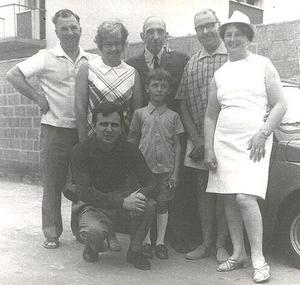
Walter and Lily with Rossolino, Marko and Perio Mutti, and Ray and Renie Lax
This story was submitted to the People’s War site by Bill Ross of the ‘Action Desk — Sheffield’ Team on behalf of Walter Hobson, and has been added to the site with his permission. Mr. Hobson fully understands the site's terms and conditions.
==================================================
This story tells in graphic detail, of the incarceration within the many P.O.W. camps that the contributor of this story was forced into, during WW2. It also describes the squalid, degrading and sub-human conditions that he was compelled to endure, not only within the camps, but whilst ‘on the run’ from them. The deaths of and devastating injuries to his colleagues, whilst actually in his presence, are also described………Bill Ross - BBC People's War Story Editor.
============================================
Other parts to this story can be found at:
Pt 1:..... a4178333
Pt 2:..... a4178360
Pt 3:...... a4178388
Pt 5:..... a4178450
Pt 6:..... a4178487
Pt 7:..... a4178496
Pt 8:..... a4178504
It was all in vain. Later, they moved us on; I think we did a month in that camp, then we went through Messina Straits into Italy. Near Naples, there was a camp known as Camp 66, Capilla.
As we were going into the camp, some lads at the other side of the wire pointed to me and shouted, “Wot tha doin’ ‘ere (Yorkshire dialect: what are you doing here?)?” I said, “Sem as your, bi’ looks on it (Same as you by the look of it).” They replied, “We berrid thee!! (We’ve buried you!!).” They’d buried somebody in my name. So I said, “This is the resurrection. Anyway, wot ya got there?” He was brewing some tea in a mucky, dirty, black old tin, and in it was some tea that was as black as ink, and he said, “It’s tea, why?”
Well, we hadn’t had anything for six days actually. He said, “Duz tha want a drink? (Do you want a drink?)” I said, “A do, arh (I do, yes).” So he passed the tin through the wire and we all shared it. That drink, although there was no sugar and no milk, it was as black as ink in a mucky old tin, and I say this, it was the best drink of tea I’ve ever had in my life.
Anyway, they took us into the camp and there were allsorts in. We were there quite a few months before they moved us. Some lads escaped and got caught again. The chap who organized the escape was Bill Cotton. From Capilla, after a few months, they decided to put us in working camps up and down Italy. They took us to a camp that was near the Port of St. Giorgio, which was a transit camp: 146. There, I saw the biggest cheese I’d ever seen in my life. This cheese, it was seven feet diameter and it was about two feet thick, tapering off to about a foot think. It came into the camp, and it had been manhandled. It had to be cut up for all the prisoners. I don’t know how long it lasted, but it was food. Then they inoculated us, through the chest. It was red hot that day, and we’d to go up four or five steps to the medical room, to be inoculated. As the lads were coming down, with it being warm an’ all, they were fainting and falling over. There were only about six of us that it didn’t affect; it didn’t affect us at all.
We stayed there for a few weeks, and I saw my first tornado. It came straight through the middle of the camp; it was taking beds and all sorts of stuff up into the air. I thought I saw also, my first, what we called a blower. It was an Australian who invented it. I’ve seen a replica of it in that camp called Eden Camp (Theme museum in Malton, North Yorkshire). What it is, with the tins that we got from the Red Cross parcels that we were receiving, we could make different things. The blower was an automatic fireplace. We used to get one tin, a klim tin. Klim is milk spelt backwards. Inside it, we would make a fan, out of the tin, and put it on an axle, try and get something to wind, and that went on to a pulley; then we found something like a cotton bobbin and placed it onto another one, then onto another axle. We’d get bootlace or string, anything that could be used as a belt. If you turned it slowly, the big fan under the fireplace would be going 50 to the dozen. It would blow enough air to create a fire from a couple of matches, a bit of paper and a cigarette packet. That was enough to brew some tea. It was a marvelous invention. I never saw it again until I went up to Eden Camp, a couple of years ago (approx 2003); there was one in there.
From there, we went into the fields working for the Italians. In this camp we were at, there were about 200 of us in a big 3-storey house, and there were only about 20 guards. Whilst in the fields. We would be planting riceand haymaking etc. We became friendly with a few of ‘em and we used to get all the news from them, because some of them could speak a bit of English and we learnt a bit of Italian. One day in particular, they were all excited. We asked one of them, “What’s the matter?” He said, “La Dulci Vie.” We didn’t know what that meant, so when we got back to the camp, we asked the interpreter whose name was Carlos. “Now then Carlos, there’s summert going off, what did they say? They said La Dulci Vie.” He said, “That means Mussolini has gone.”
Now everything was in chaos and after a couple of days, they didn’t take us out to work so we knew something was wrong. I and a kid called Jack Richie (he was in the R.A’s) who came from Morden in Surrey, decided to “pump it at the back.” We found, like a hole in the wire and we got out through there and were in a maize field. The maize was 9 feet tall. We arrived at a road at the end of the field; we saw a bus coming, one of the local busses, and we stopped it. We climbed aboard the bus. We’d no money, but they knew what we were. We were going down the road, and when we looked out of the back, there was a German tank following us, so the bus driver put his foot down and shot into a village called Lanziano. He stopped and said, “You must get out.” So we ran through a passage and the bus went on its way. Jerry continued following the bus. I don’t know if they ever caught up with it, but if they did, there were only Italians on it.
We ran through a tunnel and into a big shed. There were all Italians telling us where to go. There was a little door at the back, but they said, “No no no, you stay here.” So we went back into the shed, and when everything had quietened down, there was a bloke, an Italian, who took us to his house and said, “Right, you can stay here.” They took my mate Jack to a woman. I thought, “I don’t like the idea of being here on my own, I can’t speak Italian and they can’t speak English.” But, they gave me a meal; they took me out to a café, a dino. They’re all dinos there. When I got to the café, who should be in there but Jack, Jack Richie. He said, “Where are you staying?” I said, “Well, where I am, I’m not too happy about.” So he said, “Hang on, at this café, there’s an old woman and her daughter. Whether they own it or not, I don’t know.” Jack went away and when he came back, he said, “It’s alright, you can stay with us.” So I fetched my gear and I stopped at the café with them. One day (we used to eat in the café), we were having a meal, when two Jerry officers came in, looking all round. Naturally, we were in civvies by that time, they’d found us some civilian clothes. When the Jerries went out, they had a word with the landlady and she came back and motioned us into the storeroom round the back. In the storeroom were hundreds of bottles. We were to lie down while they piled a load of bottles round us and they said, “Stay there and don’t make a sound.”
In the meantime, there were more Jerries, they must have sent for some. They came searching all over the place. Anyway, they couldn’t find us so, after what seemed ages and ages, they came and took us back out and they said, “I’m sorry, but you can’t stay here now.” That was because the Jerries had got wind of somebody having split on (escaped from) them. Another family took us down to their house on the outskirts. It was the Mutti Family, man and wife, Rossolino and Santa, and two sons. Rossolino’s brother was Giorgio and his wife was Margarita. Margarita’s brother was a Catholic priest and that family looked after us; in fact, they got me and Jack a job with the local builder. We were building on a farm, Opadro Nepasque’s farm. They were paying us, about 30 liras, which was pretty good for those days.
We used to go out with the lads at night. The Mutti family didn’t take any money off us. They said, “We’ll get a cheque from Mr. Churchill when the war is over.” Well, I’d had my boots on and I wanted some shoes. The Catholic priest brought me some shoes that had a silver buckle on. I said, “I can’t go around with that on.” So they cut the buckle off, it was all right, they fitted OK. Anyway, we were helping the Italians in a yard one day, we were getting Indian corn which we would strip down to the seed, spread it out on the ground, let it dry, then they used to put it in the sun to dry, and that was part of their food. One day, we were doing this, when somebody came running up shouting, “Tedski come viar.” That means Jerry’s coming, so we flew down a path, out into the street, and there was a scout car and two lorry loads of Jerries coming up the road that we were running up. Some Italians were running with us. I said to Jack, “We’ll have to get off the road.” There were two D.R.s, two jerry D.R.s and they were gaining on us, so an Italian motioned us towards a pathway, which was only about four feet wide. We knew the lorries couldn’t get down it. But these D.R.s were following us and we were getting further and further away. When we got down to the bottom, which was where we were living, there was a big hedge, so the Italians (they were deserters from the Italian Army and the Jerries were rounding them up as well)……….we jumped over this hedge and we didn’t know where we were landing. We landed in a garden, then ran into the fields. But of course, we got away then and the Italians were with us. They said, “Stick to us, we’ll look after you.”
We had to cross some water that was about four feet deep. So we took all our clothes off, put them in a bundle and held them on our heads and waded through the water. When we got to the other side, we dried ourselves on our shirts, and we got dressed again. Then they took us to a farm. The Italian had a word with the farmer who said, “You can’t sleep in the house, but if you like, you can sleep in the barn.” He gave us something to eat and something to drink, cheese and bread etc. The next day, they decided to go back into the village, Lanziano and when we arrived there, the Jerries had rounded up about 17 escaped prisoners who were living in the village. We didn’t even know about them; one of them in particular was helping in a bar, and they named it after him. Quite a lot of lads got away in the meantime; nearly all ex airborne lads.
From there (we couldn’t go in any more houses), they took us to a little island. There was just one entrance to it; it was where two rivers made a V sign. We lived there for three or four days and we built a tent from leaves and twigs, grass and hey etc. and made it comfortable. The Italians used to come and feed us. Altogether, by the time we were done, there were eight of us in this tent. This Mutti family came up one day and said, “We’ve been in touch with an escape organization that’s working with the British Government, and we’re taking you through to Switzerland.” “Oh,” I said, “lovely. When and how?” He said, “We can only take you in twos.” So I said, “You and Jack go first.” Well, we set off this particular day, and there was Giovanni Mutti, and me and Jack, all three on bikes. We made quite a mess of riding the bikes at first, until we got used to them. We moved from Lanziano to Milan.
When we arrived in Milan, there were no incidents, everything went well; they took us to a house that had been bombed. Apparently, it was his and Margarita’s house. We left the bikes there, then he took us to another house that belonged to a butcher. Apparently, it was the butcher who was organizing it all. Giovanni said goodbye and we didn’t see him again. The butcher took us to his house and we said, “Tomorrow, we’re going through.” He had a car; not many had cars in those days. Anyway, he put us in his car and he said, “Put your hand down into that pocket in the door, there’s a revolver. Take it and don’t hesitate to use it if necessary.” We were going up a road, to where everything was deserted, and he had a word with somebody. He came back and said, “I’m sorry, but we can’t go today. Those guards, we don’t trust them.” So he took us back to his house, and we stayed overnight. Apparently, it wasn’t his wife whom he was living with, it was a fancy woman. To go to the toilet from our room, we had to go through their room, so we could see all that was going on.
Anyway, the car came again for us, and it was past teatime, it was starting to get dusk. He took us through to Verdoner Aloner. I think that’s what they called him. He stopped the car and said, “I’m going now, cheerio.” He handed us over to a chap, and this chap………..well, as I said, our Italian was very poor and their English was even worse, so it was all signs. He took us along a railway site to where there was a girl. He handed us over to this girl, then he said goodbye. The girl took us across a field, and then she just whistled. A bloke came and he took us through a lane, where there was another bloke waiting; a lame bloke with a stick. He took us to a house that was three storeys high. We were on the top storey. He said, “Ten o’clock tonight, we’re moving.” In the meantime, as soon as you got into one of their houses, it was wine and bread, and biscuits and whatever, oh, cheese, always cheese. So, we had something to eat, then, at a given time, he took us up a lane onto an old railway track. We followed the track up and then he gave a little whistle. He said, “Stop here.” There was a concrete blockhouse. He said, “Go into there and stop there.” So we went into this blockhouse and a while later, we heard a whistle. “Come on English, Englander, Inglessie.” I said to Jack, “I’ll go out and see what it is, and if I shout ‘it’s wrong’, get out of that window at the back.”.........>
Pr-BR
© Copyright of content contributed to this Archive rests with the author. Find out how you can use this.




 Recommended story
 Story with photo