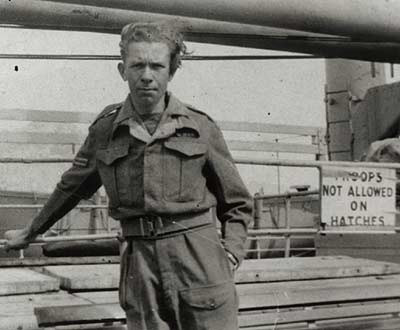
Bill Farmer
Read this introduction to Bill Farmer's story, then listen to him describe his experiences, using the links at the foot of this page.
Bill Farmer was 19 on D-Day. He went through many months of training in Scotland before being sent to France with the Kings Shropshire Light Infantry. Around ten days before the actual deadline, he and his comrades were kept out of all communication, in a sealed camp.
Farmer recounts that on D-Day, to diffuse the tension during the crossing of the Channel, the officers allowed the soldiers to play cards for money - which was forbidden by military regulations.
The KSLI took part in the siege of Caen, the strategic French city where German resistance was to prove much stronger than expected. In the heat of the battle, Farmer was at the receiving end of both enemy and friendly fire. But he managed to scrape through to the end of D-Day unharmed.
Later on, he fought in Belgium and Germany and, at the end of the war, was sent to the Middle East.
In order to see this content you need to have both Javascript enabled and Flash installed. Visit BBC Webwise for full instructions
Actually it was an offence to gamble. It was a military offence to gamble. But I think the officers turned a blind eye, being as we were on this 'do like', you know.
But I suppose they thought to themselves, 'Well, it its no point in stopping the men gambling, cause they're not really doing any harm ... And it's probably the last gamble they'll have.'
So there ... was no problem with the officers. They knew we were gambling, and they just left us to it there. I don't know what happened to all this money this one chap won, but he seemed to win all the money.
In order to see this content you need to have both Javascript enabled and Flash installed. Visit BBC Webwise for full instructions
I had a Brenn gun. On a Brenn gun you got what you call a Number Two. It's a man that goes with you all the time. And he carries spare magazines and a spare barrel. 'Cause if you use a Brenn gun a lot, it overheats, you see, you've got to change the barrel.
And anyway I said to him ... I don't know what his name was now. He dropped his rifle, and I said to whatever his name was, I don't remember ... I said, 'Come on, we're going now'. He said, 'I can't'. I said, 'Pick your rifle up'. He said, 'I can't pick my rifle up'. I said, 'Why?'. He said, 'I already lost my fingers'.
And all four fingers had been ... a piece of shrapnel had cut his four fingers off. And I said, 'Oh dear, dear, dear'. So I shouted for the stretcher-bearers, I couldn't do nothing for him. And I grabbed his wrist and sort of held his wrist, and I didn't know nothing about medical or anything. I sort of grabbed his wrist. I could try and stop the blood.
That was the thing ... I could never have done before D-Day ... I'd have fainted. But I know I had to try and stop this chap's blood flowing out from his fingers. Anyway it wasn't many seconds, many minutes before a ... either it was a medical officer, or one of the stretcher-bearers came over and said to me, 'Leave him, I'll see to him'. And I don't know, I can't remember his name. And he's cut his four fingers off, it was shrapnel or a bullet. And cut it off.
It was clean as clean. So that that poor chap wouldn't do no more shooting. But he stuck it out, he did. And I think I would have fainted, but this poor lad, he didn't faint. I said, 'You lucky old so-and-so,' I said, 'you're going back to Blighty now'. 'I ...' he said, 'I suppose I am'.
In order to see this content you need to have both Javascript enabled and Flash installed. Visit BBC Webwise for full instructions
[Some days after D-Day] we moved out of the farmyard and dug ourselves in. And we were there for, like, quite a long time there. And the poor cows there, they were getting ... of course cows, I don't know ... they have got to be milked. They must be milked twice a day. If they don't get milked, they are in extreme agony, owing to nature, I suppose. They must be milked.
And of course a lot of the cows had been hit by shellfire. And they go down if they've been hit, and our officers gave us instructions to shoot them. They said, 'Well, the poor things are in agony' ... And we had orders from the officer. He said, 'Be careful what your shooting at, make sure you kill the cows'.
And then we had another incident. They were trying to dig a hole. They tried to blow some holes in the ground. We were going to try and drag some of these cows in to these holes. We were trying to blow some holes with some 75 grenades. And drag the cows in. But of course as soon as you put a rope, or whatever we had was handy ... on the animals, of course you pull the leg. They were rotten ... didn't take long to go rotten, they pulled the legs off.
And that was another incident. We were trying to bury these cattle, and an American fighter comes over, and he fired at us with cannon shells. So we got our identification strips out. It's like a fluorescent thing you put over your pack, or you wave it at the at the aircraft to say that you're friendly. And he did fire at us. But he, as soon as he saw these identification strips, he veered off. But he fired at us, and a lot of the empty cannon shells fell round us. And fortunately none of us were hurt .... And we gave it up as a bad job, to bury the cattle. It wouldn't work. But the smell, the smell was terrible.
In order to see this content you need to have both Javascript enabled and Flash installed. Visit BBC Webwise for full instructions
As as the days went on, we thought to ourselves, or I thought to myself, 'It's a funny thing to say, but a few days ago you ... were just lads, you hadn't been out of school very long, and now ... you're just boys, and riding along on your push-bikes, and playing about with other lads and then you come up against this, and you feel ... that you've become a man all of a sudden, when you've gone through all this nightmare.'
It is a nightmare, of course, absolute nightmare. And I suppose that the German soldiers, the ordinary German soldier probably thinks the same.