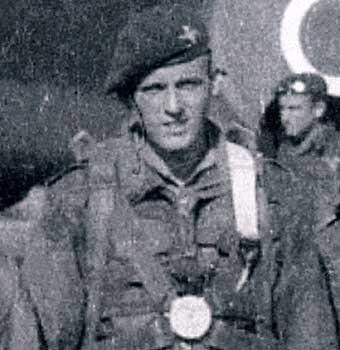
Sid Capon
Read this introduction to Sid Capon's story, then listen to him describe his experiences, using the links at the foot of this page.
Sid Capon was a soldier in the 9th Parachute Battalion, which attacked the German gun battery at Merville. This attack preceded a main assault by Allied troops, and was deemed of strategic importance to the success of the landing.
British and Canadian parachuters were sent to Merville to neutralise the German battery. A total of 650 troops were supposed to take part in the operation, but only about 150 landed on the right spot and carried the mission on.
The mission was successful, but casualties were heavy. Sid Capon was a member of the 12 Platoon C Company, which neutralised the first of the four German guns at Merville.
Capon, then 20, was wounded in the following month, while he was still in France. He went to a military hospital in Britain, and was later sent to Belgium, Germany and India before the end of the war. He left the Army in 1946, after a stint in Palestine.
In order to see this content you need to have both Javascript enabled and Flash installed. Visit BBC Webwise for full instructions
It was just a matter of being a para, and you're fired up to do a job. And you knew ... my personal opinion is number one gun. And you were fired up to such an extent, you knew that was a real thing on the invasion. You knew that was a real thing.
See, in training there, we had special branch people, women, trying to get information. You don't get that as a rule. And they were NAAFI girls, but we didn't know that. Try and get information.
We were sworn to secrecy. Sworn to secrecy. In fact, when I got a leave there, no matter what, you would not get a bit of information out of me - or any of the blokes. You were sworn to secrecy, so there we are.
In the ... field there, where we were under canvas, the NAAFI girls there were so attractive. They couldn't make ruddy tea, but they were attractive. And there was something - they weren't NAAFI girls. They were very attractive, but later we learned they were special branch. Didn't know it at the time, but they were special branch.
Try and get information, but we were sworn to secrecy so we knew something was on. And you must not, and we didn't breathe a word, not a word was breathed about ...
In order to see this content you need to have both Javascript enabled and Flash installed. Visit BBC Webwise for full instructions
They don't tell you about the flight, what it's gonna be like. And it was very quiet. And when people say they looked out and saw boats and things like this, ... it was bloody interested in boats out there.
You just sit on the aircraft. You sit. I don't forget, it's only a sea at each side. And you're lumbered up with all your clobber. And then of course, they give '20 minutes to go', they tell you '20 minutes to go'. Then they give a call for equipment check. And then you get a '5 minutes to go', as we did in our aircraft - '5 minutes to go'.
Then we're approaching the coast of France. And this is the thing they don't tell you. What happens. They don't tell you about ack-ack. When it comes up to an aircraft, what it does to an aircraft. And all of a sudden the aircraft swayed and you're thrown from port to starboard.
And before you gather, you know, to get yourself together, more or less, it's 'stand by the doors - red light - green light - go, go!'. And it's all ... something has happened ... you don't experience in training. Nobody told me that an aircraft would go zig-zag, and that it you're thrown port to starboard and you fall out the bloody thing. Different, quite different to training.
But even then, the end result can be good for you. With others it can be bad. I'm talking about landing. See the end result can be disaster for some, they can land in water. Miles away. My result was perfect. Best landing ever.
In order to see this content you need to have both Javascript enabled and Flash installed. Visit BBC Webwise for full instructions
[It] goes just through you. You just carry on. You're shouting, swearing, cursing. You're oblivious, only oblivious so ... to it. You're just carrying on. You got a job to do, and you're glad to get down near their gun.
You're glad to get down to their gun. Oblivious to anything, you know. You gotta run and get there. Zig-zag and run and get there.
You're oblivious to what's happened to number three and four gun, but you hear momentarily about number two gun, the shouts of mines and explosions. And you're zig-zagging.
You shut it out. You shut everything out. You shut it out, just shut it out. Until you get there. Then you say, 'aahh, that's it'. You get to the rear of the gun, and it's successful. At a price.
In order to see this content you need to have both Javascript enabled and Flash installed. Visit BBC Webwise for full instructions
It's all hurriedness. And you're interested in your own men, your not interested in bloody enemy or anything. You're interested in your own men.
You're not interested upon anybody else, at all. And you don't realise death is death. When it's your own men, it's strange to say this, but it was aneveryday occurrence. Men being killed.
But you don't grieve. There's no grieving. 'Oh, what's-name's gone' - you know. Same as, 'Cartwright didn't get down there.' 'Jefferson didn't get down there.' You don't know how badly they're wounded. You know, Tom Stroud, he was wounded. But, you see, when you lose a man, it's a loss. You've no grieving.
'We've lost so-and-so.' 'What's-name's gone' - that's it. But you're ... you're hardened to this.