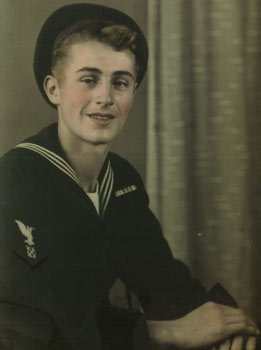
Eddie McCann
Read this introduction to Eddie McCann's story, then listen to him describe his experiences, using the links at the foot of this page.
Joseph 'Eddie' McCann was one of the survivors of Exercise Tiger, a secret US Navy operation on the English coast, which aimed to prepare troops for the invasion of Normandy. It ended in heavy losses, after a surprise attack by the German Navy.
In total, 749 US Navy and Army troops died during the exercise. McCann, who piloted small boats to carry troops, was sent to try to rescue survivors, but could pick up only 45 still alive - 11 of whom died a little later.
Some days later, McCann was in charge of one of the small boats that carried troops from battleships to the beaches of Normandy during D-Day. He had joined the US Navy at 13, after running away from home. In 1944, aged 15, he had already been in several battles, including some in Sicily and North Africa.
In order to see this content you need to have both Javascript enabled and Flash installed. Visit BBC Webwise for full instructions
Commander Scale (who was in charge of the flotilla) was actually forbidding Captain Doyle who, by all rights, you know ... the skipper of a ship usually had the say, and that's what Captain Doyle was exercising, his right as a skipper to run the ship the way he thought was practical.
And he also knew that the water was 43, 44 degrees, and these men wouldn't last long in the water. Because that water was cold. And there were men on fire ... men were swallowing their tongues, heads in one place, legs in another place. I was trying to help my men get their tongues free, and stuff out of their mouth.
And then if they were ... I could sense life, we'd brought them out of the water. But we picked up ... and then I come upon some of my friends. One was Lieutenant JG Saucier. We had started out in North Africa, and went through Sicily and Salerno and all those invasions together, and here I had to leave him in the water.
I couldn't take his body out. Although I and my boat crew took 45 men out of the water.
In order to see this content you need to have both Javascript enabled and Flash installed. Visit BBC Webwise for full instructions
That's when I told some of the other boat coxmen ... who were now in the water, and skipper turned, I think allowed two more to come in. But again, you know, he took a big chance when he tied ramp to ramp with me.
'Cos the lights go on in the tank deck, and if we were going to get hit it would have been right in that time period. But anyway, down the line I could see these motor torpedo boats, and they were moving as fast as they can, and I said, 'By God, I haven't even checked any of those people', and they were being churned in the props.
And when I complained about it, when we got into ... I was forbidden to ever tell anyone about what I did. Anything that I or my men had done, but we were forbidden to tell about what had happened.
In order to see this content you need to have both Javascript enabled and Flash installed. Visit BBC Webwise for full instructions
And I was assigned to the first wave, and my job was to land troops on Easy beach, it was Easy Red. So I was lowered and proceeded to my rendezvous area, at about 4.30 in the morning.
And after I picked up my troops, I went to my rendezvous area. That's where you're circling, and each wave would come out of the rendezvous, and take off for the beach. And when we were about 300 yards out, they started firing at us.
Up to that point we thought it might be an easy one - you're always hoping for an easy one. I wasn't really prepared for what come about in, say, in the next 100 yards. It was unbelievable.
We lost in that first wave over 2,000 men. We got hit with body parts, heads come flying, guts start stacking up all over the beach, along with the bodies. It was something that was unbelievable, and it's hard to really talk about it, when you see your brothers being mangled like they were being mangled.
In order to see this content you need to have both Javascript enabled and Flash installed. Visit BBC Webwise for full instructions
It was bad. I'd seen a lot of those that I had brought in that were already dead. There's a certain smell to hot blood, believe me, I smelled it that day, and it's something I'll never forget.
You know ... Tiger was bad too, getting back to Tiger, but it seemed like there's more mayhem played upon the troops there at Omaha. Well, you know, I keep repeating it. Their heads come flying, their legs come flying, you know, it's something that you just gonna have to see.
And then you wouldn't believe it, the way it was tearing these people apart. And you know, you gotta feel for the Germans too. I don't care what anybody thinks about me saying it, they turned out to be our brothers. too. You know, and when all's said and done, we are back being brothers. And I don't care what anybody says, we are brothers.
And I've seen it, especially when I was carrying troops back out, the wounded ones, back out to LST 515. That's what we transported the German troops back to, the LSTs. And the American troops went to the hospital ships, American hospital, and so I was working between all of them. You know, I don't know how I kept really from getting hit.