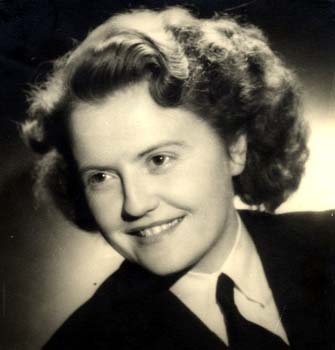
Ginge Thomas
Read this introduction to Ginge Thomas' story, then listen to her describe her experiences, using the links at the foot of this page.
For some months before D-Day, Ginge Thomas was employed as a shorthand writer to Lieutenant General Frederick Morgan, Chief of Staff to the Supreme Allied Commander (COSSAC), in London. After the war, she kept in touch with Morgan, who, in her view, should have been given much more credit as the main planner of the invasion.
Ginge Thomas had enrolled in the Women's Royal Naval Service - the Wrens - in March 1943, moving from Swansea to London. She worked with General Morgan at Norfolk House before moving with the planning staff to Southwick Park, in Hampshire, from where the invasion was to be organised.
There she witnessed the high level of expectation among those involved in the planning of an operation that would require the biggest invasion fleet ever seen. In September 1944, Ginge Thomas followed several of her comrade Wrens to France, and after that to Germany. She demobilised in August 1945.
In order to see this content you need to have both Javascript enabled and Flash installed. Visit BBC Webwise for full instructions
My more vivid recollections of Southwick Park were the doodlebugs. And that was dreadful, because we were bombarded with these doodlebugs and we were instructed ... during the night.
We were allocated to what I ... one of the air raid shelters I found on the perimeter of the park, and every hut was allocated to a shelter, and you were instructed to get up at night if the sirens went and to proceed, to dress and to put on your tin hat and take your gas mask and go to your allocated shelter. And it was a picnic, because the area warning would go, and we'd get up and nobody dressed as they should have dressed.
They rolled up the legs of their pyjamas, and put on their old grey coat, their overcoat. And the tin hat was piled high on their head above the curlers, which raised it. Faces were gleaming with cold cream and you tootled off to your allocated shelter in the pitch dark, and before you got there the 'all clear' went.
So you turned round and you came back, and very often before you got back the next warning had gone. So quite a few nights we were back and forth all night. That was a vivid recollection the doodlebugs, it was horrible.
In order to see this content you need to have both Javascript enabled and Flash installed. Visit BBC Webwise for full instructions
I remember an appeal going out to the public for any information that they thought may help the planners - like picture postcards, Michelin Guides, that type of thing. Maps, anything ... so they could plan the beachheads the other side. And I remember a flood of stuff coming in.
I remember the rooms with the postcards and things on the wall. Such a flood of stuff came in, and obviously out of a vast amount of stuff there was bound to be a fair bit that was going to be of value and help.
In order to see this content you need to have both Javascript enabled and Flash installed. Visit BBC Webwise for full instructions
General Morgan was what I would call a workaholic. If you worked in the Town Clerk's Office you're used to workaholics. My Town Clerk was a workaholic, and General Morgan was a workaholic. But he was also very conscious that because he was a workaholic, he was always apologising to me if we had to work long hours or whatever.
And I remember one thing that stuck in my mind. I think it was a Wednesday evening. If we were working late on a Wednesday evening he'd always take time off to listen to 'Itma'. I think it was 'Itma', 'It's That Man Again'.
I know there was one television programme. And he'd ... we had radio, of course, in his office. And he'd stop for half an hour to listen to this programme.
But basically he was a very, very energetic man and a very hardworking man. Which you have to be if you were the head of a plan of this size. If you weren't a workaholic, well you couldn't expect anybody else to follow suite could you?
In order to see this content you need to have both Javascript enabled and Flash installed. Visit BBC Webwise for full instructions
They all seemed very confident, until we came up to this weather, and 'shall we, shan't we, go?' This day had been built up so carefully - carefully planned, and then it looked as if perhaps it couldn't happen, with the weather forecast.
And we realised that if it didn't happen within a certain span of days, we weren't 'go' ... it wasn't going to be able to happen again for quite some time.
So there was a feeling around the campus, coming up to D-Day, of sadness, that we'd been waiting for this, and perhaps now it couldn't happen ... and the relief then, when they found the gap which the meteorologists said would just give them long enough, was tremendous.
In order to see this content you need to have both Javascript enabled and Flash installed. Visit BBC Webwise for full instructions
We found out that the invasion was on. Word spread around the camp that this gap in the weather ... and we were told that it would be in the early hours of the morning - I think two o'clock was the time given.
And the weather was still not very good. We had on the campus a little building which was the church, which we used as a little church, and we had our own padre, a young man by the name of Mike Brookes. And quite a few of us decided we obviously couldn't sleep that night, and we certainly didn't want to be in our own billets in our own Nissan hut, so we decided we'd go into the church, and wait in the church.
Which we did, and Mike was there, and then eventually as the early hours of the morning came around, we weren't so much as told as heard the steady drone of the aircraft taking off, with the gliders behind them. And because they hadn't long taken off they were quite low, and we could hear this drone and we went out and we'd look up into the sky, and we could see them. We could see the bomber, and then the glider behind, and this wave would go over.
And I remembered we prayed then like we'd never prayed before. Certainly like I'd never prayed before, because we knew probably what they were going into, and we realised there wasn't anything else we could do.