
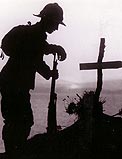
Peter Hart charts the course of the disastrous Gallipoli campaign, and discusses its impact on the Allies' planning for D-Day during World War Two.
By Peter Hart
Last updated 2011-02-17
Peter Hart charts the course of the disastrous Gallipoli campaign, and discusses its impact on the Allies' planning for D-Day during World War Two.
The Gallipoli campaign of 1915 owed much to traditional British maritime strategy. Historically, 'Perfidious Albion' had long sought to use diplomacy, or outright bribes, to inveigle other countries into fighting continental wars on her behalf on the battlefields of Europe. She did, however, use her own naval power to strike at the outlying coasts and colonies of her enemies, seeking thus to gain maximum advantage at minimum cost and risk.
In 1914, the trench lines of World War One snaked across France and Belgium, as open warfare degenerated into a modern version of siege warfare.
In 1914, the trench lines of World War One snaked across France and Belgium, as open warfare degenerated into a modern version of siege warfare. This caused many to look back to Britain's older strategic vision, and to seek to strike at Germany and the Central Powers by attacking the far-flung Ottoman Empire, after it had joined the war on 31 October 1914
At the head of the 'Easterners', as they came to be called, was the First Lord of the Admiralty, Winston Churchill. His schemes for the capture of the Dardanelles Straits and Istanbul eventually prevailed, despite the professional reservations of his senior admirals, and resulted in a plan to force the Dardanelles.
A series of bombardments of the Turkish forts culminated in an attempt to force the Straits on 18 March 1915. The interlinked defences of fixed artillery, mines, torpedo tubes and mobile howitzer batteries doomed the attempt, however, and the Allied fleet withdrew after painful losses.
As a result the Secretary of State for War, Field Marshal Lord Kitchener, although unwilling to divert new troops from the Western Front, gave his approval for a sea landing to be carried out using the assortment of divisions already gathered in the Mediterranean theatre. The troops were under the command of General Sir Ian Hamilton, and were to clear the Gallipoli Peninsula to allow the passage of the Allied fleet up the Dardanelles Straits.
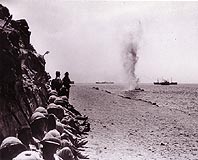 Allied troops sheltering from Turkish shelling © Hamilton was faced with many problems. He had insufficient troops, and many of those he had were inadequately trained and inexperienced. There was a shortage of boats. His maps were inadequate and, worst of all, lack of secrecy meant the Turks were forewarned, and soon created trenches and barbed wire defences around all the beaches most suitable for a landing. With every day that passed Hamilton's task grew more difficult.
Hamilton was faced with many problems. He had insufficient troops, and many of those he had were inadequately trained and inexperienced.
Plans were laid for the main landings on five beaches at Cape Helles, the tip of the Gallipoli Peninsula. A secondary attack was to be launched further north at Gaba Tepe to try to cross the Peninsula at its narrowest point. Diversionary attacks were also planned, to try and confuse the Turks.
The Turks, under the overall command of General Liman von Sanders, had small parties defending the most likely beaches, but relied on centrally positioned reserves to rush to threatened localities to counter-attack and swamp any attempted landing once they were sure it was genuine.
The Australian and New Zealand landings were made before dawn on 25 April 1915. They got ashore almost unopposed, but the total confusion that ensued in the complex, hilly terrain, combined with rapidly stiffening Turkish resistance, confined them to a small beachhead - which soon become known as Anzac.
The main Allied landings were at V and W Beaches at Helles. At W Beach, landing from open boats under a storm of fire, the men of the Lancashire Fusiliers showed their mettle, and after a gap in the defences had been exploited managed to capture the beach, despite severe losses.
At V Beach, however, underneath the old castle of Sedd el Bahr, things went badly wrong. The men (landing from open boats, or bursting out of the 'Trojan Horse' of a run-aground old tramp steamer, the River Clyde) were shot to pieces, in a gory failure that left the sea running red with blood.
The British had totally underestimated the difficulty of their task of making the first opposed landing in modern warfare, and of facing Turkish troops imbued with a determination to resist any assault on their homeland.
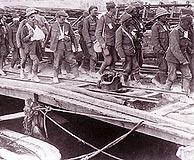 Allied wounded are on their way to the ships that will evacuate them from the Gallipoli peninsula © The Gallipoli Campaign never recovered from the failures of that first day. Over the succeeding months more and more Allied troops were thrown into the battle, culminating in a new landing at Suvla Bay in August 1915.
The Turks, however, had shorter lines of communication than their opponents, and matched the Allies man for man. Objectives assigned for the first day were still distant dreams when the British finally admitted defeat and evacuated the Peninsula in January 1916.
The 'easy' option pressed by Churchill and the other so-called Easterners had offered only a mirage of painless success. Trenches could be dug almost anywhere, barbed wire was cheap, but the over-arching defensive realities of modern warfare meant that a very substantial investment of troops, guns and munitions was required before success could be assured in any such enterprise.
The Gallipoli Campaign never recovered from the failures of that first day.
In seeking new avenues to victory, Churchill had merely awoken a new enemy, and given this foe an opportunity to fight the British - a tempting chance to tweak the lion's tail. Moreover, every division sent east was a division lost to the decisive battle on the Western Front against Germany - the beating heart of the Central Powers.
In the aftermath of the Gallipoli disaster Churchill lost both his high office and his political reputation. It was considered that he had been led astray by his 'amateur strategy', and allowed his personal enthusiasms to over-rule the advice of naval and military experts. Throughout the inter-war years it appeared that his glittering career had been cut short by events in the Dardanelles.
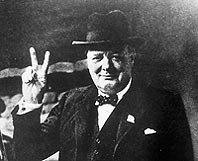 Winston Churchill © The army and navy were also badly scarred by their experiences at Gallipoli. Afterwards, it was widely considered that daylight assaults on defended shores were suicidal, and combined operations were still distinctly unfashionable when World War Two began in September 1939.
Warned by his experiences of the half-cocked landings at Gallipoli, he was determined that no invasion would be launched until everything was ready, leaving as little as possible to chance.
In the first year of the war, the evacuation of Dunkirk in June 1940, which marked a complete British retreat from continental Europe, caused the situation to change entirely. There was no avoiding the fact that the war could not be won until an Allied landing was made on mainland Europe. A beachhead had to be successfully established, and to achieve this, combined operations were essential.
In World War Two, as Britain's Prime Minister, Churchill's role was immeasurably greater than previously, and his responsibilities were on a global scale as he used the intelligence supplied to him by the 'Ultra' decoding of German signals to guide his decisions. Although still occasionally tempted by 'backdoor' stratagems, he had clearly identified Germany as the main enemy at the heart of the Axis alliance, and was instrumental in gaining the agreement of the United States to a 'Germany first' policy.
Warned by his experiences of the half-cocked landings at Gallipoli, he was determined that no invasion would be launched until everything was ready, leaving as little as possible to chance. This meant withstanding considerable pressure from the Soviet Union for a 'Second Front' as they grappled with the main strength of the German Army on the Eastern Front.
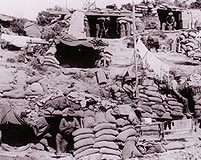 Allied dugouts cling precariously to the Gallipoli hillsides © Preparations for the Allies to return to northern France began almost immediately after the Dunkirk evacuation. There were to be many versions of the plans, however, and D-Day was certainly not the first combined operation of World War Two. It followed the Dieppe raid fiasco (of 1942), and successful combined landings in North Africa, Sicily and Italy. Yet its roots were firmly based in the Dardanelles.
There can be no doubt that the lessons of the Gallipoli landings were at the forefront of many of the planners' minds.
There can be no doubt that the lessons of the Gallipoli landings were at the forefront of many of the planners' minds. They had grasped the vital necessity for an adequate period of planning for all three services - the army, navy and air force. Experts of all kinds were required for all phases of the planning and operations. These needed to communicate properly with each other to ensure that everything was ready for use as and when required.
General Sir Bernard Montgomery oversaw the final phase of the planning, casting his meticulous eye over the plans, and demanding another raft of changes to increase the power of the assault.
The importance of accurate intelligence was now understood - not just accurate maps, but detailed information on local topography, offshore navigational details, prevailing sea currents, ground conditions, water supply, prevailing weather patterns and the exact nature and strength of enemy dispositions.
The flexibility of sea power would be used to transport a huge force to attack the identified point of weakness in Normandy, to maximise surprise and thereby to secure a temporary local superiority. Meanwhile sophisticated deception schemes would draw away and delay the deployment of German reserves.
During the landing itself hundreds of modern landing craft would crash onto the beach simultaneously to minimise the 'defile' aspect of landing from open boats under heavy fire. New technology would be used to control the heavy guns of British battleships and heavy cruisers, to target and eliminate German strongpoints.
Meanwhile the slaughter on the Gallipoli beaches had taught the planners the necessity of smothering the immediate beach areas with massed fire from rocket ships and mortars to neutralise German defensive positions. Artillery support would be maintained and expanded day-by-day through all stages of the landings and exploitation of the beachhead.
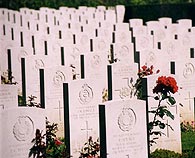 British war cemetery at Bayeux in France © Local geographical features and strongpoints which could dominate or threaten the beachhead had to be captured by coup de main at the earliest possible stage in the operation - on D-Day this was to a large extent left to the parachutists, and the commando and glider units.
The experiences at Helles and Anzac had taught the planners the absolute necessity of seizing a viable sized beachhead. It had to be spacious enough to contain an army capable of fighting face-to-face with the full strength of the Germans on a new Western Front, once the impact of the initial surprise had faded.
The chaos caused by bad weather on the coasts of Gallipoli had emphasised the importance of a secure harbour, and of ensuring that evermore troops and supplies could get ashore even in stormy seas. This led to the wonders of the prefabricated Mulberry harbours and flexible Pluto oil pipeline (laid under the floor of the English Channel, from the Isle of Wight to Cherbourg), undreamt of in 1915.
The experiences at Helles and Anzac had taught the planners the absolute necessity of seizing a viable sized beachhead.
Yet the Atlantic Wall of German coastal defences was still a formidable proposition. The Germans had had time to construct huge fixed-gun concrete emplacements and strongpoints, anti-tank obstacles, beach and underwater obstacles, minefields and layer after layer of barbed wire. Behind the beach defences lay the static infantry divisions, with powerfully armoured panzer divisions lying in reserve.
The British, haunted by disasters on the beach at Gallipoli and Dieppe, had devised special armoured vehicles to allow them to break down the coastal defences. Thus the DD Sherman tanks had a canvas skirt that allowed them to float ashore to provide immediate armoured support for the infantry as they landed.
Other tanks were equipped with rotating flails to clear minefields. There were flame-thrower tanks, petard mortar tanks to destroy obstacles, bridging tanks - many and varied were the 'funnies' that all combined to play a key role in the British plans. Only the US troops would go in alone, accompanied by nothing other than the floating Shermans.
The Allied plans called for the British Second Army to land between Ouistreham and Port en Bessin on Sword, Juno and Gold Beaches. The 6th Airborne Division was to land behind the German lines, and the First US Army landed between Port-en-Bessin and Quinville on the Cotentin Peninsula on Omaha and Utah beaches.
Meanwhile the airborne forces would reach over behind the German lines to secure key objectives before the Germans could react. The whole operation was underpinned by the complete air superiority that had been established by the Allies.
On 6 June 1944 a veritable armada of ships and aircraft crossed the English Channel and the invasion began. On the British beaches and the American Utah Beach the day went well. Although the fighting was hard in some sectors, a reasonable sized bridgehead was secured by nightfall. There was no slaughter on the beaches, and all the preparations and planning had borne fruit.
Even after all the plans and preparations, the Normandy landings were still an exceptionally risky business.
But on Omaha Beach there was a bloody shambles for the US troops. The beach area was more strongly garrisoned than the British beaches, and the assaulting troops were faced by a sandy beach leading to clay cliffs up to 60m (200ft) high. They found themselves in a veritable shooting gallery and were pinned down on the beach, much the same as the British had suffered at V and W Beaches at Gallipoli. Only after some 4,000 casualties had been suffered was the beach area cleared.
Even after all the plans and preparations, the Normandy landings were still an exceptionally risky business. If the weather had been a little worse, if the deception plans had not worked, if the panzer reserves had been handled differently - the potential for disaster was enormous.
Yet the Allied forces succeeded and the Second Front was launched against the main enemy - Germany. Churchill, by his inspirational leadership in the long years after the evacuation of Dunkirk, had acted as midwife to the landings that would bring victory to the Allies and erase the stain on his reputation left by the stillbirth at Gallipoli.
Books
British Regiments at Gallipoli by Ray Westlake (Pen and Sword Books/Leo Cooper, 1996)
Gallipoli by Robert Rhodes James (Pimlico, 1999)
Gallipoli by Alan Moorehead (Wordsworth Military, 1997)
Ten Days to D-Day: Countdown to the Liberation of Europe by David Stafford (Little and Brown, 2003)
The Longest Day by Cornelius Ryan (Wordsworth Military, 1999)
Defeat at Gallipoli by Peter Hart and Nigel Steel (Macmillan Pan, 2002)
James Cook University: Gallipoli
NZ Government: Gallipoli Campaign
Encyclopaedia.com: Gallipoli Campaign
Australian Government: Visit Gallipoli
Trenches on the Web: Gallipoli
Peter Hart is the Oral Archives Historian at the Imperial War Museum and co-author with Nigel Steel of Defeat at Gallipoli (Macmillan Pan, 2002). He has also written a number of books on the First World War and Regimental History.
Peter Hart is the Oral Archives Historian at the Imperial War Museum and co-author with Nigel Steel of Defeat at Gallipoli (Macmillan Pan, 2002). He has also written a number of books on the First World War and Regimental History.




BBC © 2014The BBC is not responsible for the content of external sites. Read more.
This page is best viewed in an up-to-date web browser with style sheets (CSS) enabled. While you will be able to view the content of this page in your current browser, you will not be able to get the full visual experience. Please consider upgrading your browser software or enabling style sheets (CSS) if you are able to do so.

