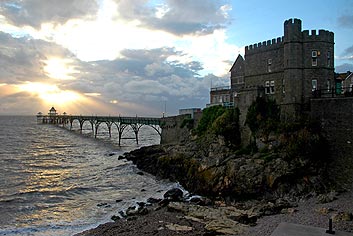
Clevedon Pier (North Somerset)
The graceful pier that extends into the Bristol Channel is considered to be the best preserved example of its architectural type. It has recently been restored to its full Victorian splendour, and has been listed Grade I by English Heritage.
Clevedon developed as a resort for Bristol from around 1795, but it was the arrival of a railway 1847 that led to hopes for its rapid development. It was thought that a new pier would not only provide an addition to the resort, but also a jetty to enable steamers to ferry passengers to South Wales. There were formidable problems to be overcome, with a tidal range of 47ft (the second highest in the world) and huge currents, but addressing them resulted in the pier’s very slender and elegant style.
The builders were able to obtain scrap iron left over from IK Brunel’s attempt to use ‘Barlow’ broad-gauge rails on the South Wales railway. These, when bolted together, formed strong struts. When it was opened in 1869 the pier was 255m (840ft) long, with at its end a six-level landing stage, which is still in use to this day for the embarkation of passengers onto the historic ships Waverley and Balmoral. The pagoda-style pavilion was added in 1894.
Sadly, on 16 October 1970, during routine testing, two sections of the pier collapsed and the pier was closed. In 1979, the council decided to demolish the pier, but were met with massive local opposition and after a public inquiry were forced to change their position. With grants secured from 1983 onwards, including most recently the Heritage Lottery Fund, and the heroic efforts of the local community, the pier was fully reopened to visitors in 1998.